If your mind won’t stop racing or your muscles are tight after a long day, a short yoga routine before bed can help you relax. This isn’t a workout; it’s a gentle way to tell your body that it’s time to rest. These five easy poses are great for beginners and don’t require any flexibility. They work best when you take slow, deep breaths and make your surroundings calm. The first pose is called “Child’s Pose.” Sit back on your heels and kneel on the floor.
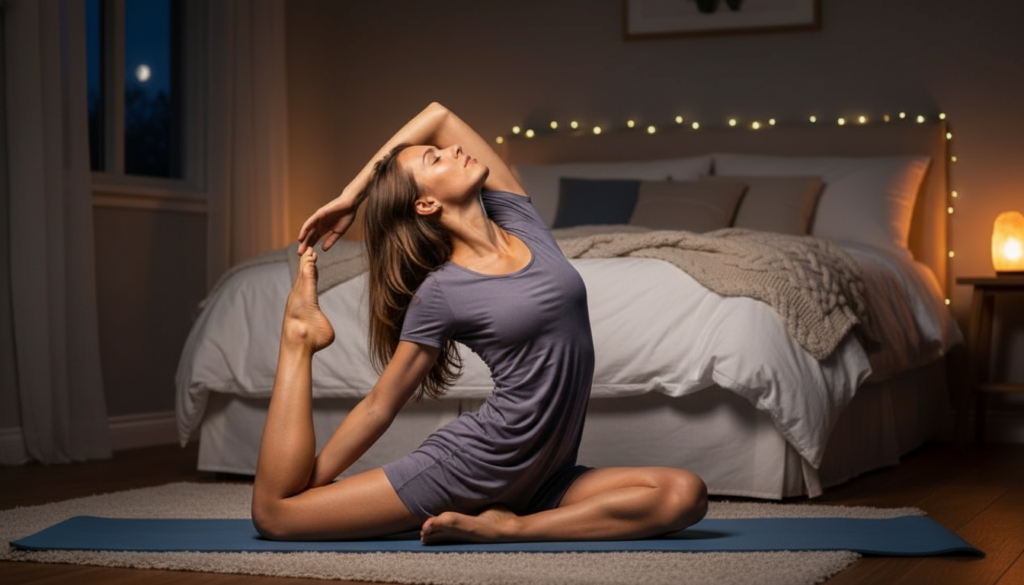
Getting Your Sleep Space Ready
When your body is relaxed and your mind isn’t racing, it’s easier to fall asleep. Gentle yoga can help loosen up tight areas like your hips and shoulders, and controlled breathing can tell your nervous system to calm down. It works like a dimmer switch for your busy day. The following poses were chosen because they don’t take much effort and can be held for a long time without discomfort. This makes them great for getting your body and mind ready for sleep.
How Yoga Helps You Sleep Better
When your body is relaxed and your mind isn’t “alert,” it’s easier to fall asleep. Gentle yoga helps your hips, lower back, neck, and shoulders relax, and steady breathing helps your nervous system calm down. You could think of it as turning down the volume on your day. The poses below are relaxing, don’t take much effort, and can be held for longer periods of time, which is great for getting ready for sleep.

Child’s Pose (Balasana) is the first pose.
Child’s Pose is a simple way to relax your back and hips and calm your nervous system. Kneel down on the floor and bring your big toes together to begin. Open your knees to a comfortable distance. Bend forward until your forehead touches the mat or a pillow. You can stretch your body by extending your arms in front of you. If you prefer a more enclosed feeling you can rest your arms alongside your body instead.
Pose 2: Legs Up the Wall (Viparita Karani)
This is one of the best poses for legs that are heavy and swollen at the end of the day. Sit sideways next to a wall and gently lie back while swinging your legs up. You can be close to the wall or a few inches away from it. If your lower back needs extra support, put a folded blanket under your hips. Put your arms on your belly or by your sides. Hold this position for three to eight minutes. If your mind keeps racing, softly count your exhaled breaths from 1 to 10 and then start over. It is boring in a good way, which is what helps you sleep.
Pose 3: Supta Baddha Konasana, or reclining bound angle
This pose is especially relaxing after dinner because it opens your hips and relaxes your stomach muscles. Begin by lying on your back. Put the bottoms of your feet together and let your knees drop out to the sides. To keep your inner thigh muscles from pulling, put pillows or folded towels under each knee. Put one hand on your chest and the other on your stomach. Tip for sleeping: Stay in this position for 2 to 5 minutes. As you breathe in, let your stomach expand on its own. Make sure your jaw stays loose and your tongue remains relaxed. When your jaw is tight, it can make your body feel a little more awake.

Pose 4: Supta Matsyendrasana, or the Supine Twist
A simple twist can help you relax and ease the stress in your lower back. First, lie on your back and pull your knees up to your chest. Then, while stretching your arms out to make a T shape, let both knees fall to one side. You can turn your head to look the other way if it feels okay, or you can just keep it facing up. Try lying in this position for one to two minutes on each side to get better sleep. Focus on breathing deeply into your ribs and the sides of your body. Put a pillow between your knees or under them to help them reach the floor more easily. It’s better to be comfortable than to stretch deeply.
Pose 5: Supported Corpse Pose (Savasana)
Savasana helps your body relax. When you use it to sleep, add extra support so your muscles can relax completely. Put a pillow under your knees and lie flat on your back to relieve pressure on your lower back. Put a light blanket over yourself. Put an eye pillow or soft cloth over your eyes if your mind keeps racing. Tip for sleeping: Stay in this position for 3 to 10 minutes. Breathe in for four counts and out for seven counts. If 7 counts is too hard, try 4 counts in and 6 counts out instead. Don’t force your breathing; instead, let it flow naturally. When you’re done, roll over to your right side and take a few deep breaths before sitting up.
A Simple Yoga Flow for Bedtime
Do Child’s Pose for 2 minutes, Legs Up the Wall for 5 minutes, Reclining Bound Angle for 3 minutes, Supine Twist for 2 minutes on each side, and Supported Savasana for 3 to 5 minutes. If you don’t have a lot of time, just do Legs Up the Wall and Supported Savasana. Just that mix can change your whole mood.
Things you can do to get better sleep
Yoga can help you sleep better, but you also need to pay attention to the time and the signals in your environment. If caffeine keeps you awake, don’t drink it in the afternoon or evening. Turn down the brightness on your screen and stay away from things that make you excited during the last hour before bed. If your mind keeps going over what you have to do tomorrow, make a short worry list with one simple action step and then put it away. While you do your poses, breathe through your nose and keep the room quiet. The most important thing is to be consistent. For two weeks, do this routine most nights, and your body will start to see it as a sign that the day is over. If you want more specific help, tell me what your sleep problem is, like trouble falling asleep or waking up in the middle of the night, or physical pain. I can then give you the same five poses with exact timing and equipment suggestions for your needs.