On a rainy Tuesday in November, the waiting room smelled faintly of menthol and wet coats. People sat with their knees in braces, holding imaging reports, and scrolling through their phones while the physiotherapist’s door opened and closed like a metronome. When Laura’s name was called, she stood up with a soft groan that was half pain and half habit. She limped inside, expecting to hear the same old speech: “Try swimming.” Pilates might work. “Take it easy.”
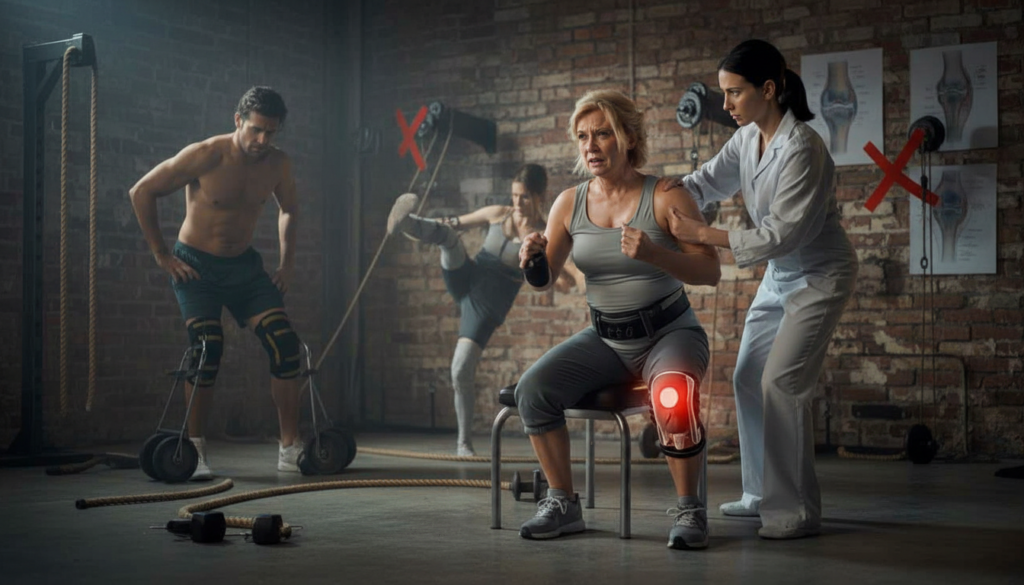
Instead, her therapist got out a weight belt and a low metal chair. He said, “We’re changing our plan.” “This will hurt a little.”
Ten minutes later, she was doing slow, heavy squats with her eyes shining, her jaw clenched, and her heart racing.

She whispered, “This doesn’t feel right.”
The physiotherapist nodded. “It feels scary.” That’s not the same.
Three other patients outside would soon hear the same thing.
Something has clearly changed in the world of knee pain.
Why are physiotherapists suddenly telling patients to do the one thing they are afraid of?
For a long time, the advice for sore knees was to do low-impact sports, stretch gently, maybe do some yoga, and put an ice pack on them at the end. The goal was to “spare” the joint, which meant moving without putting any weight on it and avoiding stress at all costs. Swimming and Pilates became the go-to activities for people with knee problems.
After that, physical therapists began to share a lot of new research on osteoarthritis, tendinopathies, and long-term knee pain. All of a sudden, saving the joint was no longer the main event. It was stressing.
**Not randomly, not violently, but on purpose.**
In a Lyon clinic, a physiotherapist named Marc has quietly stopped suggesting the pool as the best solution. He still loves it for cardio and confidence, but not as the main part of rehab.
Now, instead of doing “ugly step-downs,” he has patients sit next to a sturdy box and put one foot on it while the other slowly reaches for the floor, bending the knee and burning the thigh. Some people swear. Some people shake. Some people just say no.
After three reps, one woman, who was used to “protect and avoid” for years, started crying. “Do you want me to do what my knee hates?” she asked. He said, “I want your knee to know it can get through this.”
The reasoning is harsh and clear. Bodies get used to doing things over and over again. Knees that only move in easy, unloaded ranges get very good at surviving in easy, unloaded ranges. Then the stairs, the hill, and the six-hour shift on your feet feel like a war zone.
A lot of therapists now agree with a tougher approach: planned mechanical stress, even if it means controlled pain during and after exercise. Not random pain or sharp “uh-oh” pain, but a manageable, monitored pain.
Let’s be honest: very few people naturally sign up for that kind of pain two or three times a week.
The “painful on purpose” method that is causing a lot of problems for patients
Different clinics call the new protocol by different names, but the basic idea is always the same: progressive, loaded strength work for the quadriceps, hamstrings, and glutes, all the way through the movements that usually cause knee pain.
It usually starts with slow squats to a chair, step-downs from a small step, and isometric holds like a wall sit. The goal is to get the pain level to a 3 to 5 out of 10. The reps are high and the tempo is slow. You can feel it, but not so much that you can’t walk for days.

Some physiotherapists even say to their patients, “If you don’t feel anything at all, we’re not doing enough.”
Clinics all over the world have quoted Stuart Warden, a well-known researcher in how bones and tendons adapt. He says that joints need load to keep their strength and rebuild it. Without it, cartilage gets thinner, muscles get weaker, and balance gets worse.
But when this message gets to regular people with creaky knees, they don’t always react with excitement. Patients who were used to being wrapped in cotton wool suddenly hear that “no pain, no gain” is back on the table, but this time it’s dressed up in science.
People on online forums are calling this method “barbaric,” “reckless,” or “a fast track to surgery.”
A lot of people miss an important detail. *Pain during rehab doesn’t always mean damage.
The new way of thinking sees pain as a signal, not a siren. If it goes up sharply or stays high for 24 to 48 hours, the load was too much. If it goes up a little during the exercise and then goes back down to normal within a few hours, the body is probably just being pushed, not hurt.
The problem is that fear often speaks louder than biology. No matter what the science says, anything that hurts feels dangerous after you’ve heard your X-ray described as “bone on bone.”
How to put stress on your knee without hurting it
Most physiotherapists who use this “painful on purpose” method don’t just put people under a barbell and hope for the best. You can borrow their guardrails.
The “4 out of 10” rule is a common one: pain can get worse while you work out, but it should stay below 4–5 on a 0–10 scale. Your knee can hurt a little after the session, but it should be back to normal by the next morning.
They also begin with small things, like slow sit-to-stands from a higher chair, mini-squats while holding onto a counter, or step-ups on a 10–15 cm step. The point isn’t to be a hero. The point is to say it again.
People get stuck in two extremes. They either avoid all knee-loaded movement out of fear and slowly lose strength, or they jump into aggressive bootcamp-style classes and get stronger in just one week. Both paths will make you angry.
The middle, which is uncomfortable, is where progress hides. Work that hurts a little bit every time, two or three times a week, with honest tracking of pain levels and function. Is it easier for you to climb stairs after a month? Can you stand at work for longer? That kind of gain is more important than a certain number of reps.
You are not weak if your first instinct is to stop when you feel a twinge. You’ve probably been told for years that pain means danger because you’re human.
Claire R., a physical therapist who works with a lot of women in their 40s and 50s, says it like this: “I’d never ask a knee to suffer for no reason.” But if you never stress your knee, it will let you down when you really need it. I don’t pretend that fear doesn’t exist; my job is to help people get through it.
Start lower than you think. In the first few weeks, sit-to-stands from a high chair or step-ups on a low step may be enough.
Try the “next-morning” testIf the pain is much worse the next day, don’t stop working out; just lower the depth, weight, or total reps.
Don’t worry about your ego; worry about your head.