The kitchen in the showroom looked like a movie set, with soft pendant lights, shiny marble, and a big island in the middle that looked like it was trying too hard. There was a young couple standing there with their arms crossed, talking in low voices. The woman asked, “Where does the stroller go?” The salesperson started to spin around the island, pointing out drawers and hidden outlets, but you could see on their faces that life just didn’t fit around that big block anymore.
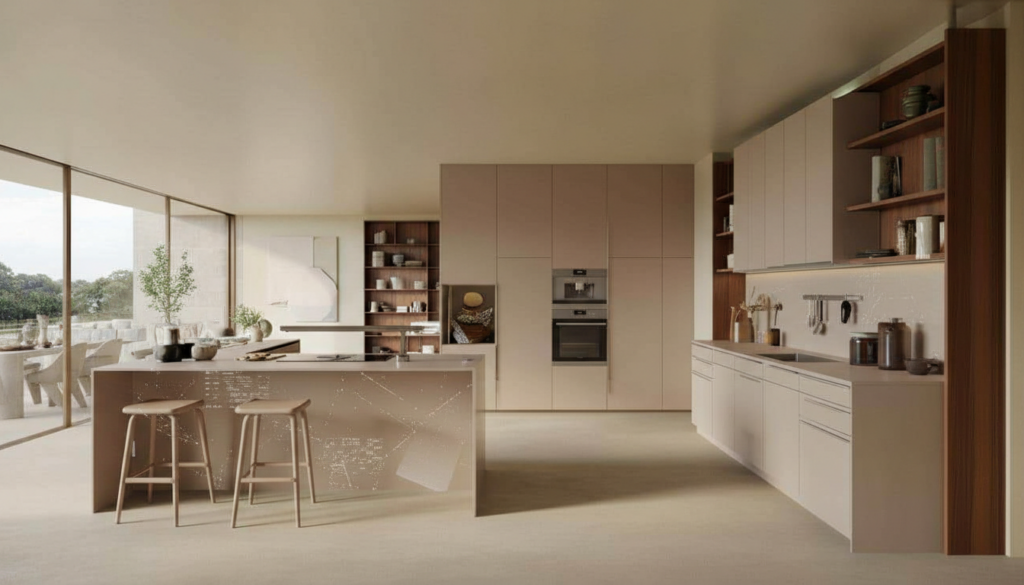
The same thing happens again when you go outside. The famous kitchen island is starting to feel out of place in small city apartments, open-plan family homes, and even renovated farmhouses. Yes, it’s pretty. Not always useful.
Something smarter and quieter is taking its place.

From a statement piece to a daily problem
The kitchen island was the best thing about the 2010s. It screamed “I watch cooking shows” and “open-plan living,” even though all you did on it was drop your keys and fold laundry.
But if you spend a whole day in a real kitchen, the cracks start to show. That block in the middle gets in the way of your flow, takes up valuable space, and attracts junk. You end up going around it with hot pans and grocery bags, like planes flying around a busy airport.
Looks great on Instagram. Not as much fun at 7:30 p.m. on a Tuesday night. to interior designers who are planning projects for 2025–2026, a pattern starts to emerge. Customers still want kitchens that are friendly and open, but they are quietly asking, “Can we skip the big island?”
A designer from London told me about a family that tore down a perfectly good stone island after only three years. They wanted a big table where the kids could spread out their homework, not a big rock that they had to walk around twenty times a day. In a loft in Paris, another couple traded their island for a thin peninsula and a butcher’s block on wheels that stands on its own.
People always say the same thing: “We can breathe again.”
Not only are our tastes changing, but so are our lives. Kitchens are no longer just places to cook. They’re places to work, make things, eat late at night, and talk about things. A fixed island locks you into one way of using the space.
People want to be able to change things up, see what’s going on, and have the option to host eight people or just two. They want surfaces that can move, seating that can change, and storage that works harder than a single row of drawers under a big slab of stone.
The truth is that a big, static block in the middle of the room suddenly feels like old technology.
The Broken-Plan Kitchen Hub: The 2026 Replacement
Designers are calling the rising star that quietly moves islands aside the “broken-plan kitchen hub.” Less big blocks and more connected areas.
You don’t get one big island; instead, you get a narrow peninsula attached to a wall or column, a big dining table that can be used for more than one thing, and one or two mobile prep surfaces that you can move in and out as your life changes. The kitchen still feels open, but it’s not just one big, echoing box.
You cook in one area, hang out in another, and move a piece of furniture to go from “family breakfast” to “friends over for drinks.”
Imagine this. There are deep base cabinets and appliances along one wall. A peninsula that is at a right angle goes far enough to hold a sink and give you some bar seating without blocking the whole room.
A few steps away is a strong, pretty table for eating. It’s a laptop station on quiet mornings. On the weekends, you roll out dough with your kids there. The table is the real center of attention at a party, while the peninsula takes care of the messy work. If you need more counter space, a small butcher’s trolley on wheels comes out and then goes away when you want to dance in the kitchen at midnight.
Same amount of space. Life is very different.
There is a simple order to this change: flow comes first, then theater. You don’t design from the middle out; you design from the paths people actually walk. Entry from the hallway, line to the fridge, path to the terrace, and view of the sofa.

The broken-plan hub doesn’t cross those lines. No more awkward “island corners” that everyone runs into. No more traffic jams between the fridge and the cooktop. You make one main prep area and keep it clear. Then you let social and flexible pieces move around it.
*The space starts to work for you, not the other way around.
How to Move Your Kitchen from Island to Hub Without Messing It Up
If you’re planning to remodel in 2026 or later, start with a pencil, not Pinterest. Draw your kitchen as two simple things: walls and paths for people to walk on. Then think about where you stand, turn, reach, sit, and talk every day.
Then, make three areas: a small work triangle (sink, hob, and fridge), a social table or banquette, and one flexible surface element. That flexible piece could be a narrow peninsula that connects to a wall, a wheeled prep cart, or a thin console that can be used as a buffet when people come over.
The key is to leave a clear, honest rectangle of empty space on the floor between these points. That’s your space to breathe.
One big mistake is to try to keep the “look” of an island while changing everything else. You get a big peninsula that still blocks traffic and collects trash. Or a table that is too big and is stuck so close to the cabinets that chairs can’t move back.
Be nice to yourself in the future. Let go of some weight to move better. If it means having to move furniture all the time, accept that you don’t need storage under every square inch of surface. Let’s be honest: no one really uses those deep, hard-to-reach corner drawers every day.
Try to have fewer, smarter storage areas and at least one surface that you can change when things go wrong.
Sofia Lando, a kitchen designer in Milan, says, “People don’t cook like TV chefs.” “They cook while they talk to friends, watch kids, and answer emails.” The kitchen hub needs to be able to adapt to those times, not fight them.
Change the island into a peninsula.A peninsula holds one side of the room in place while leaving the center open. You get more counter space and bar seating without making a block in the middle.
Make the dining table a real workhorse.Pick a sturdy table that you can wipe down and chairs that are comfortable. It works as a home office, a place for kids to do their homework, and a place to serve food at parties.
Add one mobile itemA good trolley or butcher’s block on wheels gives you more prep space when you need it and then hides it away.
Make walls for quiet storageTall, clean-lined cabinets along one wall hide the mess that used to be in island drawers and keep the room looking calm.
Keep clear paths safeLeave at least 1 to 1.2 meters of space around main roads. Every morning, your knees, shins, and mind will thank you.
A New Kitchen Mood: More Life, Less Show
The whole mood of the kitchen changes when you start to think of the island as optional. The room stops being a stage with a big hero in the middle and starts to look like how you really live. There are fewer crashes when cooking meals. People naturally move from the sofa to the table. You don’t have to yell, “Watch the corners!” when kids come in.
You might also notice something else. The space feels calmer without that big block in the middle. You can see the window, the garden, and the rest of the house from here. Conversations don’t go around things; they go in curves.
This isn’t about making fun of the island trend or getting rid of everything shiny and fancy. Trends get older. Lives change. The broken-plan kitchen hub is just the next answer to the same old question: how do we share food, time, and the mess of everyday life in a space that doesn’t fight us?
The island did well for a while. The new hub quietly asks a better question: what if your kitchen could change size with your days instead of just sitting there looking nice?
| Key point | Detail | Value for the reader |
|---|---|---|
| Shift from island to hub layout | Prioritize flow, three clear zones, and an open central area | Reduces daily frustration and makes the kitchen easier to live in |
| Use flexible elements | Peninsulas, mobile trolleys, and hardworking dining tables | Adapts to work, family, and entertaining without a full remodel |
| Focus storage on walls | Tall, organized storage replaces bulky island cabinets | Keeps clutter hidden while keeping the room visually light |
FAQ:
Are kitchen islands really going to be “out of style” by 2026?They won’t go away right away, but they aren’t the default anymore. Designers say that more clients are asking for flexible hubs and peninsulas instead of big central blocks.
What if I already have an island that I can’t get rid of?You can still “think hub.” Clear the paths around your home, add a mobile cart that fits under one side, and get a new dining table so that people don’t hang out on the island anymore.
In a small kitchen, is a peninsula better than an island?Most of the time, yes. A thin peninsula uses a wall for support, opens up the middle, and still has seating and storage without splitting the room in half.
Can a table really take the place of an island?Yes, as long as it’s sturdy, the right height, and close enough to the prep area. A lot of people feel more comfortable chopping, mixing, working, and hosting at a table than at a high counter.
What should I do first if I want to build a kitchen in 2026?Before you buy any furniture, make a map of your daily habits and walking routes. Instead of a big island, design around a small work triangle, a central table, and one flexible element.