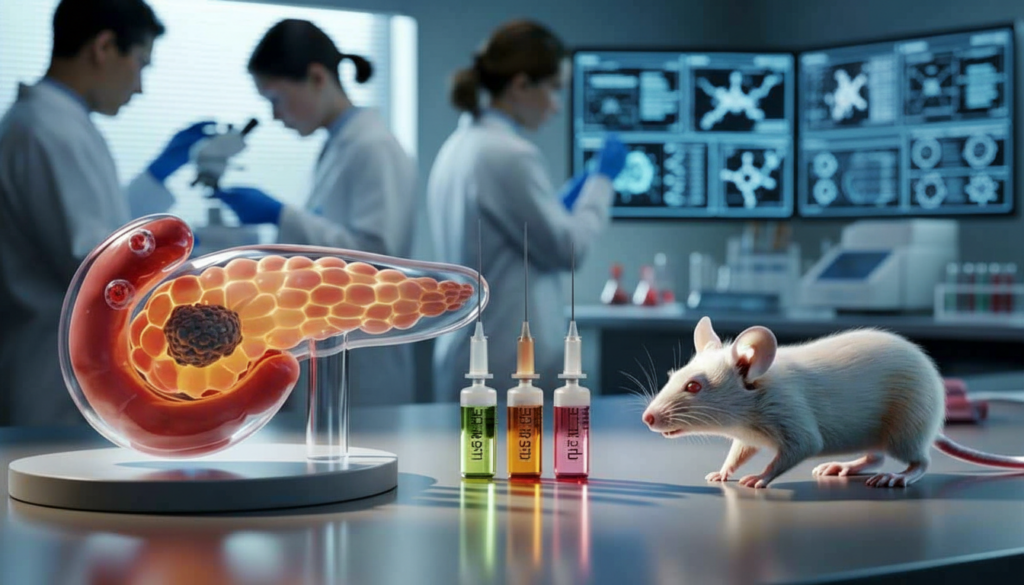
Researchers say that a combination of three drugs has killed pancreatic tumors in mice and kept them from coming back for months. This gives us cautious hope that we can find a new way to fight a disease that currently kills most patients within a few years.
Why pancreatic cancer is so hard to treat
Oncologists know a lot about pancreatic cancer. It usually grows quietly in the abdomen, with few signs that something is wrong at first. The disease has often already spread by the time symptoms like jaundice, weight loss, or stomach pain show up.
Around 13% of people will live for five years. For people who are very sick, that number can drop to about 1%. When possible, surgery gives patients the best chance of living a long time, but only a small number of patients are eligible by the time they are diagnosed.

Standard chemotherapy targets rapidly dividing cells, including healthy cells in the gut, hair follicles, and bone marrow. Tumors can get smaller for a short time, but they usually change their internal growth signals and come back in a form that is harder to treat.
Pancreatic cancer is known for being very bad because it spreads quickly and changes to fit almost anything that is thrown at it.
The genetic cause of most pancreatic tumors
A mutation in a gene called KRAS is present in almost all pancreatic cancers. This gene is like a molecular on–off switch that controls how cells grow. In healthy cells, it only turns on when the cell needs to split. In cancer cells, it stays “on.”
That stuck switch makes cells divide all the time, without any control. People called KRAS “undruggable” for years because the shape of the protein made it hard for drugs to attach to it and stop it. Targeted KRAS inhibitors have only recently started to be tested in people.
The Spanish team, led by cancer biologist Carmen Guerra at the Spanish National Cancer Research Center (CNIO), has been looking into how pancreatic tumors use KRAS and its related pathways to survive. In earlier work with mice, blocking some KRAS-linked pathways could stop small tumors from growing. But bigger ones just changed and used different backup circuits.
The backup route that kept tumors alive
The researchers had to deal with this resistance by cutting up the tumors that kept growing even when important growth signals were genetically blocked. They were looking for the molecular escape hatch that let these cancer cells live.
STAT3 was the most important protein. When major KRAS-related pathways were blocked, STAT3 activity went through the roof. That made it seem like tumors might be using STAT3 as a backup survival system that kicks in when their main options are cut off.
When tumors stopped getting the signals they needed to grow, STAT3 turned on like a backup generator, keeping cancer cells alive.
The group then genetically disabled STAT3 in mouse tumor cells and blocked KRAS and another pathway linked to KRAS. Tumors shrank and eventually disappeared under this triple attack, which suggests that STAT3 is a key “escape route” for cancer growth.
Making a three-drug attack
Genetic tricks work on mice, but not in real life. So the next step was to turn this triple blockade into real drugs. The researchers put together three drugs, each of which was meant to target one of the tumor’s main growth pathways.
Afatinib is an FDA-approved drug for some lung cancers that works by blocking growth factor signaling at the cell surface.
Daraxonrasib is a KRAS inhibitor that is currently being tested in people. It is meant to stop mutant KRAS from working.
A new experimental compound called a STAT3 inhibitor is meant to turn off the backup STAT3 pathway.
The therapy aimed to leave tumors with no easy way to change the signals that tell them to grow and no chance to become resistant by hitting all three pathways at once.
What the study on mice really found
The three types of mouse models tested the triple therapy:
Type of modelWhat it means
Implants of mouse tumorsMouse pancreatic cancer cells put right into the pancreas of a mouse
Mice that have been genetically modifiedAnimals bred to develop pancreatic cancer on their own
Grafts of human tumorsHuman pancreatic tumors cultivated in immunodeficient mice.
| Model type | What it represents |
|---|---|
| Mouse tumour implants | Mouse pancreatic cancer cells placed directly in the mouse pancreas |
| Genetically engineered mice | Animals bred to spontaneously develop pancreatic cancer |
| Human tumour grafts | Human pancreatic tumours grown in immune-deficient mice |
The results were the same in all three settings. The combination treatment got rid of the tumors.
After treatment, researchers said that the mouse pancreases looked normal and there was no sign of the original tumor.
The cancers did not come back quickly, which was very important. The team kept an eye on the animals for at least 200 days, which is almost seven months. This is a long time to follow up on mouse experiments. During that time, tumors didn’t come back, which means that the triple blockade had stopped both the main and backup growth paths.
Safety signals and side effects in mice

Strong cancer treatments often have bad side effects. But the mice that got the three-drug cocktail did just as well as the control mice on a number of important health measures.
They kept their weight the same. Their blood counts and metabolic markers stayed in the normal range. When looked at, the organs didn’t show any clear signs of damage. The therapy appeared to be non-toxic in this preclinical context.
That doesn’t mean that people will act the same way. Guerra said that mice can often handle higher doses of some drugs than people Model type What it represents
Mouse tumour implants Mouse pancreatic cancer cells placed directly in the mouse pancreas
Genetically engineered mice Animals bred to spontaneously develop pancreatic cancer
Human tumour grafts Human pancreatic tumours grown in immune-deficient mice. For example, afatinib is already used to treat lung cancer, but it can cause skin rashes and stomach problems in some people.
Why success in mice doesn’t mean success in people
A lot of cancer treatments work well in animals but not as well in people. Human tumors exhibit greater genetic diversity. Patients may have more than just KRAS mutations, and their immune systems, past treatments, and general health can all affect how a treatment works.
Pancreatic ductal adenocarcinoma, the most prevalent variant of this disease, exhibits significant variability among patients. Some tumors have extra mutations that could get around the pathways that this study looks at. Others might change in ways that aren’t seen in current mouse models.
Now, researchers have to figure out how to turn a neat success in the lab into a treatment that can handle the messy reality of human cancers.
The team wants to look at more mouse models that have different KRAS mutations and changes in other cancer genes. Before moving on to human trials, the goal is to see if the triple-drug strategy works on a wider range of tumor types.
What do you think future clinical trials will be like?
If safety and dosing studies go well, early clinical trials would probably start with small groups of people who have advanced pancreatic cancer and few other options. The main goals of these first studies would be to test safety and find a dose that works, not to show that they help people live longer.
Researchers may also examine modifications of the existing cocktail. Scientists are looking for other drugs that work on the same pathway as afatinib but are less toxic because afatinib already has known side effects in people. In the same way, new types of STAT3 inhibitors may be made to better target tumors while leaving healthy tissue alone.
Important things that patients and their families may want to know
If you’re trying to keep up with this kind of research, you’ll see these words a lot:
Pathway: A series of signals inside a cell that tell it when to grow, split, or die.
Resistance: When a tumor changes because of treatment and the medicine no longer works.
Combination therapy: Using more than one drug at the same time to block more than one way that cancer can grow, making it harder for the disease to change.
A mouse model is a type of experiment in which living mice are used to study human or mouse cancer in order to mimic some of the disease’s effects in people.
This study exemplifies the application of combination therapy in a highly targeted manner. Scientists didn’t just mix drugs at random. Instead, they mapped how tumors escape and then picked medicines that would block all of the escape routes at once.
Possible benefits and limits in the real world
If this triple-drug treatment works in people, it could have big benefits, like making tumors shrink more, having fewer relapses, and giving the body more time to develop resistance. For some patients, this could mean living longer or making tumors that couldn’t be removed before possible to remove.
But there are limits in the real world. It can be expensive to combine several targeted drugs. Patients may already be weak from previous treatments, which makes it harder to deal with side effects. Also, not all pancreatic tumors will use the same pathways to grow.
In the future, doctors may have to check each patient’s tumor for certain mutations and pathway activity and then adjust the combination treatments to fit. That kind of precise approach is still not available in all hospitals and health systems.
What this means for patients right now
This study does not alter existing treatment alternatives. Individuals diagnosed with pancreatic cancer should not discontinue or modify their prescribed treatments based on laboratory results derived from murine models. Instead, the work adds to a growing body of evidence that going after multiple growth signals at once, rather than one at a time, may be a promising direction.
The study gives families who have this diagnosis a small amount of cautious hope: scientists are starting to figure out how to untangle the complicated wiring that makes pancreatic cancer so hard to treat, and they are creating smarter treatments that target all of the major power lines that feed these tumors, not just one.