The woman using the leg press looks really angry. She’s not out of breath or in pain; she’s just really angry. She grumbles, “This again?” and pushes the sled away with a sigh, her knees bent and her trainer watching like a strict math teacher. People are stretching bands, doing Pilates moves with grace, or talking at the water fountain all around her. She is the only one who is stuck in the corner doing the exercise that everyone else is avoiding.
Then her trainer says, “This is the best thing you can do for your knees.”
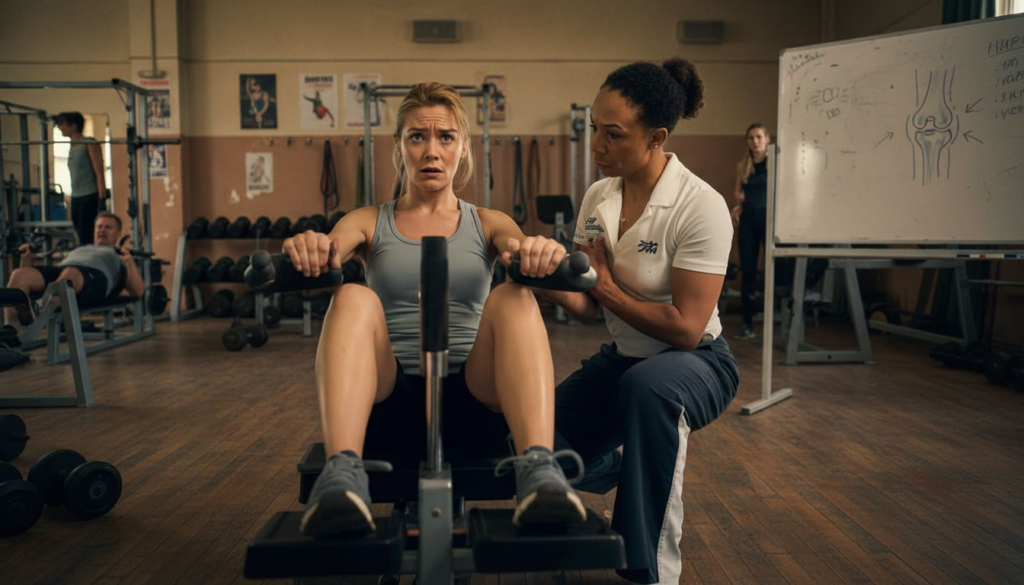
She stops in the middle of a rep and squints. What’s the best thing? What is this?
You can almost hear half the gym roll its eyes at that moment.

The exercise that everyone hates but physiotherapists secretly love
If you ask people at any gym what the “worst” exercise is, you’ll probably get the same short list: burpees, lunges, and that awful stationary squat-by-machine. The leg press, wall sit, and static squat are all examples of wallflowers in fitness. Not as glamorous as swimming. Not “zen” and good for Instagram like Pilates.
They hurt. They shake your legs. In pictures, they look boring.
But sports doctors and physical therapists keep saying the same thing over and over: “Progressive squats and leg press are great for sore knees.” Not stretching gently. Not another magical fascia roll. Power. Strength that is real, controlled, and not too heavy.
A Spanish physiotherapist posted a video a few weeks ago of a patient in her fifties making a face while doing leg presses. “Three months ago, she couldn’t go down the stairs.” Today: 70 kg for 10 reps, no pain. The video went viral. People went crazy with their comments.
“Leg press hurt my knees,” one person wrote.
Another person said, “My orthopedist told me to never squat again.”
Then the doctors spoke up: “Knees love load.” “Strong quads, happy joints.”
We’re watching a real fight between two worlds. The one that told you to “protect your knees, don’t bend them too much” and the one that now says the exact opposite.
It makes sense on paper. The knee is a hinge that doesn’t like things that are out of order, like twists, jerks, and sudden impacts. Muscle that can handle everyday life without complaining is what calms it down. Squats are basically what you do when you climb stairs, get up from the couch, or carry shopping bags.
Of course, swimming and Pilates help by making movement easier and waking up deep muscles. But they don’t often give the joint environment the progressive load that really changes it.
The ugly truth is that the “ugly” exercises are often the ones that quietly rebuild us. That’s why no one agrees.
How the most boring move turns into a routine that saves your knees
Physiotherapists agree that the move isn’t a crazy jump or a hard combo. It’s the easiest plan: bend and straighten your legs while keeping your knees safe from too much weight. This could be a leg press machine, a squat with support while holding onto a bar, or even a wall sit that turns into mini-squats.
You begin where your body is, not where your ego wants to be. That’s the hard part.
The range is very small at first. It might only be a 20° bend. The weight is so light that it’s funny. Three sets of ten, slowly, like learning to walk again. The goal isn’t heroic sweat; it’s quiet repetition that tells irritated cartilage, “Don’t worry, we’ve got you.”
People often stop doing these exercises at the worst time: the first few weeks, when it hurts but nothing feels better yet. The thighs hurt, the mind complains, and the old saying comes back: “This can’t be good for my knees.”
We’ve all been in that situation where our bodies protest and our brains look for excuses. You miss one session, then two, and all of a sudden you say, “Strength training doesn’t work for me.”

Let’s be honest: no one really does this every day. People who move forward aren’t always perfect. They don’t leave that boring corner of the gym as often as they come back to that leg press and squat.
Then, usually around the fourth or fifth week, something small changes. You get up from the couch with less noise. You feel more sure about going up and down stairs. Not a miracle, just a half-second of “Oh, that didn’t hurt.”
That’s when a lot of physiotherapists hear, “I hate this exercise, but it’s working.”
“Patients come in thinking that bending the knee is dangerous,” says sports physiotherapist Lisa M., who works with both runners and retirees. “We don’t want to make them love the leg press.” It’s to help them believe in their own strength again.
Before using any machines, do small squats to a chair.
- You should only increase one thing at a time, either weight or depth.
- Stop when you feel uncomfortable, not when you feel sharp, stabbing pain.
- Keep two “easy” reps in the tank, with your knees lined up over your toes.
- Do one “kind” activity with your strength training sessions, like walking, biking, or even swimming.
No one agrees, which is why the debate is important.
If you bring up knees at a family dinner, you’ll start a war between generations. The aunt who was told not to squat again after tearing her meniscus. The cousin who swears by Pilates on a reformer. The runner who only trusts swimming when they are in pain.
In that loud mix, the thought that the “most hated exercise” might be the best cure sounds almost like a challenge. But underneath the arguments, there is a quiet question: how much are we willing to go through pain to get comfort back?
When you say, “I have bad knees, I can’t squat,” gym trainers roll their eyes because they’ve seen people go from scared half-bends to strong, proud reps. When someone says, “I just swim, that’s enough,” physiotherapists sigh because they know that joints need more than just swimming to stay healthy.
The fear is real, though. The bad things that happen are real. The person who pushed too hard, too quickly, and without help, and ended up worse. That’s why things like “never bend your knees” or “no pain, no gain” don’t mean as much as nuance.
The truth is probably somewhere quiet, between the pool and the leg press. In between the squat rack and the Pilates mat.
You can’t just be brave or careful to build strong legs. They grow in that uncomfortable gray area where you listen to your body, fight your fears, and still show up.
Maybe the real scandal is that this hated exercise is good for your knees. Maybe the scandal is that no one taught us how to load our joints with respect instead of panic, or how to see a boring machine as a small way to get back to freedom.
Main pointDetailValue for the reader
Loading that gets better over timeStart with light weights and shallow bends, and then add one variable at a time.Lessens fear and risk while still making the knee stronger
Being consistent is more important than being perfect.Two to three sessions a week are better than random “hero” workouts.Makes it possible to get better in busy, imperfect lives
Mix strength with softnessDo squats or leg presses along with walking, biking, or swimming.Supports joints in all directions: muscle, movement, and blood flow
| Key point | Detail | Value for the reader |
|---|---|---|
| Progressive loading | Start with shallow bends and light weights, increase one variable at a time | Reduces fear and risk while still strengthening the knee |
| Consistency over perfection | 2–3 sessions a week beat sporadic “hero” workouts | Makes improvement realistic for busy, imperfect lives |
| Combine strength and softness | Mix squats/leg press with walking, cycling or swimming | Supports joints from all angles: muscle, mobility, and circulation |
Questions and Answers:
Question 1What is the “most hated” exercise for knees that people are talking about?
Question 2: If my knees hurt, are squats or leg presses really safe?
Question 3: Is swimming, Pilates, or strength training better for my knees?
Question 4: How do I know the difference between “good” pain and “bad” pain?
Question 5: How often should I work my legs each week to see a difference in my knee pain?