In the beginning of the video, there is a white towel, a beige bathroom, and a girl with glass skin stroking her hairline like it is a baby kitten. The title is “SCALP SPA AT HOME: How I made my hair SUPER THICK in 30 days.” You watch while you scroll through your phone in bed, rubbing the thinning patch at your parting with one hand. She pours a serum with glitter in it, uses a pink silicone brush to massage, and lights a candle. There is music that calms you down. There are vows. Under every product she touches, there is also an affiliate link that says “for you, babe.”
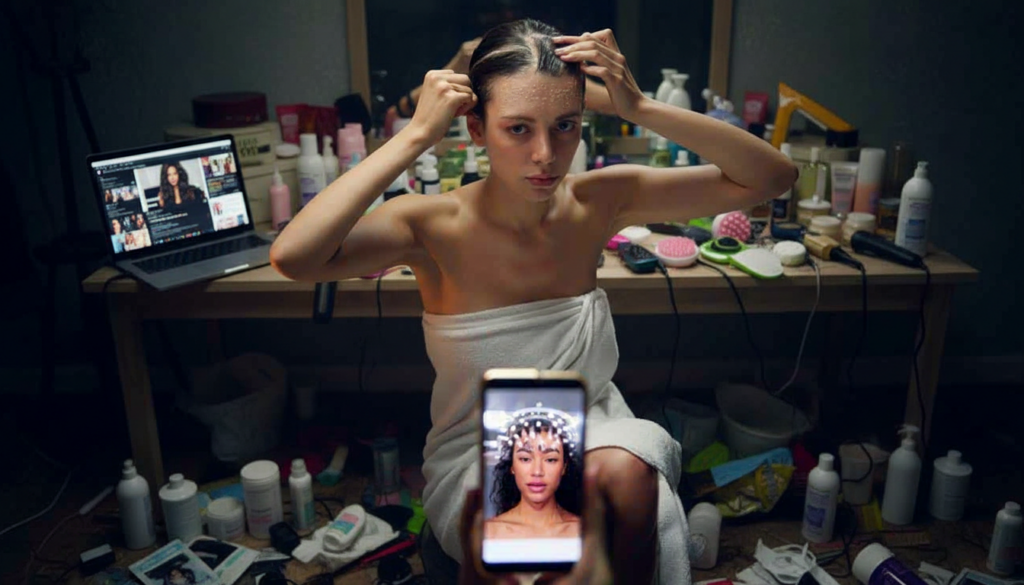
You think to yourself, “Maybe this one will work.”
Then you look at the price of the kit and see your own angry face in the black mirror of your phone.

This whole scalp spa fantasy is starting to feel… wrong.
The growing business of “scalp spa” hope
There is a lot of scalp spa content out there right now. From the outside, it looks almost like a religious place with oils, steam caps, jade combs, and sound baths. People who influence you talk about “detoxing follicles” and “activating thicker growth,” as if your scalp is a plant you forgot to water.
Underneath that pretty look is a very simple equation: women who are afraid of losing hair + social media algorithms that reward dramatic before/after shots = a goldmine.
The more worried you are about your shedding, the more likely you are to click, watch the whole thing, and then buy.
A 32-year-old woman I talked to, who we’ll call Maya, said that her descent into scalp-spa TikTok was like an addiction. Her hair started to thin around the temples a year after she stopped taking the pill. All of a sudden, her feed was full of girls washing their hair with rice water, microneedling their hairlines, or doing 20-minute “lymphatic scalp drainage” routines.
Maya bought a $75 “detox scalp mask,” a $60 LED hair band, and three different botanical serums from three different influencers. For three months, she followed every step without fail.
Her decision: her hair looked shinier. It didn’t look like it had more in it. But her bank account, on the other hand, definitely looked thinner.
Here’s the simple truth that no one on your FYP says out loud: the price of the oil on your bathroom shelf has nothing to do with how thick your hair is.
Yes, massaging your scalp can help blood flow and relax tight muscles. Yes, a clean scalp can help follicles work better. But a silicone brush and a “miracle essence” won’t help with iron deficiency, PCOS, hair loss after giving birth, or chronic stress.
When influencers say their thick ponytail came from “this scalp spa routine, babes” instead of their 22-year-old hormones, extensions, or professional lighting, they’re selling more fantasy than reality.
What a real at-home scalp routine can and can’t do
So, what does a real “scalp spa at home” look like that respects science? Less marble tray and more simple sink. It starts with something very unsexy: looking at your scalp like skin. Not like hair. Skin that sweats, gets oily, collects dead cells, and reacts badly to harsh products.
You rub a light, scent-free oil into your scalp with your fingers once or twice a week, before you wash your hair. Five minutes, little circles, no scratching. After that, you wash your hair with a mild shampoo, paying special attention to the roots. Rinse well, and only condition the ends.
That’s it. No need for a pink gadget or a 15-step dance.
A lot of women think that if a little massage is good, a 30-minute hardcore scrub will be even better. This is when the influencer routine starts to hurt you without you even knowing it. Scrubbing too much can make shedding worse by making it itchy and inflamed. Putting strong essential oils directly on the scalp can burn.

Another mistake people make is switching products all the time in search of miracles. Your scalp needs order, not chaos. Two or three simple, easy-to-use products that you use every day are better than a new “scalp detox” that you buy in a hurry every Sunday night.
We’ve all been there: standing in the shower with three different shampoos, hoping that one will magically get rid of the hair in the drain.
A dermatologist in London told me, “What really helps hair grow is boring: medical checks when needed, time, good food, and gentle care.” Instead of boring posts, social media sells drama.
If your hair loss is sudden, patchy, or lasts a long time, ask for blood tests for iron, ferritin, thyroid, vitamin D, and hormones.
If your scalp is sensitive, use products that don’t have a strong scent or that don’t have any scent at all. Think less “spa scent” and more “dermatology aisle.”
- Set goals that are possible: A good scalp routine can make you feel better, stop flaking, and help each hair live its full life. It can’t give you someone else’s genes.
- Keep an eye on the time: If you can, real changes in density take months, not just 30 days. Every month, hair grows about 1 to 1.5 cm.
- Combine self-care with facts: If you want the candles and the nice brush, use them to relax, not to get better.
The harsh truth and the less harsh one
The ugly truth about scalp spa culture is that it takes advantage of women when they are at their weakest. Hair is full of identity, femininity, and youth. When you start to lose your hair, you don’t just lose strands; you feel like you’re losing a part of yourself. “I grew baby hairs in two weeks” hits hardest at that time.
The line between inspiration and exploitation is thin, and the business crosses it every day. Every “you NEED this” is designed to make you scared. Fear of getting older. Fear of not being as attractive. Fear of looking sick. *Fear sells better than any clinical trial.
But there’s also a softer, more tender truth: taking care of your scalp at home can help you be with a body you sometimes hate.
Taking away the advertising, washing and massaging your own head is almost like a ritual. It brings you back to the body you keep judging in the mirror. There are no comments, no filters, and no “GRWM” voiceover in the background for twelve small minutes when your phone is outside the bathroom.
Yes, you can keep your little scalp brush if you like how it feels. If lighting the candle helps you relax after a long day at work, go ahead and do it. If the fancy towel makes you feel like the main character in your own bathroom, keep it. Stop thinking that it will give you a new hairline.
Let’s be honest: not even the girls who are filming this do it every day.
The change happens when you stop asking, “Will this routine make me better?” and start asking, “Is this routine good for me?” From that point of view, you might think that the best “scalp spa” move isn’t a viral serum but making an appointment with a dermatologist. Or telling your doctor how scared you are.
You might also want to let your hair story change over time. You could try shorter cuts, styles with texture, or even wigs and toppers. Not as last resorts that are shameful, but as tools. Real self-care is messy, useful, and sometimes even medical. It’s not always something you can post on Instagram.
If you want to, tell another woman in your life what really helped you and what turned out to be expensive lies and tricks. She is probably looking at yet another “hair growth journey” right now and wondering what is wrong with her. The answer is: not as much as the internet wants you to think.
| Key point | Detail | Value for the reader |
|---|---|---|
| Scalp spa has limits | Routine can improve comfort and hair quality, but not override genetics or medical issues | Protects from false promises and wasted money |
| Gentle methods work best | Simple massage, mild shampoo, and consistency beat aggressive scrubs and product hopping | Gives a realistic, doable at-home plan |
| Seek real help when needed | Blood tests, dermatology advice, and addressing hormones or deficiencies | Increases the chance of genuine improvement in hair health |
Questions and Answers:
Question 1: Can a scalp spa routine really help my hair get thicker?
Answer 1: It can help your hair grow in the best possible conditions, but it can’t change your genetics or fix any medical problems that are causing your hair to fall out. Think of it as a “supporting cast,” not the “main cure.”
Question 2: How often should I give my scalp a massage at home?
Answer 2: Most people only need to do it two to three times a week for 5 to 10 minutes. Scrubbing more often and more aggressively can irritate the scalp and make things worse.
Question 3: Do I need to buy expensive oils and scrubs for my scalp?
No, answer 3. You only need a simple, non-irritating oil (like lightweight plant oil or a pharmacy scalp treatment) and a gentle shampoo. The “luxury” packaging doesn’t change how hair follicles work.
Question 4: What signs should I look for to know I need to stop doing it myself and see a doctor?
Answer 4: If your hair falls out suddenly, you see bald spots, your scalp hurts or burns, or nothing gets better after a few months of gentle care, you should see a doctor and get blood tests.
Question 5: Is it bad that I still like scalp spa nights like influencers do?
Answer 5: Not at all, as long as you don’t think of them as medical treatments that will help you. Enjoy the ritual, but don’t get your hopes up based on sponsored before-and-after photos.