You are once again standing in front of the mirror with a towel around your shoulders and wet hair sticking to your head like silk threads. When it’s dry, it always does the same thing: it falls flat, obedient, and almost apologetic. You tried making it longer, adding layers, and using every “thickening” product the internet swore by. Nothing. Your hair goes back to its normal state—fine, limp, and see-through at the ends—five minutes after you style it.
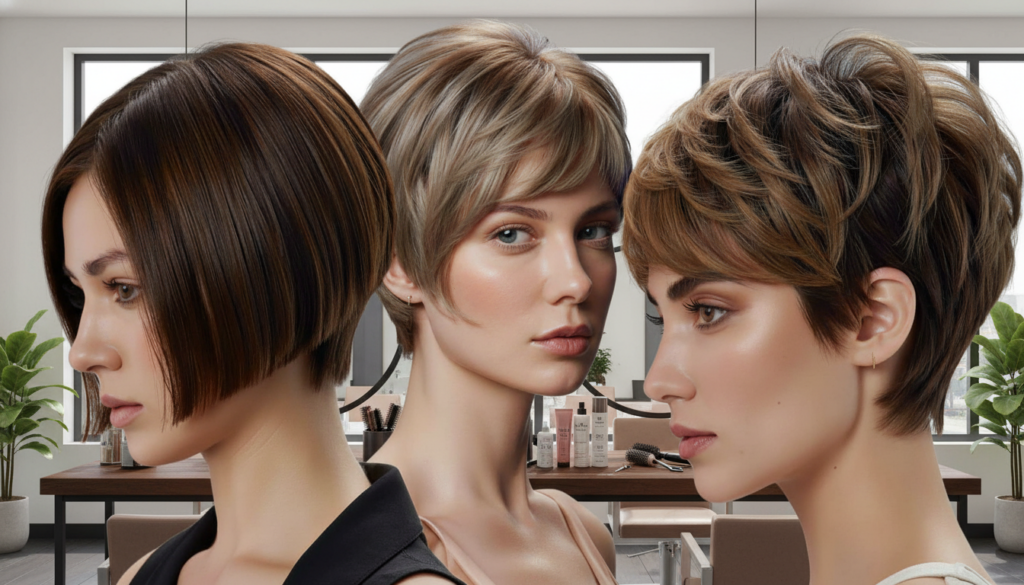
Then one day, you see a woman on the metro with a short, full, airy cut that looks like every strand has woken up. You can tell that her hair is just as fine as yours, but it looks thicker. You want to know what kind of magic she’s using.
It’s not magic, to be honest. It’s the right short haircut, cut to add volume, not length.

1. The blunt bob: a clean line that makes hair look thicker
A good blunt bob is like a power suit for thin hair. One clean, straight line that makes the ends look thicker and the whole head look fuller right away. When the scissors cut all the hair to about the same length, the weight gathers at the bottom, making a graphic, almost optical illusion of volume.
That sharp edge keeps light from getting through fine hair that is straight or slightly wavy, which is exactly what you want. More “mass effect” and less transparency. Cutting around the jaw or just below the chin, the blunt bob frames the face and gives it a “thick curtain” look, even if your ponytail is known for being thin.
A colorist in Paris told me about a client who had long, flat hair for years. She was scared of losing the little hair she had, so she always asked for “just a trim.” One day, she brought a picture of a blunt bob and said, “Let’s try it. If it looks bad, I’ll stay home for a month.”
They made cuts. There are no layers or thinning; just a straight line with a slight curve at the jaw. She didn’t know who she was when she looked up. All of a sudden, her hair looked twice as thick. People started asking her what kind of supplement she was taking. She had only taken off the wispy, see-through length that showed how fine her hair really was.
*The blunt bob’s secret is that it doesn’t care what people think.* There are no feathery ends or rough texturing that makes hair lose its freshness after two washes. Just density. The hairdresser cuts hair almost like a sculptor, with the blades almost parallel to the floor. They sometimes add a micro-undercut at the nape to help the line hug the neck.
This shape gives fine hair structure and bounce with very little styling. A round brush and a quick blow-dry, or even air-drying with some volumizing mousse, will do. The hair doesn’t have to fight to look alive when the base cut is strong.
2. The layered pixie: a small cut with a big personality
The layered pixie is a small revolution for fine hair if you’re ready to cut it shorter. It uses contrast by making the top a little longer and the sides and nape tighter. This gives you lift where you need it and takes away extra weight where it pulls everything down.
A flat helmet is never a good pixie for fine hair. It has soft layers and hidden graduations that let the hair stand up, stack, and overlap. The end result is that “fluffed up” look that you see on celebrities who say their hair is baby-fine but always looks full on the red carpet.
A woman who goes to the salon all the time told me that her “hair life” began when she stopped fighting with her fine strands and got a pixie cut. Before that, her hair was shoulder-length and stuck to her head, with the ends curling up shyly. Every morning, she spent twenty minutes backcombing the roots, but by lunchtime, the volume was gone.
Something changed when she cut her hair into a layered pixie. The roots could suddenly lift when the lengths were shorter. The stylist kept the hair soft around the ears, added a longer, side-swept fringe, and cut small layers only on the top of the head. She left with a haircut that finally worked with her hair type instead of showing it off.
The pixie is a game of architecture from a technical point of view. The stylist makes the sides less full to make the top look fuller. That contrast is what makes the crown look fuller, even if you don’t have a lot of density. When the temples and nape are cleaner, the crown looks fuller.
This cut is also good for hair that has been washed and dried. A little bit of texturizing paste and a quick tousle with your hands bring the layers back to life. Let’s be honest: no one really does a full blow-dry every day. The right pixie knows this and keeps adding volume without much effort.
3. The shaggy short cut: layers that are light and messy for volume that looks lived-in
If you want to move around more than look perfect, the modern shag worn short is a blessing. Think of soft layers around the face, a little more length on top, and a texture that makes it look like you woke up like this, but better. This layered structure makes each strand of fine hair look thicker by making overlapping areas that catch light and make shadows.
The volume isn’t “big” in the old-fashioned way. It’s more about how dense it looks, like a soft halo around the head. The ends are light but not too thin, and the whole cut is meant to be scrunched, flipped, and lived in.

A London hairstylist told me that she only does the short shag for people who don’t like styles that look too done. One of them, a graphic designer with very fine hair, came in with pictures of rock singers and French actresses. They had bangs, layers, and bangs again. She was always afraid of the same thing: “I don’t want to see my scalp.”
They made a shag that went just above the shoulders, with a light fringe that hung down like curtains and layers only on the crown. The client just dried her hair upside down, scrunched in a salt spray, and left when she got home. After a few weeks, coworkers asked her if she had more hair. No, she hadn’t. The cut just made it look better all over her head.
The shaggy short cut works because it breaks up flatness, which makes sense. Fine hair tends to stick together, line up, and lie close to the head. Well-placed layers break those lines and add small “speed bumps” that push parts up and out.
The risk is that using thinning shears too much can make strands look stringy. A soft but controlled shag is best for fine hair. It should be “more cloud than spiderweb.” With a little mousse at the roots, a diffuser, or just letting it air-dry while scrunching, you can get a textured shape that doesn’t need a lot of styling discipline.
4. The undercut bob or crop: using contrast and structure to fake volume
The undercut is a bolder trick that a lot of people with fine hair end up loving. This means that the hair on top should be longer than the hair on the bottom, which is cut shorter or even buzzed at the nape and sometimes the sides. When the hair falls naturally, you can’t see it right away, but it does affect volume.
The top hair lifts more easily when you get rid of that hidden bulk. It doesn’t get pulled down by what’s below. The undercut gives a bob or a short crop a fullness that looks like a mushroom and feels planned and edgy, not puffy.
I met a woman at a photoshoot who had a full, shiny bob that looked like a classic rounded one. There it was, a clean little undercut at the back of her head with a tiny lightning bolt shaved in when she tied it up. When she saw how surprised I was, she laughed. She said, “My hair is child-fine; this is the only way it doesn’t fall apart.”
Her stylist made a U-shaped section in the back and left enough hair on top to cover it completely. Her bob looked heavier at the ends from the outside, and it had that “bloom” at the back of the head that everyone wanted. The undercut kept everything light and easy to manage, especially when it was hot.
Her hairdresser told her at their first meeting, “Fine hair isn’t a problem to fix; it’s something to work with.” “We’re not trying to make you look like you have more hair; we’re just going to style what you have in the best way possible.”
- Undercut bob: longer layers on top, a hidden short section at the nape, and a rounded back view.
- Undercut crop: very short sides and nape, with a little more length on top. This style is great for people with strong personalities.
- Micro-undercut on the side
- Hidden design
Living with fine hair: how to pick the right short cut and the right attitude
The whole question of short cuts changes once you start to see fine hair as a texture instead of a flaw. Instead of asking, “How do I hide that my hair is thin?” you start asking, “What shape will make what I have look its best?” There are many ways to answer that question, such as a blunt bob, a layered pixie, a soft shag, or a structured undercut.
They all use the same tools: lines, contrast, and how your hair falls around your face. None of them can magically double the number of strands, but they can definitely make your hair look twice as thick. We all know what it’s like to leave the salon and feel like your head is lighter and somehow more present.
The next step is to find a hairdresser who knows how to work with fine hair and doesn’t see it as a problem. Bring pictures, tell them how your hair acts on days two and three, and talk about what you can realistically do in the morning. *Getting short hair that adds volume is a team effort between the cut and how you style it.
Do you want hard edges or soft ones? A quiet look or a bold statement look? Getting short hair for fine strands isn’t about punishment or sacrifice. It’s about choosing the hero shape that works for you, so that your reflection finally looks like the person you’ve been hoping to see.
| Key point | Detail | Value for the reader |
|---|---|---|
| Blunt bob | One-length cut around the jaw that thickens the outline | Instant impression of fuller, denser hair with minimal styling |
| Layered pixie & short shag | Strategic layers at the crown and around the face | Creates lift and movement without exposing the scalp |
| Undercut techniques | Shortened nape or sides hidden under longer layers | Boosts volume on top and adds modern, customizable style |
Questions and Answers:
Question 1: Will cutting my fine hair short really make it look thicker?
Question 2: What is the best short haircut for fine hair that gets oily quickly?
Question 3: If my hair is fine and I’m worried about “gaps,” can I wear a fringe?
Question 4: How often should I cut my hair short to keep it from getting too big?
Question 5: What hair products work best for short hairstyles with fine hair?