The numbers on the flight controllers’ screens don’t look right.
A rover wheel moves a few centimeters on Mars, a dust cloud rises, and the signal gets to Earth 11 minutes later. But the onboard clock says the maneuver “ended” before one of the sensors even thought it had “started.”
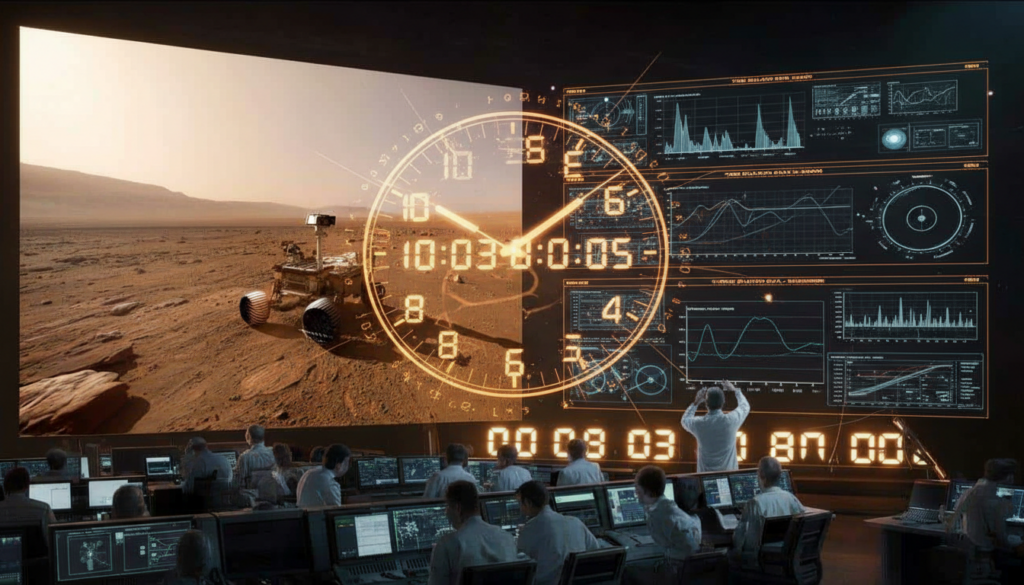
No one is freaking out. They’ve been waiting for this.
Albert Einstein said that time bends, stretches, and curls around speed and gravity. For a long time, that was just a theory to most of us, like a game on a blackboard. Now that ultra-precise atomic clocks are ticking away on and around Mars, the Red Planet is quietly confirming what Einstein drew more than a hundred years ago.

Out there, time doesn’t flow the same way.
Einstein’s strange clock problem hits Mars
The first thing that surprises engineers isn’t how long it takes for radio signals to get from Earth to Mars. That was on every slide.
They are shocked to learn that the rover’s clock is slowly falling behind Earth time after spending months on the surface of Mars. Not because it’s broken, but because the universe says so.
In a metaphorical sense, this is where Einstein enters the control room. His general theory of relativity says that clocks move at different speeds depending on how fast they are moving and how much gravity is acting on them. The planet spins at its own speed, and spacecraft move around it very quickly. Putting all of that together, the second on Mars is not the same as the second on Earth anymore.
Compared to the busy city center on Earth, Mars is like a quiet suburb. Less gravity means less pull on space-time.
Now picture that you have put two almost perfect atomic clocks, one on Earth and one on a lander in Jezero Crater. At first, they agree on numbers that don’t make sense. Months go by. The clock on Mars moves by dozens, then hundreds of nanoseconds.
That sounds so small that it’s almost funny. But for science and navigation, this tiny change is like a hairline crack in a bridge. If you don’t pay attention to it, it gets bigger. The Mars Reconnaissance Orbiter, the Perseverance rover, and the Chinese Tianwen-1 mission all depend on timing that is so precise that a few nanoseconds, stacked day after day, start to change paths and make measurements less clear.
Long before anyone thought of putting robots on Mars, Einstein predicted this kind of thing.
In his equations, time is linked to gravity. When gravity is stronger, time moves a little slower; when gravity is weaker, time moves faster. You weigh about a third of what you do on Earth on Mars, and your watch “runs faster” in a strictly relativistic way.
Add speed in orbit to the mix. Spacecraft flying around Mars are in the same relativistic mix as GPS satellites flying around Earth. Engineers already fix for relativity so that your phone doesn’t put you miles away. The twist is that this bending of time is no longer just a philosophical curiosity. For the first time, missions are staying long enough and carrying clocks that are accurate enough. It’s a line in the mission software.
Rethinking missions when your clocks don’t agree
What do you do when a planet has its own time? You begin by teaching your mission how to speak “Martian.”
Teams already have to deal with different time zones on Earth; now they have to deal with “Mars time” too. A sol, or Martian day, is about 40 minutes longer than an Earth day. When you add in relativity, mission planners have to line up three different realities: the solar time on Mars, the time on the spacecraft, and the ultra-stable reference clocks back on Earth.
The key is to set everything to a specific standard and then keep translating. Ground computers compare signals from orbiters, landers, and Earth stations, make adjustments for relativity, and move the clocks so that paths, landings, and data sequences stay in sync.
We already know how bad this can get if the timing is even a little bit off. In 1999, the famous Mars Climate Orbiter was lost because teams using metric and imperial units couldn’t agree on how to convert them. That was a mistake made by a person, not by relativity, but the lesson stuck: small differences can have big effects.
Now think about planning a future landing with people on board. An orbiter sends a signal in real time as a lander falls through the atmosphere. At 16:23:00 “Mars time,” the onboard computer thinks a thruster will burn. Controllers on Earth see that event as 16:23:00 “Earth time” with a few adjustments for relativity. If those changes aren’t done right, a burn could start a tiny bit too soon or too late. That’s the difference between a smooth landing and a “loss of signal” press release at orbital speeds.
The fix looks almost boring on the inside: more math, more calibration, and more updates. But the logic is harsh.
You create a reference time scale for Mars, like a Martian UTC, by combining atomic clocks and long-term measurements. You use Einstein’s equations to explain how time moves on Mars, in low Mars orbit, and back on Earth. Every time a signal is sent, received, or logged, the software changes between them.
This isn’t just for looks. **A shared, relativistic-aware clock system will be needed for any future network of Mars satellites, communication relays, and eventually bases.** Deep down below the simple “12:34 local time” readout in a Mars habitat, an invisible web of corrections will keep the colony in sync with its home planet and the laws of physics.
Living, working, and staying sane on a planet with “wrong” time
For the people who will one day walk on Mars, the physics quickly becomes a daily headache. Not because they’ll be solving math problems every morning, but because their bodies and schedules will be split between two worlds.
During the early rover missions, NASA had teams on Earth live on “Mars time,” which meant that their workday changed by 40 minutes every 24 hours to follow the Martian sunrise. People got tired, their social lives fell apart, and after a few months, most begged to stop.
Now, add this: clocks on Mars will slowly drift away from Earth standards in small ways. The answer is to make routines where settlers mostly trust local time for living and working. At the same time, computers quietly handle the relativistic conversions needed for navigation, communication, and long-distance coordination.

We’ve all been there: that time when you cross time zones and wake up at 3 a.m. and stare at your phone, wondering what time it “really” is. If you stretch that confusion across planets and months, you get the mental part of Einstein’s legacy.
If mission planners make crews think about both Earth and Mars time all the time, they’ll get tired. They’ll need clear rules: one clock for everyday life on Mars and another for talking to Earth. Software and procedures, not willpower, will handle the translation layer.
Let’s be honest: no one really syncs three calendars and two time zones perfectly every day. That messy human behavior meets physics on Mars. Training and tools will have to deal with this and add wide margins, alarms, and automated checks instead of hoping that astronauts will become walking clocks.
The people who are making these systems are already talking like philosophers about time. They know the numbers, but they also feel what it’s like to live off-world on a clock that is slightly different.
One mission engineer told me, “Einstein wasn’t just right in a textbook sense; he’s now sitting in every line of code we write for Mars.” “You can’t land, steer, or talk to your crew without getting permission from his equations.”
Settlers will use local Mars time as their main reference. Wake-up calls, work shifts, and EVA schedules will all be based on the
Martian day and seasons.
Most of the time, relativistic corrections will be hidden in navigation software, satellite coordination, and data timestamps that connect Mars to Earth.
There will be a “time literacy” module in future crew training. This isn’t to make astronauts into physicists, but to help them understand why their watch, their ship, and Mission Control never fully agree.
Einstein’s quiet revolution is now happening on Mars
It’s strange how normal all of this seems when you watch it happen on a console. No slow motion that makes things look dramatic, and no time warps like in sci-fi. Just clocks that don’t agree in the ninth decimal place, and teams slowly figuring out that those decimals are what matter.
*Mars is showing us that time is different for each world, based on where you are and what you’re doing. For people born in a Martian city in the future, Earth time may seem as strange as “Greenwich Mean Time” did to sailors hundreds of years ago. Their school days, festivals, and lunch breaks will all follow a sun that rises a little later each sol and a clock that is different from the one we use here.
From that quiet drift comes a bigger question: who gets to decide what “universal” time is when we don’t live under the same sky? Space agencies and physicists in labs are writing the rules for now. At some point, people on Mars might want something that is more like their own lives than those on Earth. The conflict between scientific accuracy and cultural identity will transition from calendars and holidays to the realm of physics.
Einstein probably didn’t think that people would fight over time zones between planets, but his theory made that possible. Mars is proving, nanosecond by nanosecond, that his description of the universe is correct. This means we have to change some of our most basic beliefs, like that “now” means the same thing for everyone and that a second is a second anywhere. Once those ideas break down, a lot of other things start to happen.
When you think about dust storms, power margins, crew fatigue, and how time itself changes across the system, future mission briefs will sound very poetic. Kids might learn that going to Mars isn’t just a long trip; it’s also a trip into a different way of living.
At that point, this early time with rovers, robots, and hard-to-understand time changes will look like a rough first draft. Before chronometers, sailors had to learn how to tell time using simple clocks. Now, we’re figuring out how to keep time between planets. The Red Planet, with its long days and strange effects of relativity, is slowly becoming our first place to test living with many kinds of “now” at once.
| Key point | Detail | Value for the reader |
|---|---|---|
| Einstein predicted time would flow differently in other gravity fields | Mars’ weaker gravity and orbital speeds cause measurable clock drift compared with Earth | Gives context to why Mars isn’t just “far away” but runs on a different physical rhythm |
| Missions must adapt with new time standards | Relativistic corrections, Mars-specific time scales and precise clocks are now built into software | Shows how space exploration is changing at a practical, engineering level |
| Future crews will live on local Martian time | Daily life will follow the Martian sol while computers translate between planets | Helps imagine what human life on Mars will actually feel like, beyond the headlines |
Questions and Answers:
Is it really true that time moves differently on Mars?Yes. General relativity (which says that gravity is weaker) and special relativity (which says that orbital speeds are different) together predict a small but measurable difference in how clocks tick on Mars compared to Earth. High-precision instruments already have to take this into account.
Does that mean astronauts on Mars will get older faster or slower?The effect on how people age is very small, much smaller than normal biological differences. Time moves a little faster on Mars than it does on Earth, but the difference over a person’s lifetime would be very small.
How is this different from the day on Mars, which is 40 minutes longer?The longer sol is just a problem with rotation: Mars spins more slowly. On top of that, relativistic time differences change how very accurate clocks compare between planets, even if you don’t think about how long the days are.
Will we need Einstein’s equations to navigate on Mars like we do with GPS?Of course. Like GPS on Earth, a future Martian navigation network will have to use Einstein’s formulas for timing and positioning from the start.
Could Mars make its own system for keeping track of time?Very likely. In a way, it already has: space agencies use local solar time and Mars-specific time scales for landing sites. As settlements grow, those customs could turn into a unique Martian time culture that is partly separate from Earth.