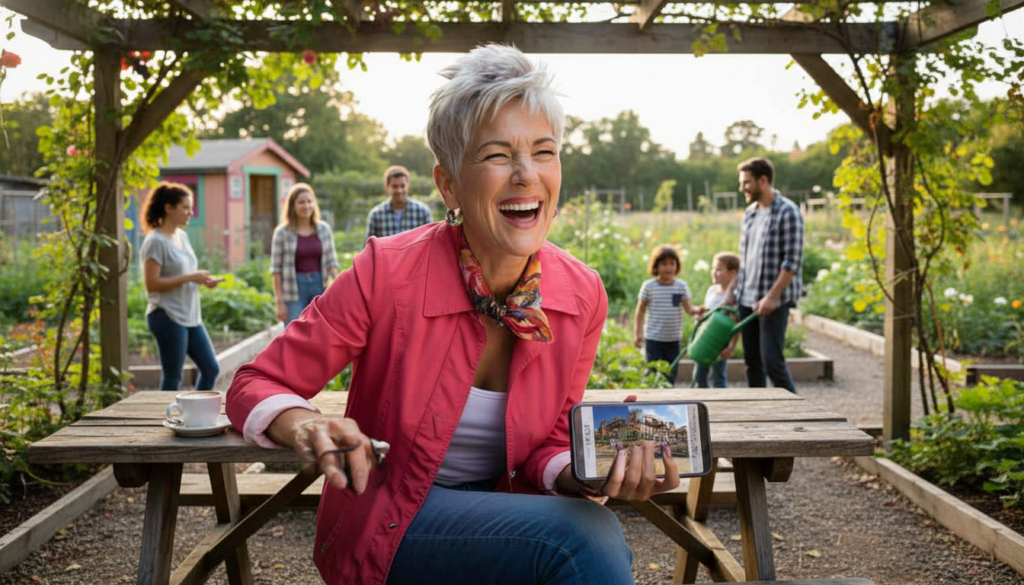
The woman in the red jacket was 72 years old. I didn’t know that part until later. The first thing I noticed was how she threw her head back when she laughed, right in the middle of the supermarket aisle, as if there weren’t three people trying to get past her cart. She had short, sharp silver hair and bright blue sneakers on. She was holding a phone that showed pictures from her most recent solo trip. A teen behind her said to his friend, “Bro, I hope I’m like that when I’m old.” I could hear him just enough to understand.
That sentence stayed in the air longer than the sound of the fridge doors shutting. We talk a lot about “aging well,” but not very often about aging in a way that makes other people admire you without saying anything.
It’s not about looking younger. It’s about staying clearly and stubbornly alive.
1. Keep making plans that make you wear real shoes
At 70, comfort is very appealing. The couch, the remote, and the routine that you know and love that doesn’t ask much of you. The issue is that comfort gradually diminishes your world without uttering a sound. The people we point at and say, “I hope I’m like that at their age,” are almost always the ones who still have dates on their calendars that could go wrong. A train to get. A meal with a stranger. Tickets to something that ends after 10 p.m. Plans that need the right shoes also have a funny way of keeping you awake.
A reader once told me about Pierre, her 79-year-old neighbor. He puts on his old leather boots and takes the 7:32 bus to the city center every first Wednesday of the month. The same group of men and women meet at the same café and sit at the same table. They met decades ago at work and now bring each other news, gossip, and pictures of their grandchildren. The bus broke down on a Wednesday. No one would have blamed him for going back.
Instead, he called a cab. He said, “What am I going to do, miss a whole month of my life because of a bus?” Younger people will lean in when they read that.
This makes sense. When you stop making plans that take you outside of your home, your world changes to fit what is easy, not what is important. People don’t invite you as much because you don’t go out as much. Your body works less well when you don’t move around as much. Your stories get smaller and smaller until they are just TV shows and doctor visits.
The people we quietly admire at 70 don’t always have lives that are full of excitement. They keep putting themselves in danger for little, everyday adventures. A show in the park. A class for the whole community. Lunch on Sunday all over town. They still act like the next good thing could be waiting for them outside, not just on a screen.
2. Keep learning something that makes you feel a little silly.
Being bad at something in front of other people takes a lot of courage. At 70, pride can tell you that you have the right to never feel that way again. But older adults who shine that light and are curious almost always have one thing they are still learning in a strange way. Languages. Playing the drums. Changes on TikTok. Yes, really.
Choose one thing that makes you think, “Isn’t this for kids?” and walk straight toward it. The point isn’t to be the best. You can still surprise yourself if you stay on the side of life.
Elena, who is 71 years old, signed up for a beginner’s hip-hop class that her granddaughter found on Facebook. She wore the wrong shoes, forgot half the moves, and said she was sorry every five minutes the first week. People were high-fiving her when she nailed a step by the third week. One teen said, “I only come because I want to dance like you when I’m older.”
Elena still gets the dance moves wrong. She still finds it funny. But now people film her on their phones and send it to their friends with a message like, “I want her energy when I’m 70.”
There is a deeper process going on. When you learn something new, your brain has to make new pathways instead of just using the ones it already has. It makes things less stiff, not just in your body or your thoughts, but also in how you see yourself. You can still grow if you’re still a beginner at 70.
Let’s be honest: no one really does this every day. Life gets in the way, your joints hurt, and you lose motivation. That’s okay. The important thing is that the phrase “I can’t learn things anymore” is quietly replaced by “I’m still the kind of person who tries” in the story you tell about yourself.
3. Keep being a friend, not just “the older one.”
One sad thing about being 70 is that your circle of friends gets smaller. People move, partners die, kids get busy, and energy runs low. It’s easy to want to pull away and accept that being alone is just part of the deal. The elders we look up to don’t deny pain, but they also don’t give in to it. They send a text first. They say to drink coffee. They remember birthdays and send memes, some of which are very inappropriate.
They want to be seen as full friends, not just “the wise elder” or “the grandparent on call.” That insistence has a sense of dignity. There is also happiness.
At a loud birthday dinner for a woman turning 30, I met a 76-year-old man named Hassan. He sat between two software engineers who were half his age. They hadn’t invited the older man; they had invited their friend. Hassan told me later that he promised himself ten years ago that he would never turn down a social invitation just because he would be the oldest person there.
That rule has led him to rooftop bars, poetry slams, and one very loud rock concert that he didn’t like but still laughs about. He has a lot of groups on WhatsApp, like “Pizza Fridays,” “Neighbors,” and “Book Club.” At 76, that doesn’t happen by chance. He keeps treating connection like a living thing that needs water, not a relic to mourn.

People of all ages are drawn to being emotionally generous. Not all of the 70-year-olds who make us say “I hope I’m like that” are the funniest or the most talkative. They are the ones who don’t rush to listen, who don’t always compare everything to “how it used to be,” and who are still interested in the strange little lives of other people.
They ask more questions. They send out links. They celebrate someone else’s promotion, breakup, or move to a new house as if their own future is still growing along with it. That stance changes them from people who watch life to people who take part in it, and you can see the difference in every room they walk into.
4. Keep moving your body like it’s yours, not your birth certificate’s.
At 70, moving around often means making a deal. Knees hurt, backs hurt, and doctors use words like “age-related” a lot. The quietly impressive 70-year-olds don’t agree that the only goal is to avoid pain. They move for fun, not just to keep things running. That can seem humble: walking around the block every day with a podcast, gardening on your hands and knees, and stretching for ten minutes before bed.
The magic isn’t in what you do; it’s in the choice to see your body as a home, not just a machine you use to get to appointments.
Denise, a woman I spoke to, swears by what she calls her “stubborn walk.” She walks the same two-mile loop every morning at 8:30, no matter what the weather is like. Some days she runs fast, some days she shuffles, and some days she only gets halfway there. Once, a neighbor told her to skip it because it was too hot. She smiled and said, “If I stop once, I’ll stop again.” I will need a map to get back after that.
Her grandkids sometimes ride scooters with her, and other times they don’t. Every holiday, they see a 73-year-old woman putting on her shoes as if it were as important as brushing her teeth. That picture stays in kids’ minds much longer than any talk about “staying healthy.”
We all know what it’s like to feel like the couch is pulling us in and not wanting to move. Your muscles and balance don’t care how old you are; they only respond to how much you use them. Most of the 70-year-olds people look up to are not marathon runners. They keep saying yes to stairs, dancing a little even when they can’t keep up, and carrying their own bags as long as they can do it safely.
They think that moving around every day is a way to vote for the person they will be in three, five, or ten years. Not superhuman. Just there, no matter what.
5. Keep caring about how you look in a way that feels like fun
Vanity and vitality are very close to each other. People who are 70 and still look good haven’t given up on their looks, but they also aren’t fighting a losing battle against time. They see style as a way to respect themselves and, to be honest, as a way to have fun. A scarf that stands out. A new haircut that looks like something. A shirt that isn’t the same beige color they’ve been buying for twenty years.
You can tell by the little things: clean shoes, nails that aren’t chipped, and clothes that fit your body today instead of a memory of one. It’s not so much about being elegant as it is about not disappearing.
A common mistake is to mix up “I’m old” with “I’m invisible.” That idea slowly creeps in. You stop buying new clothes because you don’t see the point. You choose what’s on top of the drawer by default. You joke about being a “walking cardigan,” but deep down you know you’ve given up. A true statement that shows you care: a lot of people do this after a health scare or a death, and that’s okay.
The change happens when you decide that the little effort is still worth it. You don’t need to change everything about yourself. Sometimes a small change, like changing the color of your lips, getting better glasses, or wearing shoes with a little personality, can make a big difference. You see yourself in the mirror again, but in a different way.
Maria, who is 70, said, “Every time I buy something a little crazy, my kids roll their eyes, and then three minutes later they say, ‘Actually, that looks great.'” I’m not dressing up for them. When I look in a window and see myself, I want to think, “She’s still in there.”
- Pick one thing that makes you feel more like yourself than like an old person.
- Every season, change one thing, like your glasses, shoes, or a favorite piece of clothing.
- Keep clothes that fit well now, not ones that you “might get back into.”
- Take someone you trust with you to the store and tell them to not buy anything that looks like a “retirement catalog.”
- Let yourself have one thing that is completely useless and only makes you happy.
6. Don’t always start your stories with “Back when I was your age.”
We use stories to measure a life. By the time you’re 70, you probably have enough to fill books. The question is which ones you keep telling. People get excited when older people can talk about their past without living in it all the time. They’ll talk about the crazy road trip they took in the 1970s and then switch gears and talk about the podcast they found last week.
They have things to say about the news, music, and the strange new café that opened on the corner. Their timeline goes beyond 1985. It goes on until today.
| Key point | Detail | Value for the reader |
|---|---|---|
| Keep making plans | Say yes to outings that require effort and real shoes | Prevents your world from quietly shrinking |
| Stay a beginner | Learn something new that feels slightly uncomfortable | Keeps your brain flexible and your identity open |
| Move with intent | Daily, realistic movement tailored to your body | Protects independence and radiates vitality |
Questions and Answers:
What if I’m not healthy at 70?Use the body you have, not the one you want. Small, regular actions like five-minute walks, chair exercises, and short social visits still send the same strong message: you are still living your life.
Isn’t it too late to pick up new hobbies?Not at all. Being older is actually better because you know yourself better, aren’t as proud of being a beginner, and have more stories to share with what you’re learning.
What if I don’t have a lot of friends?Start by making small connections, like talking to your neighbors, joining a local group, volunteering, or taking a class. At 70, relationships often grow from doing things together, not from knowing each other for a long time.
Do I have to always be happy?No. People respect you when you are honest about your pain, grief, or anger. The important thing is not to let those be the only stories you tell about your life now.
How can I stop feeling like a burden?Keep giving in ways that fit your energy level. For example, you could share your skills, listen, cook sometimes, or babysit if you like it. When you see yourself as a resource instead of a problem, it changes how other people see you and how you see yourself.