The woman in front of me at the market frowned at three labels that were almost the same: cauliflower, broccoli, and cabbage.
The vendor said, “Same family,” as he tossed a green head from one hand to the other. “Same plant, but dressed up differently.” She laughed it off, but I saw the woman’s eyes get bigger.
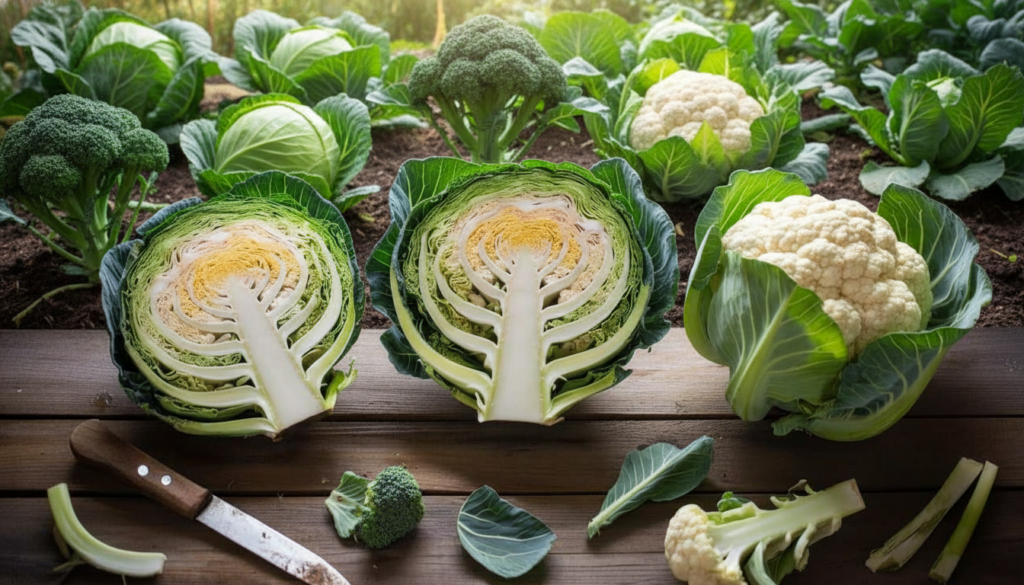
You can’t unsee it once you see it. Those white clouds that look like cauliflower. The green trees of broccoli that branch out. The leaves of cabbage are stacked on top of each other. Brassica oleracea is the same plant, but it comes in different shapes.
We’ve all been there: that moment when something completely normal suddenly seems like a magic trick you’ve been missing your whole life.
And this little vegetable twist makes more changes than you might think.
One plant, three “characters” on your plate
Take a break for ten seconds the next time you walk through the produce aisle.
Look at the broccoli, cauliflower, and cabbage like you would a picture of your family. The same basic shape, strong stems, and waxy edges on the leaves. The only thing that changes is the personality.
Cauliflower is an introvert. It’s small, pale, and stays close to itself.
Broccoli grows up and out, like it’s had just the right amount of coffee.
Cabbage curls in on itself, hiding secrets in a hundred layers.
Botanists don’t care about all this drama. From their point of view, these are just different kinds of the same wild coastal plant that used to grow on cliffs facing the Atlantic wind.
Take a moment to think about that.
People began with just one scruffy wild plant that grew on rocky shores from Spain to the UK. For hundreds of years, farmers pushed it this way and that.
Can you save the plant with bigger leaves? You’re getting closer to cabbage.
Do you like the ones with thick stems and tight buds? That is the ancestor of broccoli.
Keep picking the flower heads that are the biggest and densest? The stage is set for cauliflower.
One type of animal, but many different interests. It’s like having one playlist and getting rap, jazz, and classical music depending on what you put on repeat.

These vegetables are all part of the species **Brassica oleracea**, which is known for how easily it bends to human selection.
You can change the plant’s future by changing what part you focus on.
People wanted more leaves on cabbage. They accidentally made immature flower clusters the main attraction with broccoli and cauliflower.
We made the choices, season after season, by saving seeds from the plants we liked best. The plant didn’t “decide” anything.
This is evolution on fast forward, thanks to hungry people and stubborn gardeners.
You can see the pattern in these three, and then you start to see their relatives all over the kitchen.
Cooking like a plant whisperer instead of following a recipe
The fun part is that once you know they’re the same species, you stop cooking them like they’re strangers.
You start to think about how plants are put together instead of what the recipes are called.
Cabbage with leaves? Those are the plant’s big solar panels. They work well for slow braises, crunchy salads, and stuffed rolls.
Florets of broccoli? Little flower buds that love quick heat, like stir-fries, roasting, and quick steaming.
Curds of cauliflower? Buds that are tightly packed together and act like starch: mash them, rice them, or roast them until they turn brown.
Begin with the part of the plant you are holding. Then choose: do I want it to be crunchy, soft, or charred?
Imagine it’s Tuesday night and you’re tired, a little hungry, and not in the mood for a hard recipe.
You open the fridge and see half a cabbage, two broccoli stems, and a lonely quarter of cauliflower.
Most people would just sigh and say, “random leftovers.” A person who knows they’re all Brassica oleracea sees one flexible base.
Cut the broccoli and cauliflower into small pieces and the cabbage into thin slices. Toss everything with oil, salt, and garlic, then put it in a hot oven.
You can have a tray of roasted “one-plant salad” that tastes like you planned it all along in 15 to 20 minutes.
Let’s be honest: no one does this every day. But on the days you do, dinner feels very smart.
This small kitchen trick hides a bigger change.
When you think of plant parts, you waste less because you don’t have to follow a strict recipe for every vegetable.
Stems of broccoli? Cut them up and peel them like a crunchy kohlrabi.
Cabbage cores? Cut them very thin and fry them until the edges turn brown.
Leaves of cauliflower? They turn into crunchy, nutty chips when roasted.
You are no longer at war with “too many vegetables.” You are speaking the plant’s language, which is leaf, stem, and bud.
The little rebellion of being aware of what you’re eating
Want a simple way to make this happen in your kitchen?
The next time you buy one of the three—cauliflower, broccoli, or cabbage—make sure to buy a second one from the group.
Then, at home, put them in a row on the counter.
Touch them. Cut each one in half and look inside. Look for the thick stem that is shared, the branching ribs, and the tight clusters of buds or leaves.
Once a week, cook them the same way: either roast them, steam them, or shred them and add them to a salad. Let your tongue do the work of comparing.

We all learned that recipes are the most important thing in the kitchen and that vegetables should just do what they’re told.
That’s why a lot of people freak out when they get a CSA box or when the cabbage in the back of the fridge starts to wilt.
There’s guilt, waste, and a kind of quiet shame: “I should know what to do with this.”
You’re not the only one. No one taught us to think of broccoli, cauliflower, and cabbage as a set of tools that can be used in many ways.
Start by making the rules less strict. In soups, stir-fries, or oven dishes, you can switch them out for each other, especially since everything will be cooked down anyway. There won’t be any big changes, but you might like it.
People turned one wild plant into a whole family of foods that people buy at the store.
Learning that story changes not only how you cook, but also how you think about food, power, and your small part in evolution.
Try meals with the same type of animal.
Choose two of the three and cook them the same way to see how they are alike.
Use the whole plant.
- Don’t throw away any part of the plant; treat it as if it could be useful.
- Think about what something does, not what it is called.
- Do you need crunch, bulk, or softness? Pick the Brassica that works best for the job.
Change based on mood - Cabbage is good for comfort food, broccoli is good for quick meals, and cauliflower is good for “fake starch.”
- At the table, talk about it.
- Telling the story of the one plant makes a simple side dish stand out.
A small vegetable, a big story
When you realize that cauliflower, broccoli, and cabbage are all the same plant in different costumes, the food world seems less rigid.
You begin to see other “families” hiding in plain sight, like all the different kinds of lettuce, the many shapes of tomatoes, and the weird cousins of carrots and parsnips.
Food stops being just stuff on shelves and starts to look like living history—decisions made by thousands of people over hundreds of years.
That might sound a little too fancy for a tray of roasted vegetables.
But as soon as you say “these three are actually the same plant,” something changes at the table. Curiosity creeps in.
Someone pokes the broccoli. Someone else wants to know what else is “secretly the same.”
After that, you’re not just feeding yourself anymore. You’re part of a long conversation between people and plants.
A talk that began on a windy cliff, with a tough little wild Brassica looking out over the sea.
| Key point | Detail | Value for the reader |
|---|---|---|
| Same species | Cauliflower, broccoli and cabbage are all forms of Brassica oleracea | Changes how you see and combine everyday vegetables |
| Think by plant parts | Leaf, stem, bud structure explains how they cook and taste | Makes it easier to improvise meals and cut food waste |
| Flexible cooking | You can often swap one for another in many recipes | Less stress in the kitchen, more freedom and creativity |
Frequently Asked Questions:
Is it true that broccoli, cauliflower, and cabbage are all the same plant?Brassica oleracea is the name of the plant that all of these come from. Over hundreds of years, people have bred it for different parts: leaves for cabbage, buds for broccoli, and cauliflower.
Can I use cauliflower instead of broccoli in recipes?Yes, a lot of the time, especially in soups, roasts, gratins, and curries where everything cooks all the way through. Because cauliflower is denser, you just need to change the cooking time.
Is one of the three better for you than the others?All three are high in fiber, vitamin C, and plant chemicals that protect cells. There are differences, but for most people, the best one is the one they eat the most.
Are kale and Brussels sprouts also the same type of plant?Yes. Brassica oleracea is also the name for kale, Brussels sprouts, kohlrabi, and a few other plants. They are all bred for different traits, like leaves, mini-cabbage buds, or swollen stems.
Does this change the way I should cook them?It gives you more freedom: think of them as interchangeable parts of a toolkit and focus on the part of the plant you’re cooking—leaf, stem, or bud—and the texture you want.