The water in the Barents Sea looks flat and safe on a grey morning, like dull metal under a low sky. The air smells like salt and fuel oil, and a few gulls fly around slowly. You’d swear nothing is moving on the horizon. The sonar screen then shakes. A queue. A blur. Something deep down just crossed the operator’s field at a speed that shouldn’t be underwater. No one says anything for a second. Someone says quietly, half joking and half worried, “That has to be Papa.”
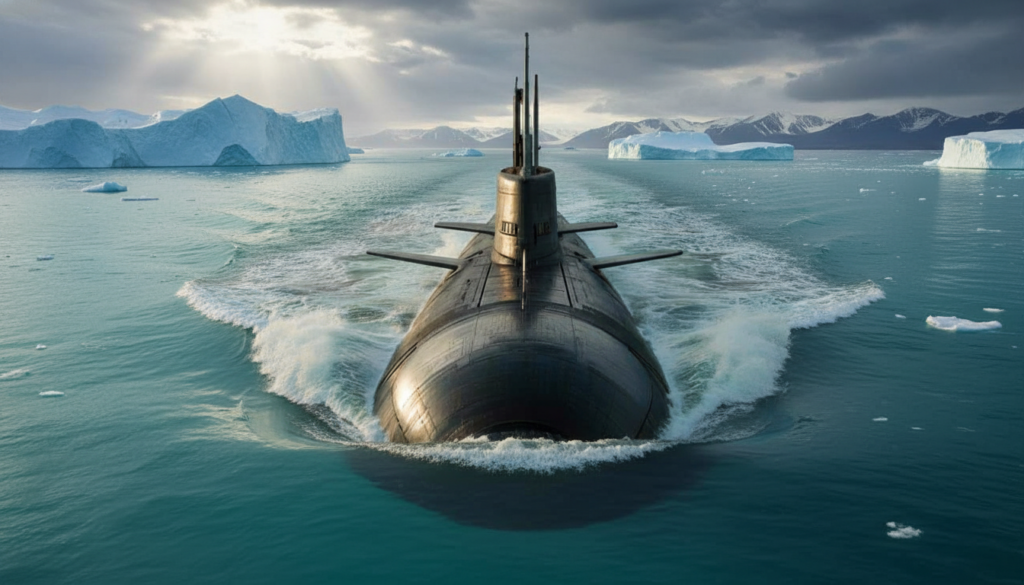
They’re talking about one submarine, a ghost from the Cold War, that was made to outrun torpedoes and fear itself.
The K-222 was the fastest nuclear submarine ever built by the Soviet Union.

The submarine that broke the speed limit
K-222 was born in the 1960s, when the US and the Soviet Union were racing each other deep in the ocean. It was called Project 661 on paper. Sailors called it the “Golden Fish” because its titanium hull was so rare and expensive that it might as well have been made of treasure.
This machine wasn’t made to go quietly. It was made to break through the limits of what a submarine could do.
In December 1970, off the northern coast of the USSR, K-222 did something that no other combat submarine has officially done since then. It went about 44.7 knots underwater, which is about 83 km/h. That’s the speed of a highway, but below the surface.
The crew could feel the pressure in their chests. The hull shook like it was alive. Later, sailors said that when the boat was at full power, it shook like it was trying to break free from the sea itself. They were riding on a torpedo that was as big as a ten-story building.
There was no mistake about this speed. The Soviet Navy wanted a hunter that could catch up with NATO aircraft carriers and get away from any torpedoes. Designers used a double reactor setup and a full titanium hull, which is stronger and lighter than steel, to get there. The other side was terrible: the boat cost a lot of money, was hard to build, and made a lot of noise when it sped up.
K-222 could win any race. It was a different story to stay hidden.
Why the fastest submarine never became the standard for the fleet
The recipe for that record-breaking dash was very extreme. Two nuclear reactors that used pressurised water sent steam to strong turbines, which turned each turn into raw thrust. The hull was smooth and shaped like a torpedo. It was wrapped in titanium panels that were welded together in huge, special places because normal shipyards couldn’t handle the material.
Engineers pushed hydrodynamics, propeller design, and reactor output to their limits to get past 40 knots. They were playing on the edge of what the metal and the people inside could handle.
But the real story is in the numbers that no one wants to talk about. Some people in the Soviet Union joked that they could have built a small surface fleet for the same amount of money as K-222. It was very important to get titanium, shape it, and weld it together. They trained whole teams to work with the rare metal.
Taking care of things was a nightmare. One small repair could require complicated steps, hard-to-find tools, and workers with special skills to be flown in.The “Golden Fish” on a navy spreadsheet looked more like a golden hole in the ground.
There was another problem, and all the sonar operators in the North Atlantic knew it. K-222 was loud when it went fast. The fast-spinning machines and rushing water made it sound like an underwater siren. NATO crews said they could hear the Soviet speedster from a long way off.
Speed gave submarines more range and excitement, but stealth is what keeps them alive. In the cold logic of submarine warfare, a slower boat that stays hidden is better than a fast boat that makes noise like a goods train.
What we can learn from this “supercar” from the Cold War
You can picture K-222 better if you think of it as an underwater hypercar. You don’t see fleets of Bugattis delivering mail, even though they can fly past anything on the highway. This titanium monster is the same way. It was a test of the idea. A great “we can do this” moment.

Designers showed that you could use nuclear power, titanium, and daring hydrodynamics to make something that no one else had. They also showed why most navies don’t.
A lot of us really like these extremes. The biggest, the fastest, and the deepest. But K-222’s story has a quiet lesson in it. Military planners knew they needed boats that were less expensive to keep up, easier to build, and much quieter. The next generations of Soviet submarines, and later Russian ones, were more focused on being stealthy and reliable than on being fast.
Let’s be honest: no one really wants to ride in an underwater version of a Formula 1 car on a long, dangerous patrol.
K-222 still had an effect on the people who worked with it and against it.
Admiral Vladimir Chernavin, who later led the Soviet Navy, is said to have called it “a triumph of technology and a headache for logisticians,” which is almost too perfect.
| Main Point | Detail |
|---|---|
| Unmatched speed | 44.7 knots underwater, a record still admired by submarine enthusiasts |
| Titanium hull | Extremely strong, rust-resistant, and difficult to work with—over-engineered |
| Short service life | Launched in 1969, retired by the 1980s—a brief yet impactful Cold War presence |
| Naval “myth status” | Fewer real missions but surrounded by stories, rumours, and speculation |
| Legacy of lessons | Changed perceptions of noise, cost, and underwater “performance” |
| Speed record | Shrouded in mystery and memory, with ongoing intrigue |
K-222 is no longer here. They cut up the famous titanium plates, scrapped the hull, and took the fuel out of the reactors. You might be able to see the ghost outlines of a Russian shipyard on a satellite image of the area. But if you talk to people who used to be submariners, they’ll still tell you stories about the “Golden Fish.”
When veterans talk about a machine that scared them and fascinated them at the same time, it’s strange how tender it is.
The paradox is easy to understand and human. We want records. We like to say things like “fastest ever,” “first in history,” and “nobody has done this since.” At the same time, we quietly move toward what works every day: the steady, quiet boats that come and go from port without making news. The legend is made by speed. Endurance makes the world go round.
We’ve all been there, when the crazy, shiny choice calls to us and a quieter voice tells us that maybe, just maybe, the smart choice is the one that wins in the end.
K-222 is right at that point. A submarine that was made to be faster than everything else, retired early, and is still talked about 50 years later. The fastest nuclear submarine ever built taught navies that speed isn’t the only thing that matters.
Somewhere under the waves, in the black water between sonar pings, that lesson still echoes: not every record-breaker is meant to last, but some are meant to be remembered.
Main pointDetail:
What the reader gets out of it
Experimental titanium hull, dual reactors, and high cost for the “Golden Fish” designThis shows how far engineers went to make things go faster underwater.
44.7 knots (about 83 km/h) submerged in tests in 1970 set a record.Helps explain why naval fans are still interested in K-222
Legacy and choicesShort lifespan, loud at high speeds, and a lot of maintenance workExplains why modern submarines put stealth ahead of speed
Questions and Answers:
How fast was the K-222 compared to other subs?
Most modern nuclear attack submarines can go over 30 knots when they are underwater. K-222 went almost 45 knots, which is faster than even today’s boats can go.
What made the K-222 the “Golden Fish”?
The nickname came from the fact that the ship’s titanium hull made it very expensive, almost like it was made of gold instead of steel.
Did K-222 really fight in real battles?
There are no known direct combat actions. During the Cold War, it was mostly used for testing and as a strong symbol, with only a few operational deployments.
Why didn’t the Soviet Navy make more submarines like the K-222?
Planners decided that it was not possible to repeat the design on a large scale because of the high costs, technical difficulties, and loud noise levels at high speeds.
Is there a submarine today that can go faster than K-222?
No, officially. There are rumours about other experimental boats, but K-222 is still the fastest nuclear submarine ever built.