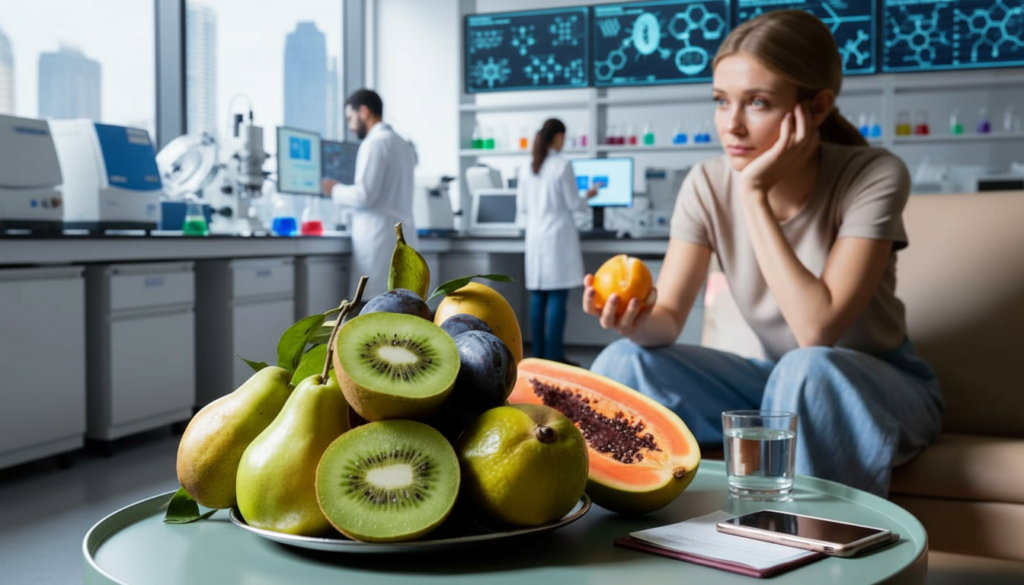
There was a faint smell of disinfectant and overripe bananas in the waiting room. A young woman sat hunched over her phone, her belly in one hand and a half-eaten tangerine in the other. She looked at the peel and then at the doctor’s door, as if she thought it would swing open and tell her if this little bright fruit was helping her or making things worse without her knowing.
A poster on the wall about the “Mediterranean diet” had a basket of shiny figs and apples. No one was paying attention to it. People were too busy scrolling, drinking coffee from paper cups, or trying not to think about the boring cramps that brought them there.
In their intestines, something small was going on between all those oranges and apples.

No one in the room knew that the fruits might be quietly guiding their stomach’s next move.
Fruits that help your gut move: not just “fibre”
Gastroenterologists are beginning to say it out loud: not all fruits act the same way when they get into your stomach.
They all seem nice on paper. Vitamins, water, fibre, and bright colours that could sell any health app. But when they get to the long, folded tube of your intestines, some of them tell your smooth muscles to speed up, while others just give them a gentle push.
There is a maze of tiny molecules and shortcuts between your gut cells and your nervous system behind the simple idea that “fibre is good for digestion.”
And these facts are slowly changing how experts talk about constipation, diarrhoea, and the everyday bloating that people think is “just my stomach.”
For example, look at kiwi. Not too long ago, it was just that fuzzy green fruit you cut up and put on yoghurt. Now, it is often seen at gastroenterology conferences as a gentle, natural alternative to or companion for traditional laxatives in some patients.
Researchers in New Zealand, Japan, and Spain have all found similar things: eating two to three green kiwis a day can help people with constipation go to the toilet more often, without the harsh urgency of pills. People say that ‘easier passage’ and less need to strain are good things, which may seem like a small detail until you’ve spent months timing your mornings around the bathroom.
The interesting thing is not just that it “works.” That’s how it works.
Researchers looking into the effects of kiwi say that the story goes well beyond just the fibre content. Inside that bright green flesh is a mix of soluble fibre that holds water, tiny seeds that add weight, and bioactive compounds that seem to affect gut receptors.
Some of these molecules, such as actinidin (an enzyme found in kiwi), may have a small effect on how quickly food breaks down and how the muscles in the gut contract. Some people might be giving their gut bacteria very specific types of food that release gases and short-chain fatty acids, which irritate the nerves that line the intestinal wall.
A more complex idea is coming to light: fruit isn’t just roughage that goes through. It’s a slow-release message that sends biochemical signals that can either tell your gut to get moving or to calm down and take its time.
How to “program” your motility with fruit: small changes every day
Gastrointestinal teams that follow patients for months often suggest one simple, testable change: change the fruit, not the whole life.
Instead of saying “eat more fibre,” they’ll tell someone who is always tired to do a two-week experiment with certain fruits that are known to help with motility. That usually means adding two kiwis after breakfast or a ripe pear at the same time every night, while keeping the rest of the diet pretty stable.
The goal is to send the gut a steady biochemical signal every day, like training a sleepy muscle to expect a wake-up call at a certain time.
It’s not as dramatic as a detox, and it lasts longer in real life.
Researchers are starting to narrow down the list of foods that can help your gut move faster: kiwi, prunes, ripe pears, and sometimes papaya. Each of these has its own set of sorbitol, fibres, and plant chemicals that seem to help things move.
On the other hand, people with loose stools or irritable bowel patterns often feel better when they cut back on certain fruits that ferment quickly or work almost too well, like large amounts of mango or watermelon in a sensitive gut.
We’ve all been there: you blame “something I ate” without realising it could be the third giant bowl of grapes in two days, which is quietly speeding things up.
Experts agree on one reassuring point: the goal is not to make a perfect fruit schedule for life. The goal is to find out how your own motility reacts.
A doctor from Lyon who specialises in digestion summed it up in a recent webinar:

“People see fruits as snacks that don’t have any flavour,” she said. “But your gut reads them like short letters. Some people say “speed up,” some say “slow down a little,” and some don’t say anything at all. You stop feeling so powerless once you know which is which for your body.
To make that experiment less abstract, doctors often suggest a simple “fruit toolbox”:
The Silent Helpers: Fruits That Aid Digestion
Some fruits have a quiet yet effective way of supporting our digestive system. These natural wonders, packed with enzymes, fibre, and sorbitol, work gently to enhance bowel movements and digestion. Let’s explore how these fruits can help.
Fruits for Improved Bowel Movements
| Fruit | Benefit |
|---|---|
| Kiwi (Green) | Helps promote regular bowel movements with natural enzymes and fibre. |
| Prunes | Rich in sorbitol, small but effective in improving bowel frequency. |
| Pears | Soft fibre and sorbitol in ripe pears aid digestion, especially with skin. |
Fruits for Better Digestion
| Fruit | Benefit |
|---|---|
| Papaya | Contains enzymes, water, and fibre to support digestion and bowel transit. |
| Bananas | Green bananas bind stools, while ripe bananas soften them for easier digestion. |
The Quiet Chemistry: These fruits may not scream for attention, but their gentle chemistry speaks volumes for your gut health. Incorporating them into your diet can help maintain a balanced and efficient digestive system.
Scientists who are tracing those “letters” are making maps of paths that sound like something out of a sci-fi movie. Some sugars in fruit, like sorbitol, pull water into the colon. The extra fluid makes stools softer and bigger, which makes the intestinal wall contract more often.
Then there are polyphenols, which are the colourful plant chemicals found in apples, grapes, and berries. These things don’t just go through; bacteria break them down and send out signals that activate the enteric nervous system, which is a huge network of nerves that is often called your “second brain.”
*It’s like finding out that half of your snack was really a conversation starter with millions of microbes that live in you.
Some fruits also have fermentable fibres that feed bacteria that make short-chain fatty acids, such as butyrate and propionate. These molecules can change how tight or loose your gut barriers are, but they also seem to change how quickly contractions move along the colon, which affects motility.
The same fruit can make one person feel better and another person feel gassy and miserable because the microbes in their bodies are different. This is where the idea of “universal food rules” starts to fall apart.
Let’s be honest: not everyone does this every day, but when people keep a rough log for a week or two, patterns often jump out at them.
Many researchers would love to see more real-world trials that mix these things: certain fruits, microbiome profiles, nerve activity, and how comfortable patients say they are. The pieces are on the table; they just need to be put together.
The growing agreement is simple but strong for now. Some fruits don’t just passively deliver fibre. They are low-key drugs made from plants that have milder effects and softer edges, but they can still move your gut in one direction or another.
That one thought can strangely set you free. When you think of your fruit bowl as a set of levers, you stop seeing bloating and irregularity as fate and start seeing them as things you can work with.
A different way to look at the fruit bowl
At night, the fruit bowl is usually just there as decoration in any kitchen. A few tired apples, a banana with spots, and maybe a clementine that got away and is now waiting for someone to get hungry.
Research on the gastrointestinal system is quietly telling us to look at that bowl in a new way. Not as a moral test of “healthy choices,” but as a mix of small biochemical pushes and pulls that change how our gut works over the next 12 to 24 hours. A piece of fruit will fill you up and keep you hydrated. Another will get you going. A third will soothe and slow down.
The trick is to choose the right one for the day your body is living, not the day someone else thought you should eat it.
That doesn’t mean you have to count every grape or worry about every bite. It means paying attention to what happens when you eat ripe pears every day and what happens when you switch them out for apples every day. What happens to your mornings after three days of eating a lot of watermelon instead of kiwi?
People who start playing this quiet detective game often say that they get more than just better transportation. They feel like they have a little more control over their own pace, both literally and figuratively. Not as much at the mercy of “my bad digestion,” but more like having a slow conversation with it.
Researchers still don’t know a lot about the secret language that fruits and the gut use to talk to each other. This is a very human thing to feel. It gives you room to try things, make mistakes, and tell stories at the kitchen table.
The main pointDetail:
What the reader gets out of it
Certain fruits affect motility.Kiwi, prunes, pears and papaya have effects on how often you go to the toilet and how easy it is to pass.Instead of vague advice like “eat more fibre,” it gives you real options to try.
There are effects other than fibre.Sorbitol, enzymes, and polyphenols affect microbes, gut receptors, and the enteric nervous system.Helps readers understand why different people can feel very different about the same fruit.
Small, consistent habits are important.Two-week experiments with one or two specific fruits at set times show personal patterns.Gives you a realistic, low-stress way to improve your digestion every day
Questions and Answers:
Question 1Which fruits have the most scientific backing for helping with constipation?
Question 2: Can eating too much of a fruit that makes you move cause diarrhoea?
Question 3: Is kiwi really as good as some mild laxatives?
Question 4What if I have IBS and fruits make me feel bloated?
Question 5: How long should I do a fruit-based motility experiment before I make a decision?