On Saturday mornings at the grocery store, the scene is like a quiet lesson. People in their thirties who are in a hurry are in the self-checkout queue, trying to scan, bag and answer Slack while holding onto their tote bags and notifications. A woman in her seventies slowly takes things out of her cart, almost like a ceremony, two registers down. She talks to the cashier, makes a joke about how much tomatoes cost, and then takes a moment to breathe before paying. Her groceries are just like everyone else’s. Not her speed.
You can almost feel how different these two ways of living are. One is optimised, hyper-connected, and always a little late. The other one looks “old-fashioned,” but when she leaves, her shoulders are very calm.
We’re beginning to think something isn’t right.
1. Being slow isn’t being lazy; it’s a way to stay alive.

People in their 60s and 70s have been told for years that they are “slow.” Not fast enough at the ATM, not fast enough to cross the street, not fast enough with technology. No matter what, they kept moving at their own pace. Burnout clinics are now full of people in their forties who have lived the last ten years at 1.5 times the normal speed. The older generation seems stubborn, but what they were fighting for was a basic human pace.
They knew that not every day had to be busy. That walking somewhere could be an activity in and of itself, not just a way to get to the “real” activity. Being slow didn’t mean you were against progress. It was a quiet refusal to always be out of breath.
When you ask people in their seventies about their days, they use different words. “I do things.” “I took my time.” “I went for a walk to check on the river.” It sounds like poetry. In fact, it’s a schedule. A retired bus driver I met in Lyon keeps a handwritten list of things to do: coffee, newspaper, market, nap, and calls. Half of the things on it would never be in an app that helps you get things done. But he sticks to them like a CEO would.
Studies support him. Studies on “time affluence” show that people who feel like they have enough time are happier with their lives, even if they have less money. That “wasted hour” on a bench or the extra twenty minutes cooking from scratch turns out to be an investment.
We tried to hack our way out of this simple logic. People’s bodies don’t get new versions every year like smartphones do. Our nervous system and our attention span both have limits. People who grew up without permanent notifications learned to respect those limits almost without thinking. It’s not putting things off when they say “I’ll do that tomorrow.” It’s about managing energy.
We, on the other hand, tried to fit emails into walks, podcasts into showers, and side jobs into the evenings. If the goal is to do as much as possible, the older pace looks “inefficient.” When the goal changes to staying sane for the long term, their rhythm suddenly looks like a survival guide we laughed off.
2. Relationships last longer than any investment plan
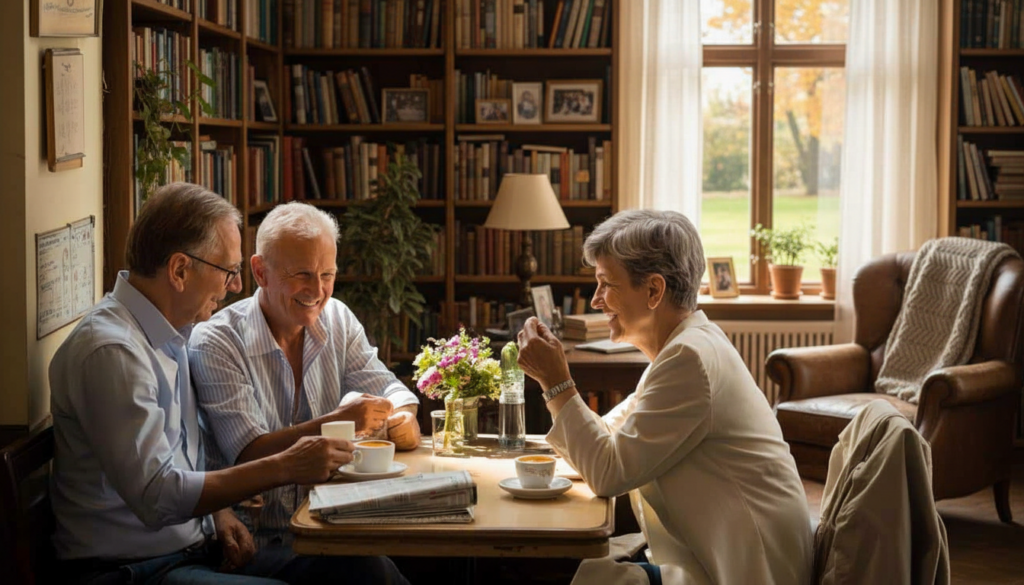
If you ask someone in their 60s what they’re most thankful for, very few will say “my ETF portfolio.” They’ll talk about a neighbour who became family, an old friend who still calls, and cousins who get together every year no matter what. The older generation always put birthdays, funerals, Sunday lunches, and “just popping by” at the top of their list of things to do. People made fun of them for being sentimental. But when life gets tough, no one calls their savings account for help.
They always did the same thing: show up. For coffee, for moving day, and for visits to the hospital. That pattern made a safety net that no app can copy.
There is a woman I met in a coastal town who is a perfect example of this. She is in her late sixties, divorced, and has a small pension. She looks weak on paper. In real life, she’s one of the safest people I know. She plays cards with her neighbours every Thursday. She makes a big pot of soup on Sundays “in case anyone stops by.” Three people came to help her when her boiler blew up last winter: one brought towels, one brought a spare heater, and one brought tea.
We scroll past threads about how lonely people are, and then we forget about them when the next notification comes. She doesn’t look at the studies. She just makes sure she never eats lunch alone on Sundays, and she hasn’t in twenty years.
Our hyper-individualistic ears don’t like the logic. You can control your money and your job, but relationships are messy and hard to predict. Older people have been through a lot of economic ups and downs. They know that a market crash can cost you your job, your status in a reorganisation, or your savings. You don’t often lose a friendship that you’ve been taking care of for years with small, regular acts of kindness. For them, having coffee with a friend is not a treat, it’s work.
For years, we worked to make connections that would lead to opportunities. They quietly built communities to stay alive. Now that we live in a world where adults are “connected but alone,” their insistence on Sunday lunch looks like a stroke of genius.
3. Saying “no” sooner will save you a lifetime of regret.
People in their 60s and 70s have a skill that seems almost cruel when you first see it: they can say “no” in less than three seconds. There was no long excuse or guilt trip, just “No, that doesn’t work for me,” and a soft smile. It’s easy to blame this on age: “You don’t care what people think when you’re older.” They would really tell you they wish they had started a lot sooner.
What seems like bluntness is often the last version of a skill they were too scared to use for years. Time and a few painful stories have made the lines sharper.
A retired nurse told me about her “decade of yes.” In her 40s, she took every extra shift, every family request, and every school volunteer spot. She was proud to be “the reliable one” until she passed out in the hospital hallway after working for 14 hours. Her rules now that she’s in her seventies fit on a post-it note: no late nights, no drama, and no guilt trips. Her kids know that she will listen if they call, but if they try to give her their problems every week, she will gently push back.
Let’s be honest: no one really does this every day. She sometimes takes on too much. The difference is that she has a red line and sticks to it, even if it makes someone sad for a short time.
When you’re young and scared of being left out, boundaries seem mean. For the older generation, being cruel meant saying yes for too long and watching their health, marriage, or sanity break down. Behind every calm “no” is a memory of when they didn’t say it and had to pay for it. They learned that taking care of your time isn’t selfish; it’s what lets you be there for the people and things that really matter.
We are only now starting to call this “burnout prevention” and “emotional labour.” They just say, “I’m too old for this,” and that sentence has more wisdom than a lot of self-help books.
4. The little things you make fun of are the things you really want in life.
If you look closely at people in their seventies, you’ll see something quietly radical: a lot of them follow small, almost boring rituals. Same breakfast. Same path. The same show on TV at 8 p.m. Every Tuesday, I call my brother or sister. It looks like it’s going in circles from the outside. It feels like scaffolding from the inside. *These little things they do over and over again are how they make their days stable, even when loss, illness, or just the feeling of being left behind by a world that moves too fast could easily take over.*
Their rituals don’t have anything to do with getting things done. They’re about anchoring. About knowing that the kettle will still boil at 7:30, no matter what the news says.

A man in his early seventies lives by himself above a bakery. He opens his window every morning, leans on the sill, and watches the street for ten minutes. That’s all. It all started when his wife died and he couldn’t stand being in his empty kitchen. He knows the dog walkers, the parents who take their kids to school, and the cyclist who is always late. He waves, and they wave back. He says that silly little habit got him out of “the grey fog.”
We love “morning routines” that can be hacked, like lemon water, journaling, meditation, and a cold shower. His version is just as accurate, but much more forgiving. It is based on something we forget: doing something over and over again makes you feel like you belong.
People who are older have had time to realise that life isn’t just about the best moments; it’s also about what you do on an average Tuesday. Their daily lives are simple, but they are very strong. They get through pandemics, loss, and economic shocks. They knew that the best way to feel like none of them are special is to try to live every day like it is.
A 79-year-old widower told me, “The day you stop having little habits is the day life starts to feel like waiting.”
Morning anchor: one simple thing you do every day, like having coffee, going for a walk, or looking out the window.
Weekly connection: a call, lunch, or activity that happens every week.
Evening wind-down: a little sign that the day is coming to an end (tea, TV show, stretch).
Something you do every autumn and spring to keep time from getting blurry.
These aren’t fancy. They are, in a quiet way, what a good life is mostly made of.
5. Getting older isn’t a bad thing; it’s just a new game with new rules.
Another thing you can’t help but notice when you really listen to people in their 60s and 70s is that many of them care a lot less about staying young than we do. They’ve come to terms with the fact that their knees hurt and their memory sometimes skips. In return, they have gotten a kind of wide-angle view of life. They don’t freak out when things go wrong. They’ve taken enough detours to know that most of them don’t end up where they want to go.
We talk about “anti-aging” a lot. They laugh and say, “Good luck.” Not because they are angry, but because they have been there. They know that fighting the passage of time takes energy away from living the days they do have.
If you listen to a group of women in their late sixties talk about their bodies, you’ll notice something interesting. There is complaining, but there is also humour and a kind of peace. Stretch marks, scars, and wrinkles turn into stories instead of flaws. One of them told me that she stopped dieting when she realised she had spent 40 summers hating pictures of herself. Now she eats the cake and then dances at the community hall on Friday nights, even though her hips hurt.
Younger people are starting to say things like “pro-aging” and “body neutrality.” People who have already buried friends and partners talk about it in a more direct way: “I woke up again today.” That’s the miracle.
The deeper lesson is almost too easy to understand. Getting older isn’t a mistake. It is the default setting. The older generation accepted that it would happen sooner and changed their expectations accordingly. They changed their minds about wanting to be impressive and instead wanted to be at peace. From counting years to filling days.
We’re slowly catching up as we watch them garden with sore backs, laugh at things they used to worry about, and make plans for five years from now. Not because they think they can’t die, but because they know that as long as there is a next week, there is also a next chance.
So what should we do with these late realisations?
One of the most surprising things about listening to people in their 60s and 70s is how little they talk about “having it all figured out.” They’ll talk about their regrets without holding back, like things they wish they had done differently, loves they didn’t dare, and jobs they stayed in too long. But under the stories are a few stubborn truths that they keep telling anyone who will listen: go slower, start saying no sooner, call your friends, keep your little rituals, and stop pretending you won’t get older.
We’ve all been in that situation when something an older person says hits us harder than any quote on Instagram. In a car, at the kitchen table, or in a waiting room. You nod politely, but years later you suddenly get what they meant.
The question is not “Were they right?” but “How long are we willing to wait before we live as if they were?” A lot of our quiet discontent is in the space between knowing and doing. You can say nice things about being slow while still making two plans for the same night. It’s easy to talk about mental health but hard to say no to a meeting. It’s easy to say “people matter most” when you haven’t heard from your best friend in months.
You don’t have to make big changes to your life to do any of this. This week, it’s one less yes. A slow walk with no headphones. One regular call that goes back on the calendar and stays there. One small ritual that you guard with all your might.
The older generation has already paid the full price for these lessons. We are fortunate to be able to buy them used. Saying “You were right all along” isn’t real respect. We need to make small changes to the way we live tomorrow morning so that when we reach their age, we won’t have to say, “I knew this 30 years ago and still didn’t do it.”
They don’t want us to live like they do. Just to stop ignoring the wisdom that only comes after years of trying and failing. You can’t fake it by reading; you have to listen and then be brave enough to act a little differently starting now.
Main Point 1: Slowness is Safe for the Reader
Choosing a human pace is good for your mental and physical health in the long run. You can step off the constant-urgency treadmill without feeling guilty or stressed about it. Slowing down allows for better decision-making, focus, and emotional well-being.
Summary Table: Key Points for Better Living
| Main Point | Benefit | Action |
|---|---|---|
| Slowness is Safe | Improved mental and physical health | Choose a human pace |
| Relationships Last Longer | Stronger, supportive connections | Small acts of kindness |
| Life is Shaped by Rules | Peace and stability | Establish simple routines |
Questions and Answers:
Question 1What is one small habit I can start this week that people in their 70s do?
Question 2: How can I slow down without getting behind at work?
Question 3What if my family isn’t as close as it used to be?
How do I say “no” without feeling bad or rude?
Question 5: If I’m already in my 40s or 50s, isn’t it too late to change how I live?