I heard it just before the supermarket closed. A tired dad with one kid in each hand was looking at a pile of weirdly shaped vegetables and asking the worker, “So… sweet potatoes are just healthier potatoes, right?” The worker thought for a moment, shrugged, and said, “Yeah, sort of,” before moving on. The kids took a bag of fries, and the dad added a few sweet potatoes “just to be good.” The cart rolled away under the cold neon lights.
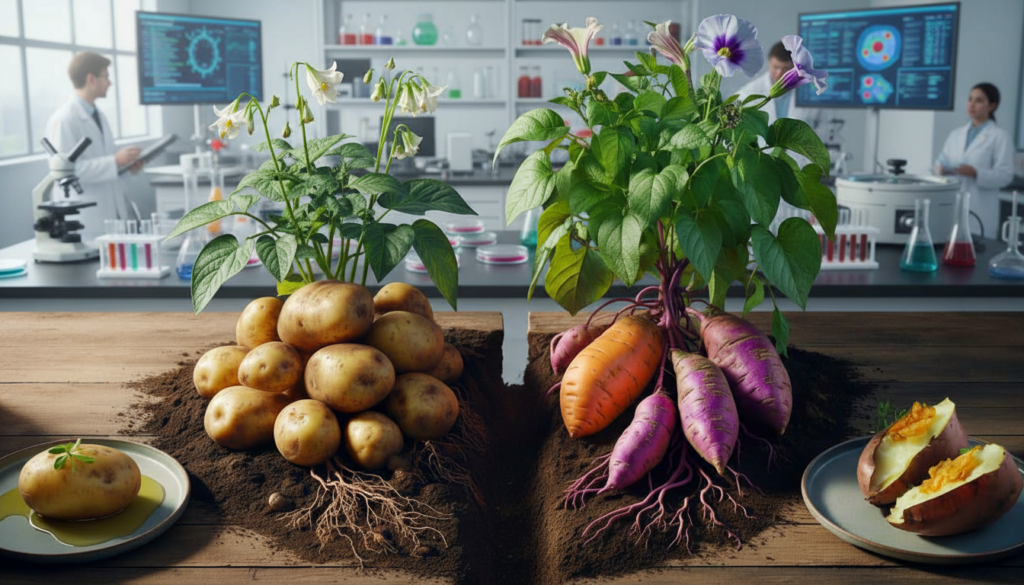
We do this all the time. We switch them out for one another, boil them together, and mash them in the same dish, as if they were brothers from the same family. Same name, same shape, and same ways to cook. Isn’t it the same thing?
The answer from science is very different.

Two “potatoes” that have the same name but not the same family tree
Stand in front of the aisle with the vegetables and squint. The classic potato is on one side. It has pale skin, rounded curves, and is the quiet workhorse of a thousand dinners. On the other hand, sweet potatoes are long, orange-fleshed, and sometimes purple, and they have jackets that are a little wrinkled. At least they look like cousins, if not siblings.
When botanists look at the same scene, they almost want to laugh. There are more than one kind of regular potato and sweet potato. They come from different places. There are tomatoes and peppers in the nightshade clan. The other one is from the morning glory family, which includes delicate vines with trumpet-shaped flowers that climb fences at dawn.
They mix together on the plate. They hardly even look at each other on the family tree.
Remember the last time you made a “healthy swap.” You might have ordered sweet potato fries instead of regular ones, told yourself it was a better choice, and felt a little bit good about yourself when they came in a golden, crispy pile. Same idea as potatoes, but with a halo. Is that right?
But the roots tell a different story. The common potato, Solanum tuberosum, comes from the high Andes in South America, where it has survived cold nights and rocky soils. Sweet potatoes, Ipomoea batatas, had a different path through human history. They spread from tropical Central and South America, probably by sea and river routes, carried by traders and farmers who followed warm climates and rich, loamy ground.
These two plants didn’t grow up together. They just happened to be in the same kitchen.
From a scientific point of view, there is a big difference between them. They are in different plant families, have different flowers, reproduce in different ways, and even have different poisons in their green parts. The Solanaceae family includes regular potatoes. This family is known for having natural toxins like solanine in its leaves and sprouts. Sweet potatoes are part of the Convolvulaceae family, which is more like decorative vines than anything you’d put in a stew.
The similarity is mostly an illusion of language. Europeans met these tubers at different times and called them all the same thing: “potato.” The name stuck, and the confusion settled in. We carried it into our recipes, diets, and food myths. *Language brought together what evolution kept apart.
Science keeps saying the same thing: things that look the same on the shelf can be very different when you look at them under a microscope.
What makes them different on your plate and in your body
The first big difference in how your body handles them happens in the kitchen. Starch is the main part of regular potatoes. Depending on how you cook them, they can raise your blood sugar quickly, like a polite but pushy guest who won’t stop ringing the doorbell. When you boil and cool them, they make more resistant starch, which your gut bacteria love. When fried into chips, they tend to fall into the “comfort now, regret later” category.
Sweet potatoes have more fibre and natural sweetness. The beta-carotene in them makes the flesh orange, which is the same colour that makes carrots glow. If you bake one in its skin, you’ll get a slow, steady release of energy and all the antioxidants that nutritionists love to talk about. Peel it, deep-fry it, and cover it in sugar, and the good things go away fast.
Same oven, same tray, but very different things going on inside.
A lot of people fall into the same trap: they think that “sweet potato = healthy.” They drown them in marshmallows on Thanksgiving, stack them into mountains of loaded fries with cheese and bacon, or bake them and then cover them in syrups and sauces that make a healthy root look like a dessert. Food marketing knows that the health halo is strong.
Let’s be honest: no one really does this every day. A lot of the time, we go back and forth between “I’ll be good this week” and “I deserve this tonight.” The goal isn’t to pick a winner. It’s important to know that these two roots have different strengths and that the way we cook them is more important than the name on the package.
The plant doesn’t make the final decision; your fork does.
Scientists like to remind us that plants didn’t grow to make our diets better. They changed to stay alive. Sweet potatoes used colour and sweetness to attract animals and spread seeds. Regular potatoes used starchy underground storage to get through the harsh seasons in the Andes. At some point, people came and made both strategies into food traditions.
A plant geneticist from Lima says, “We talk about potatoes and sweet potatoes as if they were upgrades of each other,” but “they’re like comparing a cat and a parrot.” They’re both pets. That doesn’t mean they are related.
A few simple facts can help clear things up here:
Different plant families: nightshade and morning glory are not two branches of the same family.
Sweet potatoes have more fibre and beta-carotene, while potatoes have more simple starch.
Andean highlands for one, tropical lowlands and ocean crossings for the other.
Why this small change in how we eat makes a big difference
You can start playing with them more smartly once you realise that “potato” is just a name. A baked sweet potato with its skin, some olive oil, and some spices is a great base for a day when you need a lot of energy and less blood sugar spikes. A bowl of potato mash made from boiled, cooled, and then reheated potatoes will feel like a hug on a cold night when you want something that tastes like childhood. It will also have a slightly lower effect on your glucose.

A single action can change the whole experience: be careful what you add. Industrial sauces, butter, cream, sugar, and cheese often do more harm than the root itself. It’s better to switch up the toppings and cooking methods than to worry about which one is “good” or “bad.”
Plant, plate, and setting. That’s the real shape.
We also don’t talk about the cultural layer enough. The potato is not a neutral ingredient for many Indigenous groups in the Andes. It’s who you are, where you’ve been, and how you’ve survived famines and cold centuries. In some parts of Africa and Asia, sweet potatoes are a safety net crop that feeds families when other crops fail. When we turn both of them into “carbs to avoid after 6 p.m.,” something is lost.
We’ve all been there: a diet headline scares us away from foods that fed whole civilisations. Curiosity turns into fear. Guilt takes the place of taste. Knowing that these two tubers come from different families and traditions can help you appreciate what’s on your plate a little more.
Food is never just chemistry. It also has to do with memory and geography.
This mistake is almost a running joke among nutritionists. People come in for consultations sure that they made the right choice by switching from “bad” potatoes to “good” sweet potatoes. Then they talk about recipes that are full of sugar, fat, and ultra-processed toppings. People either blame or praise the tuber, but the real problems are hidden in the details.
One dietitian says, “I’d rather see someone eat a simple boiled potato with a drizzle of olive oil than sweet potato fries from a fast food restaurant three times a week.” The plant family doesn’t keep you out of the fryer.
This boxed list can help you think quickly:
Potatoes taste better when they are boiled, cooled, roasted with little oil, or made into soups.
Sweet potatoes taste best when baked, steamed, or roasted with the skins on and light toppings.
Both lose their appeal when they are fried, covered in sugar, or buried under thick sauces.
The quiet strength of being aware of what you’re really eating
It’s hard to forget that sweet potatoes and regular potatoes are not very similar once you see it. The vegetable aisle doesn’t look like a blur of familiar shapes anymore. Instead, it looks like a map of plant families that travelled across oceans and centuries to get to your basket. You don’t need to study plants. Just knowing that these two “potatoes” come from different parts of life can help you make better choices.
You could start switching them on purpose. Using the sweetness of one to lower the amount of sugar in a recipe. Instead of sauces from a jar, use the neutral creaminess of the other as a base for herbs and spices. Little changes that happen over weeks and months and add up.
The bigger surprise is that our kitchens are full of foods that look alike but don’t come from the same place. Tomatoes and strawberries are both red and juicy, but they are very different. Almonds and apricot pits look a lot alike, but they are very different in terms of risk. There are many pairs of things, like sweet potatoes and potatoes.
You’ll know a strange little secret the next time you see someone throw both of them into their cart without thinking: they’re putting two people who don’t know each other in the same bag. And you might want to tell the story of how science quietly changed what we thought we knew about something as simple as dinner.
| Important Point | Detail | Value for the Reader |
|---|---|---|
| Different plant families | Regular potatoes belong to the nightshade family, while sweet potatoes are part of the morning glory family | Clarifies why they grow, taste, and behave differently in cooking |
| Distinct nutrition profiles | Sweet potatoes typically contain more fibre and beta-carotene than white potatoes | Helps you choose based on your energy needs, blood sugar goals, and flavour preference |
| Cooking method makes the difference | Preparation style, cooling, and toppings influence health impact more than the tuber itself | Gives practical ways to eat smarter without labeling whole foods as “good” or “bad” |
Questions and Answers:
Are sweet potatoes better for you than regular potatoes?
Not always. Sweet potatoes usually have more fibre and beta-carotene than regular potatoes. When boiled and cooled, regular potatoes can be very filling and form resistant starch. How you cook and dress them and how much you eat them are the main things that affect your health.
Can you use sweet potatoes instead of potatoes in every recipe?
You can try, but the outcome will be different. Sweet potatoes are sweeter, softer, and don’t hold their shape the same way. They taste and feel different in some dishes, like classic potato salads or certain gnocchi, but they work well in bakes, mash, and fries.
Do sweet potatoes and potatoes have the same harmful substances or allergens?No. Potatoes are part of the nightshade family, and their green parts and sprouts can have solanine in them. People who don’t eat nightshades can eat sweet potatoes without any problems because they don’t contain this toxin.
Which one is better for blood sugar?Sweet potatoes cooked with the skin on, especially baked or steamed, don’t raise blood sugar as quickly as many other types of potatoes. That being said, potatoes that have been boiled and cooled develop resistant starch, which can also help control blood sugar levels. Deep-frying and sugary glazes are both bad for you.
Are yams really sweet potatoes?No. True yams, on the other hand, come from the Dioscorea genus and are common in parts of Africa, Asia, and the Caribbean. People in North America used to call orange-fleshed sweet potatoes “yams,” which caused a lot of confusion that still exists today. However, they are not the same plant.