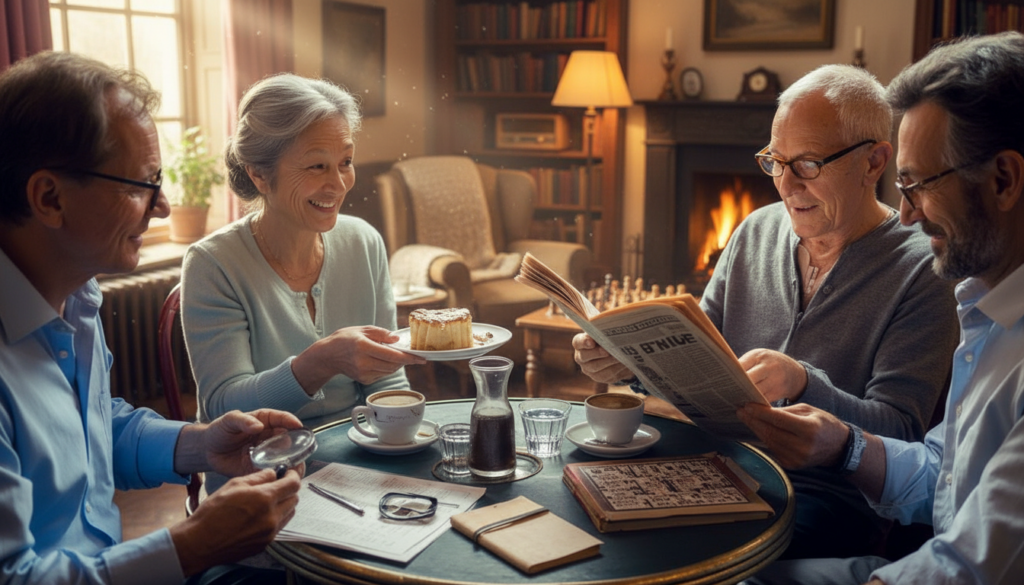
Every Thursday morning, a small group of people meets at a local café in Lyon around a scratched wooden table. There were no laptops or AirPods, just coffee cups leaving rings on the table and a stack of paperbacks being passed around. They’re all in their 60s and 70s, and they talk loudly about the news, their joints, their grandkids, and the latest thriller someone finished at 2 a.m. One of them, who used to be an electrician, takes a folded newspaper out of his bag like it’s a religious item. Another person passes around a homemade cake that is wrapped in foil that is a little wrinkled.
Of course, they have phones in their pockets. But they hardly touch them.
What stands out isn’t their age. They look lighter, that’s what it is.
Why old habits still feel good in a strange way
You can see it in any tube car: people with their heads down, thumbs flicking and faces lit up in blue light. Younger adults are more connected than any other generation in history, but they also report the most stress, anxiety, and loneliness. A survey by the American Psychological Association in 2023 found that adults aged 18 to 29 were the most likely to feel overwhelmed by everyday life. People in their 60s and 70s, on the other hand, quietly say they are happier with their lives, even though they have more health problems and less money.
They’re not following the latest health trends. They are sticking to the same habits their parents had.
Maria, who is 72 years old and lives alone in a small flat on the edge of Madrid, is one example. The screen on her smartphone is a little cracked, and it’s more than five years old. She only looks at WhatsApp twice a day. She walks to the same bakery every morning, talks to the baker, and eats a slow breakfast at her kitchen table while doing a crossword puzzle. No app for tracking fitness or productivity. Just her routine, her papers, and people who know her name.
When someone asks her if she’s happy, she shrugs and says, “Most days, yes.” Why not?

Researchers are now paying close attention to this gap. Numerous studies on subjective well-being conducted in Europe and North America indicate that following a decline in midlife, happiness generally increases from the late 50s onwards. Some of this comes from the perspective and emotional control that come with age. But a quieter factor keeps coming up in interviews and focus groups: old-school habits that limit passive screen time and keep the day centred on real-world activities. Making a call instead of sending a text. Walking instead of scrolling. Not in front of a laptop, but at a table.
These little, analogue decisions seem to help keep your mind clear in a world that never stops buzzing.
The little analogue rituals that make the whole day different
When you talk to happy older people, you will always hear about one thing: a set morning routine. Not a perfect “5 a.m. millionaire routine.” A simple, repeatable start that doesn’t require a screen. A cup of tea on the porch. Taking care of plants. Instead of reading about the weather in an app, you can open the window, feel the air, and see the weather. A lot of people call this “setting the tone” or “getting their head on straight” before the world starts making demands.
They act like the first hour of the day is a small piece of land they still own.
Young adults often try to do the same thing with ambitious habit trackers and wellness challenges, but they feel like failures when life gets messy. To be honest, no one really does this every day. The older people who look zen aren’t following perfect routines; they’re following routines they know well. They say what they can do, not what they think is cool. They also let themselves off the hook quickly when a day doesn’t go as planned. No “I messed up my streak, what’s wrong with me?” spiral
They just get up tomorrow and put the kettle on again.
At her kitchen table, where she had handwritten recipe cards and a half-knitted scarf, a retired teacher summed it up.
She laughed and said, “I don’t need a mindfulness app.” “I have my soup, my walk, and my neighbour who talks too much.” Most days, that’s enough to keep my mind clear.
Her daily life isn’t very exciting, but it’s stable. She makes a list of things she needs to buy on paper, calls her sister every Sunday at 5 p.m., and keeps a small notebook where she writes down three good things that happened. The notebook has dog-eared pages, coffee stains, and is very private.
Instead of having ten chats at once, call one person every week.
Using paper for at least one thing, like making lists, writing in a journal, or following recipes
A walk, a meal, or a craft that doesn’t involve a screen
Going back to a comforting childhood tradition: a Sunday lunch, a certain radio show, or a board game
Allowing routine to be “good enough” instead of “Instagram-worthy”
These are the little, old-school things that change how a whole week feels without anyone noticing.
The quiet revolt against always being “on”
There is an emotional thread that runs through these stories of older, happier adults: they won’t be available all the time. A lot of them grew up with landlines, letters, and having to wait days for an answer. That feeling of being late never really went away. They answer messages when they sit down and put on their glasses. They don’t feel bad about missing a meme or a post that went viral. Younger adults who have been taught to respond right away may see this as being stubborn. In practice, it’s a kind of limit.*They just don’t get that every minute of their day has to be urgent.*
Take a moment to think about your own habits. The urge to check notifications in every little space. The way a quiet ride in a lift feels “wasted” if you’re not doing something. We’ve all been there: you open your phone to send a quick message and then 25 minutes later you feel a little empty. Older people who are happier sometimes still get distracted, but their baseline is different. They are not online by default. They fill their boredom by looking around, not by refreshing their feed.
That one change makes a big difference in the noise level of a whole life.

Younger adults shouldn’t throw their phones in the river or act like they live in 1973, though. It means that borrowing certain things from that time is a good idea. For example, eating at a table instead of in front of a laptop, calling someone when a text fight goes on too long, keeping hobbies that don’t involve screens, and letting some messages wait. These aren’t games that make you feel nostalgic; they’re strategies for your nervous system. Connection, autonomy, and rhythm are the three main things that keep coming up in research on happiness. Old-school habits help all three.
What looks “outdated” from the outside may be what keeps so many people in their 60s and 70s strong on the inside.
| Key point | Detail | Value for the reader |
|---|---|---|
| Analog routines calm the day | Simple, repeatable rituals like paper lists, walks, or set call times create a sense of control | Gives a low-effort way to reduce stress without new apps or gear |
| Boundaries around screens boost mood | Older adults often delay replies and limit notifications by habit | Shows how small changes to availability can ease anxiety and mental overload |
| Real-world contact matters more than constant contact | Regular face-to-face chats and old-fashioned phone calls deepen connection | Offers a realistic path to feeling less lonely, even without a huge social circle |
FAQ:
Do I need to quit social media completely to feel happier?
Probably not. The happiest older adults often use technology, they just don’t let it run their day. Start by carving out one or two clear offline pockets instead of going all-or-nothing.
What’s one old-school habit I can try if I’m always on my phone?
Pick a daily activity and declare it screen-free: breakfast, your commute, or the 30 minutes before bed. Protect that one slice of time like older adults protect their newspaper or walk.
I don’t have many friends nearby. Do “real-world” habits still help?
Yes. Even brief in-person contact with neighbors, shop staff, or colleagues can lift mood. Combine that with phone calls or voice messages, which feel more human than endless texting.
Isn’t this just nostalgia for a past that had plenty of problems?
The past wasn’t perfect. What’s useful is not the era, but specific behaviors from it: slower communication, face-to-face rituals, and less constant interruption. You can import those into 2026.
How can I keep these habits when my work is fully online?
Use boundaries, not fantasies. Create tiny analog islands inside your digital day: a notebook next to your keyboard, a phone in another room for 20 minutes, a real break for lunch. **Small, consistent limits matter more than radical detoxes.**