Every time you swing open the cabinet, there’s that faint metallic clatter. Bobby pins scatter. Tweezers slide toward the sink. The nail clipper you swore you lost reappears under a layer of powder and toothpaste specks. It’s a tiny mess, but it greets you daily — especially when you’re already running late.
We tolerate it because it feels small. “It’s just a few pins,” we tell ourselves. But those few pins somehow multiply, migrate, and turn into visual noise. Over time, that clutter becomes louder than your alarm clock.
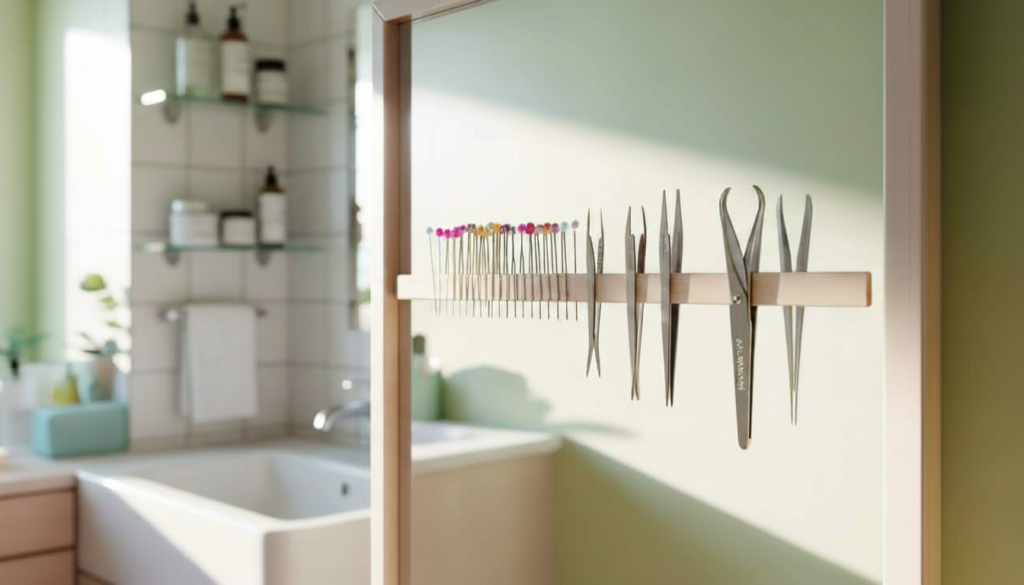
Then one day, you spot a simple idea online: a slim magnetic strip fixed neatly to the inside of a cabinet door. Bobby pins lined up in tidy rows. Tweezers snapped into place. Suddenly the chaos looks… optional.

The Magnetic Strip Trick That Changes Everything
The inside of a cabinet door is usually wasted space. We open it, grab what we need from the shelves, and shut it again without ever thinking about the door itself. But that flat surface is right at eye level, inches from your hands, used multiple times a day.
Now imagine it working for you.
A thin magnetic strip runs along the inside. Bobby pins attach in straight lines. Tweezers, nail scissors, and clippers cling securely in their own spots. No more digging through drawers. No more knocking things over. Just open, grab, close.
Picture a rushed weekday morning. Five minutes before a meeting. You reach blindly into the cabinet — and this time, everything is exactly where it should be. Your fingers find what they need instantly. The door closes. Routine continues. No frustration spike at 8:03 a.m.
There’s a psychological reason this feels satisfying. Our brains relax when scattered objects become structured. Small metal items are classic “floating clutter” — they drift, pile up, disappear. Giving them a visible vertical home turns background chaos into quiet order.
And when items have a clear parking spot, your hand naturally returns them there. It’s not just storage. It’s behavior design.
How to Set Up a Magnetic Strip the Right Way
Start with a thin, adhesive magnetic strip the kind often used for knives or tools. Measure the inside of your cabinet door carefully so the strip won’t hit shelves when closing. Trim if needed. Clean the surface thoroughly, especially in humid bathrooms where dust and moisture weaken adhesives. Then press firmly along the entire strip to secure it.
Next comes the organizing part. Gather your small metal essentials: bobby pins, tweezers, nail clippers, eyebrow scissors, even that tiny metal file you constantly misplace. Arrange them in simple groups. Leave breathing room between clusters so the strip doesn’t look overcrowded.
Avoid two common mistakes:

Overloading the strip until it looks cluttered again.
Choosing a weak magnet that can’t hold heavier tools.
Go for a strong, heavy-duty option and test it with your heaviest item before committing.
A quick five-second reset at night — snapping everything back into place — keeps the system effortless.
Why One Small Strip Can Shift Your Whole Routine
After a few days, something subtle changes. You open the cabinet and instead of bracing for clutter, you see neat rows waiting. That tiny sense of control at the start and end of your day spills into other habits. You wipe the sink more often. You toss expired products. The space feels lighter.
The beauty of this solution is that it’s realistic. No complicated organizers. No aesthetic pressure. Just a vertical strip using space you already have.
And once you see how effective it is, you start spotting other “dead zones” around your home — inside kitchen cabinets, along metal shelving, even on mirror frames.
It’s not about buying more storage. It’s about making invisible space functional.
A row of bobby pins won’t solve everything in life. But it can give you two small moments a day where you open a door and think, “That’s better.”