One Tuesday night, I was lying on the couch and scrolling through my bank app. I was half-bored and half-anxious. Rent, food, and gas are all fine. Then I saw a line of small, repeated charges that looked like a pattern I had never seen before. This costs $6.99. There, $9.99. $14.99 over and over again. They looked like little bits of digital dust. But they were all over the place.
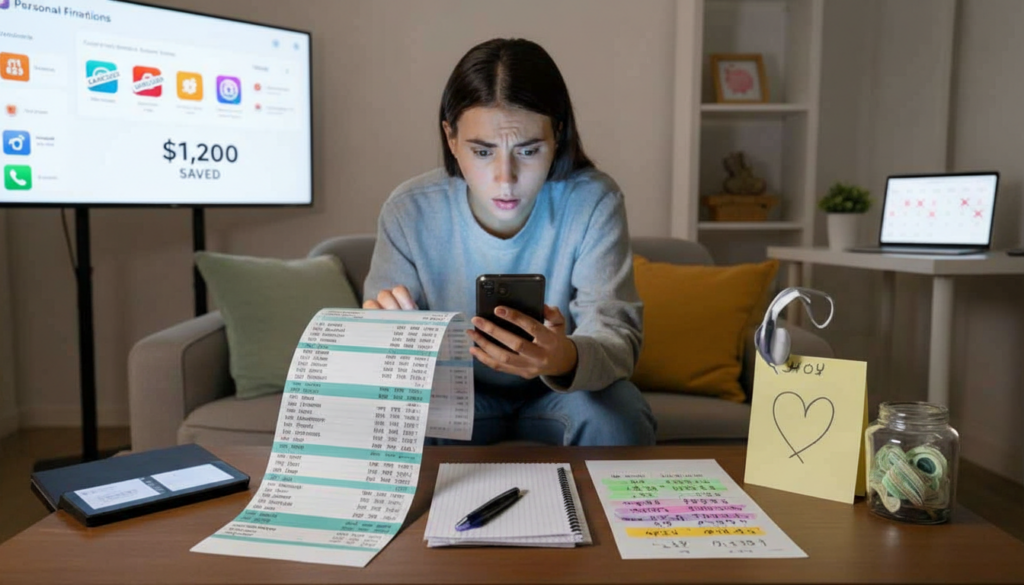
I clicked on one. Then another. Then one more. I hadn’t opened the fitness app in months. I only kept the streaming service for “that one show” that ended two years ago. A “free trial” that hadn’t been free in a long time.
I took a notepad. Wrote down the numbers. They were added together.

The number at the bottom really made my heart stop for a second.
When little subscriptions slowly take your money
The first thing I learned was very simple: I wasn’t being robbed by one big bill. Twenty little ones were draining me. At the time, each subscription seemed like a good idea. $4.99 to “improve my productivity” and $7.99 for more cloud storage. I paid $3 here and there for “pro” versions of apps I didn’t even know I had.
They felt like background noise by themselves. Not dangerous. Not worth remembering. That was the trick. I never felt the loss of money in real time because it left my account so quietly.
I remember seeing a $5.99 charge from a meditation app and laughing out loud because I thought it was free. I downloaded it during a busy week at work, clicked “start free trial,” and never looked back. Until my bank statement did the work for me.
Then there was an online magazine I didn’t read anymore, a gaming subscription I only used during lockdown, and two streaming services where I was just watching the same show over and over again. It was like a small, hidden leak under the floorboards that added up to more than $100 a month.
The pattern became clear to me once I stepped back. We don’t pay for services; we pay for how we feel. Motivation for the future. Possible output. Entertainment in your head. Cancelling them later feels like saying that version of ourselves never really happened. That’s why these costs stay around long after they are useful.
Let’s be honest: no one really reads every line of their bank statement every month.
These platforms are aware of that. They make things that work with our laziness and hope. That’s how I learned that I was spending about $1,200 a year on things I barely remembered agreeing to.
The “subscription audit” that made my year
I printed out three months’ worth of bank statements and got a highlighter. That was the turning point. Stuff from the old days, like writing things down on paper and using a kitchen table. I circled every charge that came up again, no matter how small. I didn’t judge or cancel yet; I just wanted to see the whole picture.
Then I made a list with three columns: “Use weekly,” “Use monthly,” and “Haven’t used in a long time.” Be honest, not guilty. The third column filled up faster than I thought it would.
One charge really got to me: $19.99 a month for a fitness platform that lets you do everything. I signed up in January, when I was full of good intentions and New Year’s energy. I had used it exactly nine times. It had been more than six months since the last session. I looked at the total amount spent: over $200 for nine workouts I couldn’t even remember.
On the other hand, the $9.99 music streaming service made the cut easily. I used it every day, while I was walking, cooking, or working. The same goes for the cloud storage where all my pictures were. That’s when I realized this wasn’t about “no spending.” It was about spending money on things that are part of my real life, not just on the person I want to be.
Once I could see the list clearly, canceling became a strangely fun game. I opened each app and went to the “Account” or “Billing” sections to look for the small “Manage subscription” links. Some platforms made it way too easy. Two clicks and you’re done.
Some were like obstacle courses, with hidden buttons, emotional pop-up messages, and even special “discounts” that popped up as soon as I tried to leave. This part was eye-opening. Any service that made it hard to cancel right away seemed less reliable. Why are you begging me to stay if you’re so good?
I had saved about $100 a month by the time I was done with the audit. That’s how the $1,200 a year suddenly became clear again.

How to say no without feeling bad
This is how I did it, step by step, without making it a full-time job. I set a timer on my phone for 45 minutes and ran with it. I didn’t “think about” canceling during that time. I just did it. I opened the bank app, wrote down all the charges that happened every month, and then looked up the original sign-up and login information for each name in my email.
Next, I canceled everything I hadn’t used in the last 60 days without any argument. If I really missed it, I could always sign up again later. That rule took away a lot of emotional bargaining with myself.
The money wasn’t the strangest part. Every time I clicked “cancel,” I felt a little guilty. It felt like I was letting down my “better self,” who was going to meditate every day, read long essays, learn a language, and do yoga at dawn. We’ve all been there: when your subscription history looks like a project you gave up on.
So I changed the story in my mind. I wasn’t going to give up. I was making changes to the contract to reflect my real life. If a habit was really important to me, I didn’t need three subscriptions that all did the same thing to prove it. I needed one simple tool that I could use.
Sometimes, the best thing you can do for your future is to let go of things you don’t need anymore.
Do a “subscription clean-out” every three months.
Print or save three months’ worth of statements and mark anything that happens more than once. No judgment stage first, just seeing.
Follow the “60-day rule.”
Stop or cancel if you haven’t used it in two months. Your wallet should show how you live now, not how you lived in the past or how you want to live in the future.
Before you delete, downgrade
Some services have plans that are cheaper but not obvious. You can keep what you love and cut the cost in half by going from “premium” to “basic.”
Make a “subscription budget.”
Set aside a certain amount of money each month for services that you need on a regular basis. You have to get rid of one to add a new one.
Take the money back on purpose
Redirect the cash you have available. Savings for a trip, an emergency fund, and debt. It’s easier not to slip back when you see your goal grow.
What happens when you stop paying for the person you aren’t?
Getting back $1,200 a year didn’t feel like winning the lottery. It felt like finally shutting off a dripping faucet that had been bothering me for years. The most surprising effect was on the mind. I suddenly felt more focused. Less apps. Less logging in. Less emails saying, “Your monthly payment has been processed.”
It was strange, but my daily life felt better once they were gone. My money was no longer spread out among businesses that didn’t even know my name. It was in my own account, waiting for me to make decisions that mattered to me.
The next month, when the usual payments didn’t come in, I moved the $100 to a different savings account that I named “Future Joy.” Is that cheesy? It’s possible. But it felt so much better to watch that number go up than to just scroll through another platform I barely used. *That* was the real change: money stopped being a loss that happened automatically and became a choice again.
And here’s the simple truth that no one wants to say out loud: most of us don’t have a problem with our income; we have a problem with our silent drain.
When you plug that in, even a little, you start to see choices everywhere. A weekend away that you thought you couldn’t afford. A little less stress when the car breaks down. A little safety net that wasn’t there before.
The $1,200 I got back didn’t change my life by itself. But now I see every “Start free trial” button in a different light. That changed in every way.
| Key point | Detail | Value for the reader |
|---|---|---|
| Track every recurring charge | Highlight 3 months of bank statements and list all subscriptions | Instant visibility on hidden leaks and forgotten payments |
| Apply the 60-day rule | Cancel or pause anything unused for two months | Quick way to cut costs without overthinking or guilt |
| Redirect the savings | Send recovered money to a named goal or savings pot | Makes the wins tangible and reduces the risk of re-wasting it |