You see it again as you walk out the door: that lonely little charging cable hanging from the wall with no phone attached. The LED is still dimly lit in the hallway.
You say to yourself that you’ll unplug it later. You never do.
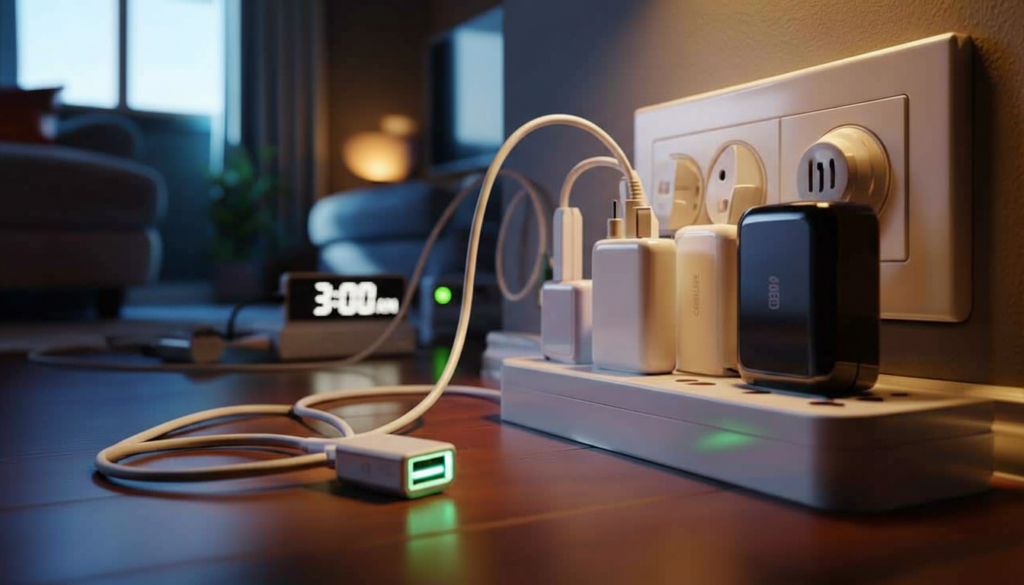
Hours go by, even days, and that cable just sits there, quietly drinking power like a guest who never leaves the buffet.
The meter can see and hear it, but no one else can. Your wallet does too.

That charger that looks “dead” isn’t really dead.
People usually think that a charger only uses power when a phone or laptop is plugged in.
Our brain just thinks the wall is “off” because it feels cold and the socket is silent.
The hard part is that many modern chargers stay awake most of the time. They keep small circuits powered so they can respond right away when you plug in a device.
You can’t see it or feel it, but it’s there all the time.
Energy companies call this kind of waste “vampire power.”
It’s the TVs, game consoles, smart speakers, and even that harmless-looking USB charger that keep using power when they’re not in use.
A single cable may only use a small amount of power, like a fraction of a watt.
But most houses have more than one cable. They have five, ten, or maybe even more of them, and they are all over the house—in bedrooms, kitchens, and offices—quietly adding to the bill every month.
A few tenths of a watt on paper doesn’t seem like something to worry about.
But when you multiply that by 24 hours a day, 365 days a year, and then by every charger and adapter in your home, you start to get real numbers.
Experts say that standby consumption can account for a few percent of a typical household’s annual electricity use.
That’s money spent on nothing. No light, no heat, no comfort. Just little, constant leaks of power that don’t help you at all.
How to end your relationship with vampire cables at home
The easiest thing to do is to make cable zones “on-demand only.”
Don’t leave the charger plugged in all the time. Instead, keep it in a small tray, drawer, or box near the plug.
You plug the charger in when you need it and take it out when you’re done.
It seems like such a simple, almost childish rule, but that’s how habits are formed: by doing the same small thing over and over again.

We’ve all been there: you’re in bed and see the charger glowing across the room and think, “I’ll deal with it tomorrow.”
Let’s be honest: no one really does this every day.
That’s why you need small systems instead of willpower. A power strip with a switch on the floor next to your desk. A multi-plug behind the TV that you turn off at night.
You turned off the power to a bunch of chargers and devices all at once, without having to crawl around behind furniture or look for each cable.
One electrician I talked to recently said, “People think the big waste comes from what they see.” Most of the time, the real drain is in what they’ve lost track of.
Use power strips that can be switched on and off.
Put chargers and small devices in a group, and then turn off their power with one click.
Give someone a “charging corner”
Put all of your cables in one place where you can see them so you know when they’re plugged in.
Pick smarter chargers
Some newer models use almost no power when they’re not in use. Look at the labels and reviews.
Look at months when you are more disciplined and months when you aren’t.
The hidden cost of always being on standby goes beyond your bill.
Once you see how many small devices are quietly humming in the background, it’s hard to forget.
Every single LED, every warm charger, and every device that is “almost off” makes a low-level buzz in the house all the time.
You don’t have to be obsessed or live in the dark.
You start to notice things that are plugged in for no reason, things that are drawing power but not giving you anything back, and you trim them back a little at a time.
| Key point | Detail | Value for the reader |
|---|---|---|
| Vampire power exists | Chargers draw small amounts of energy even with no device attached | Helps you understand where wasted electricity comes from |
| Small leaks add up | Multiple idle chargers over months can raise your bill and footprint | Shows why unplugging actually matters over time |
| Simple habits work | Using switched strips, centralizing cables, unplugging after use | Gives you easy actions for saving money and energy |