Most talks about global warming are about smokestacks, cars, and melting ice, but a lot of the story happens underground. A scientist who built her career on showing the unseen half of the planet just won the 2026 Tyler Prize for Environmental Achievement, which is often called the “Nobel of the environment.”
The Nobel Prize for the Environment Goes Underground
The University of Southern California hosts the Tyler Prize, which honors researchers who change how people think about and care for the Earth. Jane Goodall, a primatologist, and Michael Mann, a climate scientist, are two past winners who are well-known for their work on climate change and conservation.
American biologist Toby Kiers, who studies the evolution of fungi and plants, is the 2026 winner. For almost 30 years, she has studied a topic that was once thought to be very narrow: how plants and fungi work together in the soil. Her research uses lab experiments, global field trips, and new technology to show how these underground networks affect biodiversity and climate.

Kiers’ research shows that fungal networks are more than just background biology; they play a role in regulating carbon on a global scale.
Kiers has become a public advocate for what she calls “the invisible biodiversity beneath our feet” in addition to her scientific work. She says that any serious climate plan must take soils and fungi into account.
Fungal roads under our feet
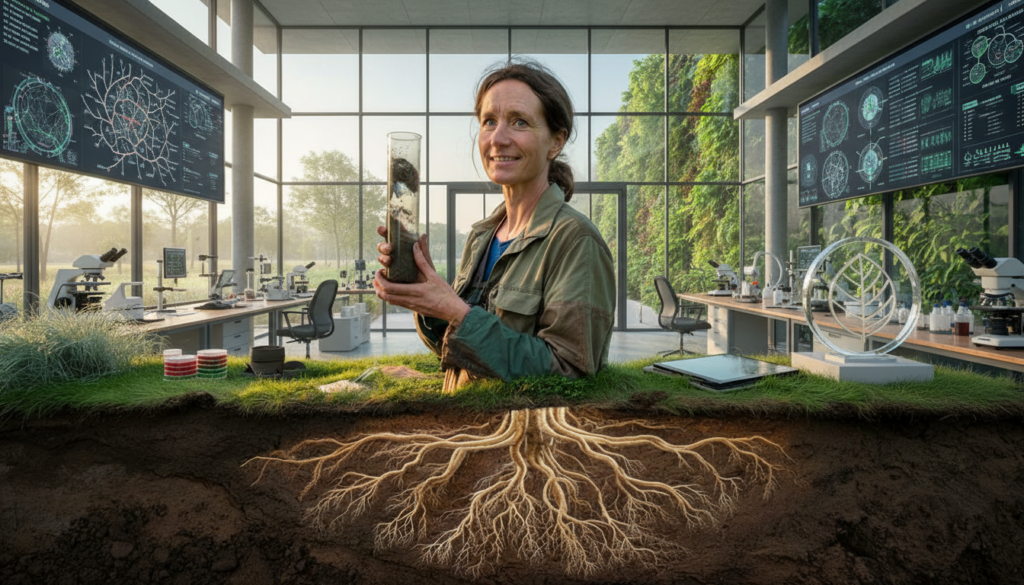
Fine fungal filaments wrap around plant roots in forests, grasslands, and farm fields. These are mycorrhizal fungi that work with almost 90% of land plants. The fungi give plants sugars that they make through photosynthesis in exchange for water and nutrients.
These links don’t just connect one tree or crop. They often make huge networks that connect plants of different species. These fungal “highways” let water, nitrogen, phosphorus, and other chemicals move through them.
Scientists sometimes call this huge underground mesh the “wood wide web.” It’s a living structure that quietly supports whole ecosystems.
Kiers and his team have shown that fungi do not randomly move goods by looking at how resources move through these networks. They act more like market players, sending nutrients to places where they can get the best return in plant sugars. This work brought ideas from economics into ecology, changing how scientists think about how animals work together in nature.
A secret climate controller
In addition to feeding plants, mycorrhizal fungi also deal with huge amounts of carbon. Plants take in carbon from the air and send some of it to their roots, where it is then sent to fungal partners. Recent estimates say that these fungal networks trap about 13 billion tons of carbon dioxide in soils all over the world every year.
Some of that carbon gets trapped in stable soil structures that can last for hundreds or even thousands of years. Intensive plowing, deforestation, or soil degradation can damage these networks and release stored carbon back into the air.
Kiers’ work has helped bring this risk to light. Her team gives land managers and policymakers information they can use when making plans to deal with climate change by mapping fungal networks and measuring how much carbon they move and store.
From a small group to a global policy discussion
In climate debates for years, mycorrhizal fungi got a lot less attention than forests, oceans, or ice sheets. Kiers has worked to change that by co-founding projects to map the diversity of fungi around the world and pushing for the protection of fungi in international meetings.
Her research projects often use satellite data, soil samples, and genetic sequencing all at once. This method lets teams make maps of underground fungal communities in the same way that botanists make maps of forests or coral reefs.
Her group studies how logging affects the diversity of fungi and the storage of carbon in tropical forests.
In areas where farming is common, they try out ways of farming that protect or restore fungal networks.
They study fungi that help plants survive drought in drylands, which gives them ideas for how to adapt to climate change.
Kiers says that fungi should also be included in climate budgets and land-use plans because they are on climate maps.
Why the jury for the Tyler Prize paid attention
The Tyler Prize jury usually gives awards to research that is both deep in science and useful in the real world. Kiers fits that description. She has written important academic papers on how cooperation changes between species, and she has also used her research to add to discussions about agriculture, reforestation, and the loss of biodiversity.

Her research touches on some of the most important questions in climate policy, like how much carbon can land systems hold? What kinds of farming can lower emissions without hurting yields? How do we protect biodiversity that people don’t see often but rely on every day?
Part of Kiers’ workClimate significance
The movement of carbon through fungal networksImproves estimates of carbon sinks on land.
How farming affects fungi in the soilLeads to farming that doesn’t pollute the air and is good for the soil
Mapping the diversity of mycorrhizae around the worldFinds places that need to be protected or restored.
From the lab to the field: effects in the real world
Kiers’ work has an impact on both farming and conservation policy. Many modern farming methods, like using a lot of fertilizer and deep tilling, break up fungal networks. That can make crops more reliant on chemicals and make it harder for soil to hold carbon and water.
Her findings corroborate a collection of practices commonly categorized as “regenerative agriculture.” These are lower reliance on synthetic fertilizers, cover crops, more diverse crop rotations, and less tillage. These kinds of things help fungal communities set up and keep up the exchanges that make soils fertile.
Some farmers are now working with soil ecologists to keep an eye on both fungal health and crop yields. Trials show that fields with more mycorrhizal networks can sometimes keep producing with less fertilizer. This saves money and lowers emissions at the same time.
Healthy fungal networks can be a type of “green infrastructure” that helps with both climate goals and food security.
What could happen if the underground alliance falls apart
People are becoming more and more worried that ignoring underground ecosystems could hurt climate policy. For instance, planting a lot of trees may not work if the new forests don’t have the right fungal partners or if they are planted on degraded soils where networks are broken.
Soils that used to hold carbon can become sources when land is changed too much. When you deep plough, drain, or use pesticides over and over, fungi and other soil life die off. This makes organic matter break down faster and more carbon escapes into the air.
Kiers’ research helps us figure out how many of these tipping points there are. In terms of climate, it says that protecting existing soil networks may be just as important as planting new trees or building renewable energy infrastructure.
Key terms and situations that help you understand the science
There are now a lot of technical terms related to this work in climate models and policy documents. A few of them are worth looking into:
Mycorrhiza is a relationship between a fungus and plant roots that is good for both. The fungus gives the plant water and nutrients, and the plant gives the fungus sugars.
Soil carbon sink: The ability of soil to hold on to carbon for a long time instead of letting it go as carbon dioxide.
Regenerative agriculture: Farming methods that try to improve soil health, biodiversity, and carbon storage while still producing food.
Climate modellers are beginning to simulate scenarios that incorporate alterations in mycorrhizal networks. For example, if 10–20% of current farmland used methods that improve fungal communities, modeled results show that soils will store more carbon over the next few decades.
On the other hand, scenarios with more intensive farming and more deforestation show that fungal diversity is going down and carbon sinks are getting weaker. Even with quick cuts in fossil fuel use, those paths make it harder to keep global warming below 1.5 to 2 degrees Celsius.
What this means for the choices we make every day
Fungal ecology may seem far away from everyday life, but it has to do with food, forests, and climate policies that affect everyone. Underground ecosystems are affected by support for farming that is good for the soil, pressure to cut down on deforestation, and attention to how land is used locally.
Kiers’ win of the Tyler Prize shows that discussions about climate and biodiversity are getting bigger. The story isn’t just about emissions from cars and power plants anymore. It’s also about the quiet, cellular negotiations that are going on between roots and fungi under our feet.