A small group of people stood in the cold by a dusty strip of river near Fresno just after sunrise. They watched a miracle flicker in the shallows. A ranger in a worn-out green jacket pointed and spoke in a voice that was almost a whisper. There, a single chinook salmon fought the current with a stubborn, pulsing tail and held its ground against the flow of the San Joaquin River. The water here used to be dry for long periods of time, more like a memory than a river. But this fish had done something that no one alive had ever seen before: it had come back to the river where its ancestors last spawned about a hundred years ago. People forgot to talk when they heard phones ring and boots crunching gravel.
Even the noise from the highway seemed to fade away for a moment.
Something very old had just begun again.
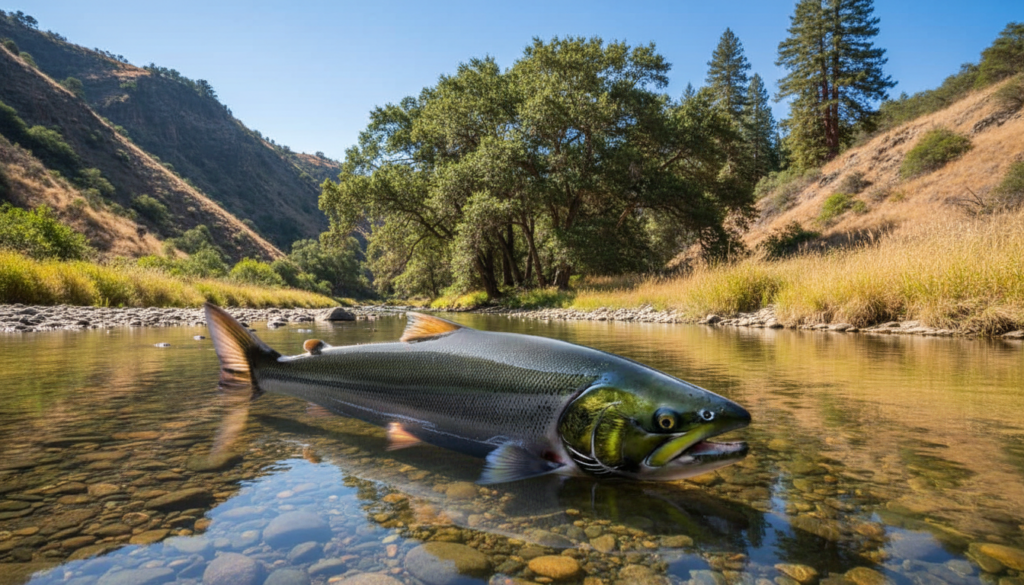
A single salmon that changes the story of a river
It looked like just one fish on the outside. It was about 30 inches long, with a dark back and silver sides that were spotted like old ash. Biologists saw more than that. They saw living proof that a river that California had once thought was useless could still carry life, not just water, from the Pacific to the Central Valley. The chinook had traveled hundreds of miles, getting past dams, predators, and warm plumes of agricultural runoff. It didn’t pay attention to any of the reasons not to be here.
The one salmon in the San Joaquin River quickly became a news story, a piece of data, and, for many people watching, a small, unexpected boost of hope.
People had given up on this part of the San Joaquin for years. Some parts of it went dry for 60 miles at a time, which was a sacrifice zone for irrigation canals and pumps that fed one of the most productive farm belts on Earth. Older people remember kids racing dirt bikes on the open riverbed. When a huge restoration settlement in 2006 made water releases and habitat work necessary, critics laughed. Billions of gallons for just “a few fish”?
Fast forward, and that “few fish” has become a story that will last for a hundred years. The returning chinook didn’t come here in a truck or get dumped out of a hatchery truck at the last bend. It used its instincts to find its way back to the river system where it was born, following faint chemical signals in its body before it ever saw the ocean.

Biologists refer to this type of return as “natural-origin” spawning. It’s the best way to help salmon recover, when people stop helping and the species’ own ancient programming takes over. The San Joaquin salmon wasn’t just a survivor; it was a sign that broken ecological circuits can be fixed. The fish’s journey connected the ocean, the delta, and the river in a way that planners and engineers have been trying to do with meetings and legal briefs. Let’s be honest: no one really stands on the bank of a river every day and feels centuries of policy, drought, and concrete shake in their boots. But that’s what this one chinook did without making a sound.
How a river that was dead learned to carry salmon again
Fixing a river for salmon is more like getting a patient out of intensive care than flipping a switch. First came the water: controlled releases from Friant Dam to reconnect dry areas and lower summer temperatures. Then the plumbing was changed so that some of the most extreme diversions that had turned the San Joaquin into a patchwork of pools and dust could be moved or toned down. Workers dug side channels and made shallow gravel bars where salmon could lay their eggs in the future.
Cottonwoods and willows were planted along the banks to shade the water and cool off the hot Central Valley heat that can cook young fish before they ever reach the ocean.
At the same time, workers at the hatchery carefully tagged young salmon, called smolts, and sent them downriver to the Pacific. A lot of them never came back. Some were eaten, while others were shocked by warm water or sucked into pumps. For restoration teams, progress often looked like failure on a spreadsheet. Then people heard that a tagged adult had been found heading up the system and then saw it in a restored reach. When the radio beeps turned into real fish thrashing around, it felt more like a scene from a sports movie than science.
We’ve all been there, that moment when the long shot you thought was dead suddenly comes back to life.
There is a harsh, unromantic truth behind the emotion: this recovery is fragile. The San Joaquin’s salmon story could break again if the weather stays dry for a winter, a policy changes, and the river temperature rises by a few degrees. The Central Valley’s farms still depend on the same water that the fish need. That water is also important for urban growth. But the return of a natural-origin chinook raises a new question for everyone who is fighting over allocation charts: if a river can do this, what else are we willing to let it do? *The truth is that one salmon has changed the tone of a 20-year argument in a way that no court ever could.
The fish became a tool to show that the system isn’t as broken as many people thought and not as strong as some people want it to be.
What this means for rivers, readers, and the little things we do
You might never stand on the banks of the San Joaquin, and you might live thousands of miles away from California. This story still has more of an effect on your day than it seems. Scientists call salmon a “keystone” and a “connector” species because they connect oceans, rivers, forests, and communities. When they come back, they bring marine nutrients with them in their bodies, which feed everything from insects to bears to the trees that hold the riverbanks in place.
So, when one chinook nose-taps its way into a long-dry reach, it’s not just a win for fish nerds. It’s a gentle reminder of how interconnected our lives and the world around us are.

It’s easy to think of stories like this as one-time feel-good stories. Scroll down, smile, and keep going. People start to connect the dots closer to home, and that’s when the real change happens. Perhaps that means backing local groups that tear down old dams or expose buried creeks that run under city streets. It could be as easy as being aware of where your food and water come from, even the quiet streams and wetlands that don’t get much attention.
If you’ve ever felt helpless reading about climate change or biodiversity loss, this salmon offers a different, stubborn story: restoration doesn’t need to be perfect; it just needs you to keep going when the river looks empty.
One of the biologists who worked on the San Joaquin project said something that stuck with me:
“We weren’t trying to save this fish. We were trying to give it a choice to show up. The best part is that it took us up on that offer.
There is a small plan inside that line that you can use to improve your relationship with nature. You don’t have to change everything about your life right away. You can give your local area a chance to surprise you. That could mean voting for a restoration measure, going to an urban river that hasn’t been cared for on the weekends, or just telling this story to someone who thinks we’ve already lost.
- Support a local river or wetland project with a small, regular donation.
- Pick foods from farmers who don’t drain waterways but protect them.
- Be quiet and pay attention when you’re near real water, like rivers, creeks, or the coast.
- Share stories of recovery like this one to change the mood online from doom to effort.
- When something new comes up, ask one annoying question: What happens to the water?
- A hundred-year detour, and what comes after one fish
A chinook coming back to its native California river after 100 years doesn’t fix dams, get rid of drought, or make sure that the salmon run is healthy. What it does is break the story open. A river that was once thought to be “dead” has now put a living, thrashing response on the record. That matters to scientists, farmers, and anyone else who wants to know what recovery might look like in a century full of loss. The San Joaquin salmon reminds us that nature’s time scales are longer and stranger than we can handle.
The fish spent years in the ocean, then days and nights pushing back upstream, following a scent trail it had never smelled before.
We will find out in the next few seasons if this was a one-time mistake or the start of a new song. If politics and the weather don’t work out, there might be more fish, or the river might go quiet again. But something small has already changed for people who live and work along the banks. The kids’ baseline changes when they see that picture of a salmon in their “dead” river. A world where chinook belong here is a little more likely than a world where they don’t.
That’s where the story comes back to you, reading it on a phone in between work emails, news headlines, and all the other noise of the day.
Like this salmon brought nutrients from the ocean upstream, stories like this bring us a different kind of nutrient: proof that repair is possible, even if it’s messy and uneven. You don’t have to be a scientist or a government official to be a part of that. You just have to think of your local river, pond, coastline, or even drainage ditch as something that could surprise you again. **In a hundred years, someone else might stand on a bank you know and watch a species you helped give a second chance to come home.** A small choice, like a vote, a donation, or changing a habit, can become a quiet force that pushes you in the right direction.
Somewhere, a fish you will never see might already be turning its body toward that faint, impossible smell of home.
| Key point | Detail | Value for the reader |
|---|---|---|
| Restored rivers can rebound | The San Joaquin, once dry and written off, now hosts a returning chinook salmon | Shows that damaged ecosystems near you may still hold real comeback potential |
| Policy and patience matter | Two decades of legal battles, water releases, and habitat work set the stage for this single fish | Highlights how long-haul efforts, not quick fixes, often unlock dramatic moments |
| Individual choices ripple outward | Local support for restoration, better water use, and informed food choices all feed into river health | Offers concrete ways to turn a distant news story into personal, practical action |