Instead of coal or regular gas, this facility uses a huge hydrogen-powered turbine that can start up at any time and keep the lights on when the weather isn’t good for renewables.
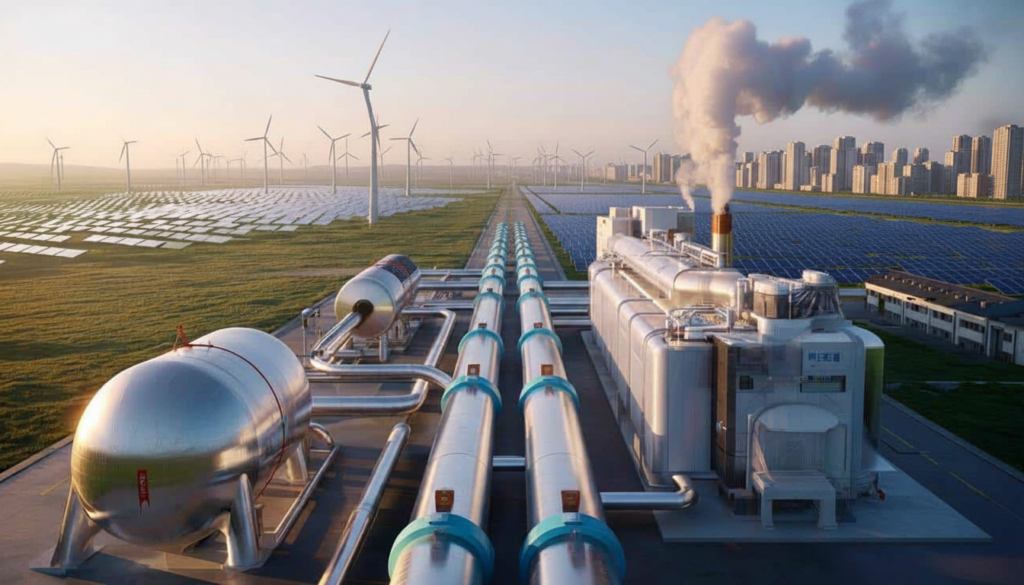
A hydrogen “super turbine” that wants to break world records
Jupiter I is the name of the machine at the center of this story. It was made by the Chinese company MingYang Group and is now the largest gas turbine ever to run on 100% hydrogen, with a capacity of 30 megawatts (MW).
Jupiter I was put in Inner Mongolia, which already has a lot of wind farms and solar parks. Its only job is to turn extra clean electricity into power that can be controlled and used when needed.

Jupiter I can burn up to 30,000 cubic meters of hydrogen every hour and make enough electricity to power about 5,500 homes.
According to information released in China, the unit can make up to 48,000 kilowatt-hours of electricity every hour when it is running in combined-cycle mode. That is a big piece of flexible capacity for grid operators who are trying to keep wind and solar from getting too crazy.
The problem of storing renewable energy still hasn’t been solved.
Wind turbines and solar panels are now cheaper than ever, but they have one big problem: they don’t care when people need power. They make energy when the sun is shining and the wind is blowing, not when factories are running and kettles are boiling.
When production is high at noon or on a windy night, the grid often can’t handle all the power. Sometimes operators have to turn off turbines or cut back on solar farms because they don’t have enough storage. This means they waste clean energy.
Batteries can help, but utility-scale battery projects are still expensive, take a lot of resources, and are usually only meant to store energy for a few hours, not days. That’s when hydrogen starts to look good as a long-term backup.
How extra power becomes hydrogen
The idea behind Jupiter I starts before the turbine, not in it. When there is more electricity from wind or solar plants than is needed, it can be used to split water into hydrogen and oxygen through electrolysis. The oxygen is either released into the air or collected for use in industry. The hydrogen, on the other hand, becomes a carrier of energy.
Too much renewable energy on the grid means that electrolysers have to work harder.
Electricity breaks water down into hydrogen and oxygen.
Tanks, pipelines, or underground caverns are where hydrogen is kept.
Later, hydrogen is used to make electricity when needed.
In the past, that stored hydrogen could be used to power fuel cells, which make electricity through a chemical reaction. Fuel cells are quiet and work well, but they take a while to get going and aren’t the best choice for quick changes in grid demand.
This is when a gas turbine that runs on hydrogen comes in. It works almost like a regular fossil gas plant, but it doesn’t leave as much carbon behind.
Using hydrogen instead of fossil gas
Jupiter I burns hydrogen directly in a gas turbine, which is similar to how natural gas or jet fuel burns. The exhaust is the main difference. When hydrogen is made from low-carbon sources, it mostly gives off water vapour instead of carbon dioxide.
MingYang says that the turbine can avoid releasing more than 200,000 tonnes of CO₂ each year compared to a regular coal-fired plant with the same amount of power.
The turbine can speed up quickly, which is useful in the late afternoon when the sun goes down or when the wind suddenly dies down. Grid operators get a tool they already know how to use: fast, dispatchable power, but with cleaner fuel.
Why it is so hard to design a hydrogen turbine
It’s not enough to just switch the fuel hose to change hydrogen to methane. Hydrogen burns hotter and faster, and its flames are harder to control. It can make metal brittle and make flashback, where the flame goes back into the hob, more likely to happen.
MingYang engineers had to change the turbine’s internal aerodynamics, combustion chambers, cooling systems, and digital controls that keep everything stable when the load changes.

Jupiter I is a complete redesign of standard gas-turbine hardware so that it can handle hydrogen’s speed, heat, and volatility in industrial settings where it will be used all the time.
The outcome is a 30 MW-class turbine that runs on pure hydrogen and has stable combustion and the strength needed for commercial use. The project is a technical step that only a few manufacturers around the world are trying to do on this scale right now.
Why China is putting a lot of money on hydrogen flexibility
China is now the world’s biggest installer of solar and wind power, and places like Inner Mongolia often have too much of it. A lot of that renewable potential goes to waste at important times without flexible assets.
Planners want to do two things at once by putting a big hydrogen turbine in this area: first, use electrolysis to absorb extra green power, and second, give the local grid a steady, controllable supply of power when renewables drop.
These kinds of projects are also part of a bigger race. Major gas turbine manufacturers in Europe, the US, and Japan are working on hydrogen-capable gas turbines. However, most of the models that are currently available run on a mix of hydrogen and natural gas rather than pure hydrogen at this scale.
| Feature | Jupiter I hydrogen turbine |
|---|---|
| Fuel | 100% hydrogen (no fossil gas blend) |
| Rated capacity | 30 MW |
| Hydrogen consumption | Up to 30,000 m³ per hour |
| Estimated homes powered | About 5,500 households |
| Annual CO₂ avoided | Over 200,000 tonnes vs. coal, at similar output |
The good and bad sides of hydrogen: it helps the climate but also poses real-world risks
Hydrogen is a way to lower emissions from heavy industry, power generation, and long-distance transportation. But on its own, it causes a whole new set of problems.
One of them is leaking. Hydrogen is the smallest molecule in the universe, and it can get through very small holes in pipes and valves. It doesn’t trap heat like CO₂ does, but it can indirectly make warming worse by changing the way other gases in the air work. That means you need to be careful and look for leaks.
The way things are made is also important. Green hydrogen comes from renewable electricity, while grey hydrogen comes from natural gas, which releases a lot of carbon dioxide. A hydrogen turbine only helps the environment if the hydrogen it uses is low-carbon.
What “dispatchable” really means for your home lights
When energy experts talk about “dispatchable” power, they mean electricity that can be turned on and off when needed. This is a bit of an abstract term for something very real. For a long time, coal, gas, and nuclear plants have done this job. Wind and solar don’t.
Hydrogen turbines like Jupiter I provide a different way to get dispatchable capacity that works with a grid that has a lot of renewable energy sources. In real life, that might look like this on a normal day:
At noon, solar farms make more electricity than homes and factories need. Electrolysers turn up, making hydrogen.
In the early evening, people get home and the demand for power goes up while the solar output goes down. The hydrogen turbine kicks in to fill the gap.
At night, wind farms keep running. If the grid has extra capacity, electrolysers may be able to store that in hydrogen again.
Grid planners like the speed of response and the ability to guarantee capacity even when the weather is bad.
What this might mean for other countries
If Jupiter I works well and on a large scale, it makes the case for similar projects in Europe, the US, and the Middle East, where plans are being made for big hydrogen hubs. For example, coastal industrial areas with access to offshore wind could use electrolysers, storage caverns, and hydrogen turbines to back up their grids.
There are still some things we don’t know, like who will pay for the infrastructure, how to set the price of the electricity from this system, and whether other technologies, like long-lasting batteries, advanced nuclear power, or flexible demand, might be cheaper than hydrogen.
But the lesson for engineers from Inner Mongolia is clear. Hydrogen is moving from PowerPoint slides to real hardware, and turbines like Jupiter I are testing whether a cleaner, more controllable form of electricity can be used at the same time as wind and solar on a large scale.