Before the alarm goes off, the radiator clicks on. The street still has that pale blue morning light outside, the kind that makes you think twice before getting out of bed. You reach out of bed and test the air. You can tell right away that it’s too cold to be comfortable and too warm to complain. For a long time, people have said that 19 °C is the best temperature for the home. The temperature that is “responsible.” The one that saves the world, the money, and our minds.
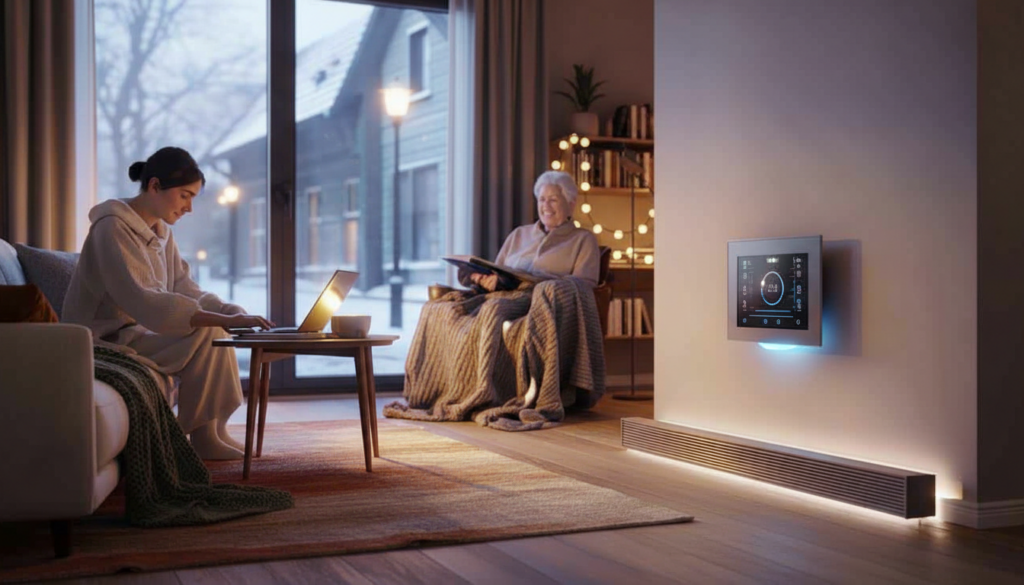
But when your toes touch the cold floor, the theory seems very far away.
Why the 19 °C rule is falling apart
For a long time, 19 °C was a moral standard. It felt like a sin against the environment to turn the thermostat up and like a heroic sacrifice to turn it down. The number was everywhere: on government ads, energy bills, and even in office memos. It changed from a suggestion to a rule of behavior.

But reality keeps getting in the way. Kids doing their homework while wearing hoodies and gloves with no fingers. In October, older parents sit in the living room with a blanket on their knees. People who work from home all day are stuck at their screens. The old rule just doesn’t work with how we live now.
For example, Aurélie, who is 38 years old, started working from home full-time two winters ago. She tried to keep the sacred 19 °C, but rising energy costs and guilt-inducing messages on social media made it hard. By January, she was always tense in her neck, her hands were always cold on the keyboard, and she was tired all the time, even after drinking coffee.
At first, her doctor didn’t give her vitamins. He asked a direct question: “How hot is it in your home office?” He just raised an eyebrow when she said, “19 °C, like we’re supposed to.” He told her to check 20–21 °C during the day for a few weeks, especially when she was sitting still. Her headaches got better, and she didn’t need that extra cup of tea at 5 p.m. to warm her bones anymore.
Experts are now saying something simple: the right temperature isn’t a set number. It’s a range. Also, it depends on how old you are, how active you are, how well your home is insulated, and even your gender. Studies on comfort show that our bodies react differently to 19 °C when we’re moving around than when we’re sitting still for hours. The rule of 19 °C came from a time when most people weren’t typing all day in a cold corner of the living room.
Energy experts and doctors are slowly coming to an agreement on a new recommendation: during the day, living areas should be kept at about 20–21 °C, especially if you’re working or sitting still. At night and in rooms that aren’t being used, the temperature should be a little lower.
The new target temperatures that experts really suggest
The new guideline that is coming out is less strict and more human. Instead of a universal 19 °C, many health and energy experts now say this: When you’re awake and not doing much, try to keep the main living spaces at around 20–21 °C. The living room, the corner of the home office, and the kids’ study area are all examples of this.
You can lower the temperature in the bedroom to about 17–18 °C at night. This helps you sleep better and lowers your bill. Kitchens can be a little cooler because cooking makes the room warmer. When you take a shower, though, it’s better for the bathroom to be 21–22 °C so you don’t get that painful shiver when you get out of the water.
Nobody tells you this out loud, but your body is not a thermostat with a factory setting. A young adult who moves around a lot, lives in a flat that is well-insulated, and cooks every night can feel fine at 19–20 °C. A senior citizen with poor circulation living in an old, drafty house might actually be putting their health at risk at that same temperature.
We’ve all been there: you’re at your grandparents’ house and think, “Wow, it’s hot in here,” but they still feel cold. Some doctors say that the main room should be 21–22 °C during the day for them. The “good” temperature now looks more like a sliding scale than a single magic number on a flyer.
There is also a psychological truth: if there is a cold draft on the floor or an icy wall behind your back, a room that is 20 °C doesn’t feel like 20 °C. It’s not just the temperature of the air that makes you comfortable; it’s also how your body gives off heat to everything around it. That’s why a simple thick rug or better windows can make a room that isn’t well insulated feel as comfortable at 20 °C as it does at 21 or 22 °C.
Let’s be honest: no one really walks around their house with a thermometer in their hand and changes it every hour. Experts are now calling for a mix of small habits and reasonable goals, with less dogma and more real life.
How to use the new temperature range to heat your home more efficiently
Many experts say the best way to do this is to choose a base temperature for your living space, around 20–21 °C, and then instead of feeling guilty, play with zones and times. At night, set your thermostat a little lower: 17–18 °C in bedrooms and 16–17 °C in rooms that aren’t being used or the hallway.

If you work from home, try this small routine: raise the temperature in the living room or office to 20–21 °C while you work, and then lower it a notch when you leave, cook, or move around more. The goal is not to heat everything all the time, but to heat where you are when you need it.
A lot of people make the mistake of thinking “all or nothing.” They either freeze at 18–19 °C to be good, or they give up and push to 23 °C everywhere as soon as the first cold snap hits. The new method encourages subtlety. You don’t have to live in a fridge to protect your wallet and the environment.
Dress for the season, even when you’re inside. This one tip will change everything. Not a mountain parka, just a warm sweater, socks, and maybe slippers instead of going barefoot on the tiles. That means you can feel good at 20–21 °C instead of chasing 23 °C just to feel “in a T-shirt like summer.”
Léa M., an energy engineer, puts it this way: “We’ve made 19 °C a moral standard when it should have stayed what it really is: a number in a context.”
She gives her clients a checklist to help them make changes one step at a time instead of worrying about a strict rule.
- When you’re home and mostly sitting down, set the temperature in your living areas to around 20–21 °C.
- For better sleep and lower costs, keep bedrooms at 17–18 °C at night.
- When you take a shower, make the bathrooms a little warmer, and then make them cooler again.
- Instead of “on/off marathons,” use programmable thermostats or simple time switches.
- Fix drafts (seals, rugs, curtains) so that 20 °C really feels comfortable.
- Changing how we think about comfort: it’s more than just a number on the thermostat
The change from the sacred 19 °C brings up a bigger question: what does it mean for you, in your own home, with your own body and routine, to be “warm enough”? Some people will feel very comfortable at 20 °C, wrapped up in a sweater and holding a cup of tea. Some people will need that little extra half-degree to stop their shoulders from getting tense all day. The goal isn’t to get the display to be perfect; it’s to find the right balance between comfort, health, and energy use.
You might even see that your relationship with heat is changing. You might have loved tropical interiors and wearing T-shirts in the winter a few years ago, but now you like the way you feel when it’s around 20 °C. Or the other way around. Our needs change over time, and so should our rules.
“Anything goes” doesn’t mean the end of the 19 °C rule. It’s more like a call to take back your thermostat as a tool, not a sign. To talk about it with your family or roommates. To say out loud what feels good and what is too much. A small, honest talk like that can do more for the world and your mood than a number on an old poster.
| Key point | Detail | Value for the reader |
|---|---|---|
| New comfort range | Around 20–21 °C in main living areas, cooler at night | Helps balance comfort, health, and energy savings |
| Adapt to your profile | Age, activity level, insulation, and health change your ideal temperature | Encourages a personalized, guilt-free approach |
| Think in zones and moments | Heat where you are, when you need it, instead of uniformly | Reduces bills without feeling like you’re “living in the cold” |
Questions and Answers:
Is it now “too cold” at home at 19 °C? Not always. Some active adults who live in well-insulated homes may be fine at 19–20 °C. Experts are saying that this rule doesn’t work for everyone anymore, especially for kids, seniors, or people who sit still all day.
What temperature do doctors say is best for older people? Most health professionals recommend that seniors live in a main living room that is between 21 and 22 °C, and if they feel comfortable, their bedrooms should be a little cooler. Avoiding being in the cold for long periods of time is the most important thing, as it can make circulation and breathing problems worse.
Will setting the temperature to 20–21 °C make my heating bill go up a lot compared to 19 °C? One extra degree does make you use more energy, but you can make up for it by zoning rooms, lowering the heat at night, sealing drafts, and not heating up spaces that aren’t used very often. The goal is not just “more heat,” but “smarter use of heat.”
What temperature is best for sleeping in the bedroom? Most sleep experts say that 17 to 18 °C is the best temperature. A bedroom that is a little cool and has a warm duvet usually helps you sleep better and longer than one that is very warm.
How can I tell if my house is too cold?If you are always tense, wearing coats inside, seeing condensation and mold, or if people who are weak feel cold even when they are resting, it may be too cold. You should trust both a thermometer and what your body is telling you, and stay within the new recommended range.