It was glowing under strip lights at a big-box store the first time I saw the nine-in-one kitchen tower. There were half-drunk cardboard coffee cups and bored partners waiting by the trolleys. A shiny black-and-chrome cube that promises to air fry, slow cook, grill, roast, dehydrate, steam, pressure cook, bake, and reheat while smiling at you from a box. A woman in a beige puffer coat tapped the box and said to her friend, “This would fix my whole kitchen.”
A sad row of lonely air fryers with red stickers across their faces sat on a discount shelf behind them. Last year’s heroes, who are now $39.99 and begging for another chance.
No one even looked at them once.
There was something strange about that scene. It was almost like we were speed-dating appliances and then ghosting them a month later.

The nine-in-one dream and the plastic hangover
The new nine-in-one gadget is marketed as a miracle: one box, one plug, and one solution to the mess and disorder of modern kitchens. Brands say you’ll throw away your air fryer, rice cooker, steamer, toaster oven, and half of your pans. Say goodbye to clutter and hello to clean, simple countertops.
There are a lot of sped-up videos of golden fries, sticky ribs, and brownies made in the same drum on TikTok and Instagram. Influencers hold up the box like it’s a ticket to a better life. They sigh, “I can’t believe I ever cooked without this,” as they slide perfectly crisp tofu onto white plates.
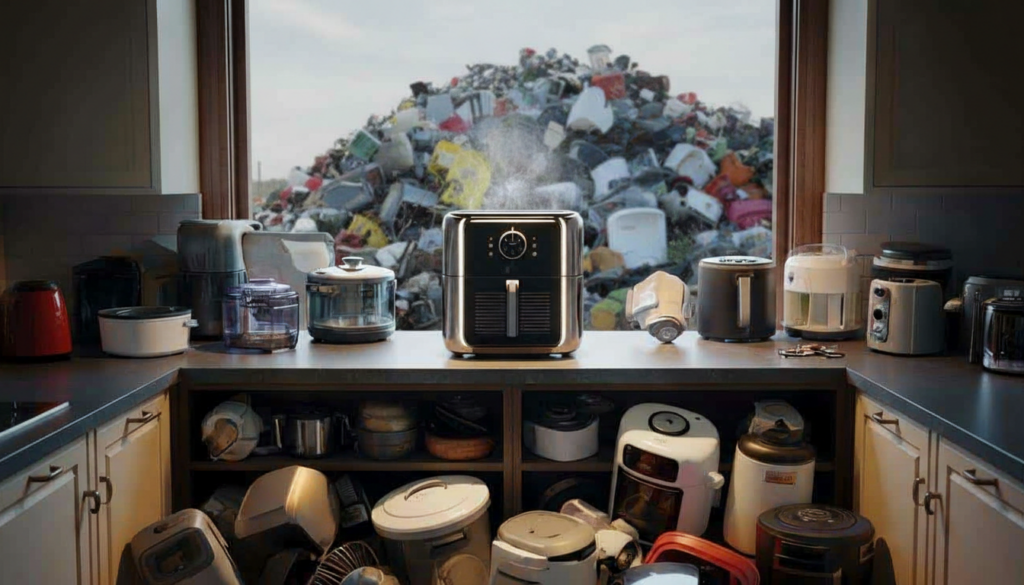
It looks like freedom on screen. In real life, it often looks more like another heavy plastic cube trying to fit into a cupboard that’s already full.
A waste contractor in London told me, “We can almost set our calendar by it.” He says that when the air fryer craze hit, truckloads of “barely used” units started showing up at collection centers three to six months later. Some are still in their plastic wrap.
He can now see the same shapes of logos in different sizes. They threw away old air fryers, multi-cookers, and sealed blenders. They were all made of plastic shells with wires and metal inside. No easy way to take it apart or recycle it. Just complicated trash.
You can look through dozens of “hardly used” nine-in-one units on Facebook Marketplace. These are gifts that never quite fit into someone’s routine. Each one is a story of hope, guilt, and another square foot of junk in the world.
These all-in-one appliances are likely to become e-waste from a design point of view. They put together plastics, heating elements, circuit boards, and screws that aren’t standard in a way that is cheap to make but hard to take apart. They don’t work with municipal recycling systems.
When the nine-in-one box breaks or goes out of style, it often ends up in the worst place: crushed, burned, or sent overseas. The “minimalist” countertop in your kitchen quietly means that there is a very non-minimalist footprint somewhere else on the planet.
To be honest, not many people think about where that old gadget goes after it disappears from under the sink for more than five minutes.
How to avoid the hype and keep your kitchen from becoming a junkyard
One simple thing you can do to change everything is to treat a new appliance like a trial employee instead of a soulmate. Before you buy that nine-in-one, make a list of the three things you really use every week. Not the ones you want to use. The ones you already use with the tools you have.
Then ask yourself a direct question: what keeps you from cooking more now? Not enough time, not enough skills, or not enough counter space? A new machine won’t magically fix things if the problem is energy or confidence. A sharp knife and a non-stick pan might be better for your life than a big cube of hot air.

Try the “30-day note test”: for a month, write down every time you think, “I wish I had a gadget for this.” That list is a lot more honest than any ad.
Buying things for the fantasy version of yourself is the worst thing you can do. The person who makes lentil curries in big batches, bakes sourdough bread on weekdays, dehydrates apple rings for the kids, and steams salmon on Tuesday nights just because. You might find that person on YouTube, but they don’t actually live in your building.
We’ve all had that moment when you open a cupboard and a bunch of plastic bowls and tools that you don’t use fall on your feet. You feel bad, like you wasted money, and a little like you were tricked, but you also feel strangely attached to the promise they once held.
To be kind to yourself, you need to accept how you really are. You don’t need nine ways to cook if you mostly reheat leftovers and roast vegetables. You need one or two tools that you can trust and that won’t end up in a landfill on a bad day.
Marie, a volunteer at a French repair café, says, “Every time we buy a new multi-gadget, we’re not just making our kitchen better.” “We’re voting for a world where it’s normal to throw things away and fixing things is rare.”
Before you buy, ask a friend if you can borrow, rent, or try out a similar appliance for a week. Once the novelty wears off, pay attention to how often you really use it.
When you own it, learn how to reset electronics, clean filters, and change seals. These boring skills can often make a device last twice as long.
If it breaks, don’t just assume it’s “dead.” Check local repair cafés, maker spaces, or brand repair programs first. Most failures can be fixed in 15 minutes.
When you’re ready to let go: Look for certified e-waste collection days or stores that will take back your old appliances. If you throw it next to the trash cans, someone else has to pay for it.
The most powerful thing you can do is wait 24 hours before clicking “buy now” on any new kitchen gadget. That little space is where better choices are made.
What kind of kitchen do we really want, besides the air fryer?
There are always more than just gadgets in stories about nine-in-one gadgets. They are about time, goals, and the quiet pressure to make every part of our lives better, even our frying pans. The air fryer became a sign that “I’m getting my life together,” but then it was replaced by something newer, bigger, and supposedly smarter.
There is already a quieter revolution going on at the same time. People are fixing up old 1980s mixers. A few times a year, neighbors share dehydrators instead of buying their own. Small companies are making modular appliances that let you change out parts instead of buying a whole new box.
The question isn’t whether the nine-in-one is “good” or “bad.” It’s about the kind of relationship we want with the things we use to cook every day. Do we want a carousel of short-term relationships or a few long-term friends who are a little scratched and very familiar?
You might already be able to tell that the next plastic cube isn’t the real upgrade. It’s a slower, more honest way to decide what gets a plug in your kitchen.
| Key point | Detail | Value for the reader |
|---|---|---|
| Question the nine-in-one promise | Most people regularly use only 2–3 functions out of the 9 on offer | Helps avoid paying for features that will gather dust |
| Think in lifespans, not launch dates | Complex mixed materials and electronics often turn into unrecyclable e‑waste | Encourages smarter, more sustainable purchases that last longer |
| Repair and share before replacing | Borrowing, fixing, or reselling extends an appliance’s useful life | Saves money, reduces clutter, and cuts personal contribution to plastic junkyards |
Questions and Answers:
Question 1: Is it ever a good idea to buy a nine-in-one gadget, or is it always a bad idea?
Question 2: What should I do with my old air fryer if I get a new one or stop using it?
Question 3: Are these multi-cookers really worse for the environment than a normal oven?
Question 4: How can I tell if I’ll really use all the features on a new appliance?
Question 5: Are there any brands or styles that are better for fixing and throwing away?