When you step over the threshold, that little jump from the jet bridge to the plane, the cabin lights are still bright. Your bag hits your leg, the air smells like coffee and recycled air, and three people are already looking at you. They grin. You smile back. It doesn’t feel like anything. A polite conversation before you fight for space in the overhead bin and start scrolling through your phone in row 23B.
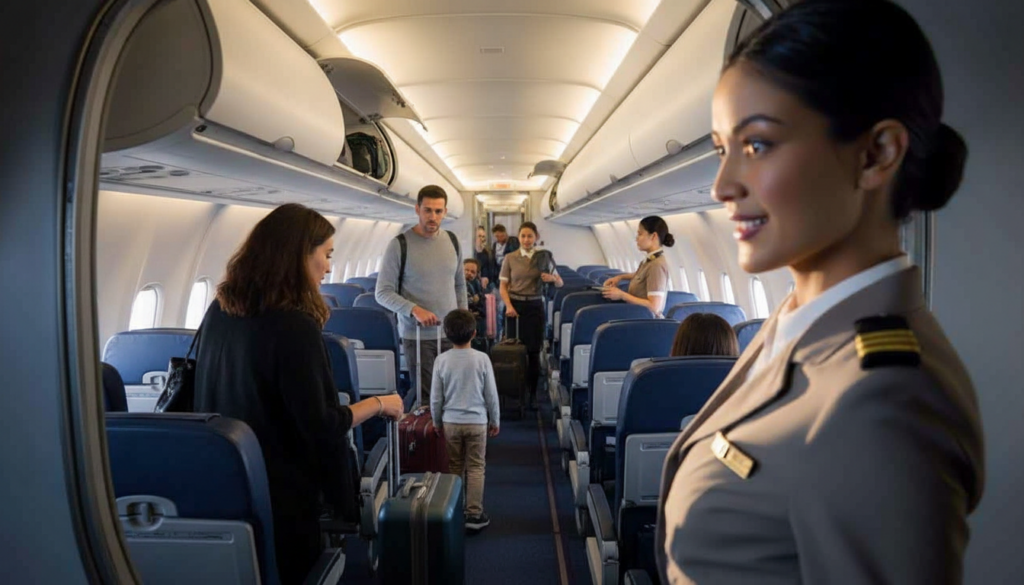
What you don’t feel is what they’re quietly writing down about you in a matter of seconds.
The way you breathe, the way you hold your boarding pass like it might explode, and the way you wear your jacket. The way you say “hello.” How you look around the cabin, or don’t.

This isn’t being paranoid. It’s what they do.
And they go faster than you think.
1. Your mood hits them like a strong wind.
They can tell how you feel before you even say anything. Are you calm and present, or are you already on edge because of the long security line and the expensive sandwich? Flight attendants will tell you that they can feel a tense passenger like you can feel a cold draft under a door.
They see stiff shoulders, fake smiles, and blank stares. The ones who walk down the aisle quickly, as if they’re late for a meeting. The people who stop, look you in the eye, and say a real “hi” instead of mumbling something at their shoes.
You think you’re blending in with a crowd that is moving. No, you’re not. Your mood goes ahead of you.
I once saw a businessman get on board with his jaw clenched and his phone glued to his ear. He didn’t look at any of the crew members. He threw his bag into the overhead compartment, cursed under his breath, and then yelled at the stranger in his row for “taking too long” to sit down.
A woman in leggings and messy hair walked by two rows behind him. She looked tired, but she smiled at everyone and said sorry as she squeezed into her middle seat. The flight attendant took both of them in under ten seconds.
Who got a quiet check-in later, some extra water, and a soft “Are you okay up here?””on the final approach. Flight attendants don’t have any favorites. They are putting people in order of who might need help and who might get worse.
This radar has a useful purpose. Being in a bad mood on the ground can become a real safety problem at 36,000 feet. Limited space, late meals, turbulence, alcohol, and crying babies all make whatever you brought with you worse.
Long before they make the news, cabin crew are trained to spot “problem passengers.” They also know how to spot people who are about to cry or who are trying to hide their panic behind a book or a hoodie.
So that first “hello” isn’t just small talk. It’s information. It tells them what to say to you if there is a medical problem, a delay, or bad weather. And yes, sometimes it tells them who might not be able to get a drink.
2. It’s clear that you are either confident or not about flying.
In just two steps, they can tell if you’re a seasoned flyer or someone who still checks their seat number three times like it’s a code. They pay attention to how you hold your boarding pass, if you know where to find your seat, and how you put your bag away without being asked.
A frequent flyer moves like their muscles remember how to do it. Put your bag down, take out your laptop, take off your belt, and put it back on. Not much wasted movement. The nervous flyers fumble with their things, stare at the panels above their heads, and pull on their seatbelt five times to make sure. They tell jokes and then go very quiet at other times.
The flight attendants don’t judge either group. They just remember it in their heads for when they need to keep an eye on someone during turbulence or boarding chaos.
A young man in a hoodie got on a crowded evening flight and stopped in the doorway. There were a lot of people behind him, and the line was backing up into the jet bridge. He kept looking at his boarding pass and then at the seat numbers, as if he thought they would move around on their own.
The head flight attendant changed right away. “Is this your first time flying with us?””She asked softly. His shoulders went down a little. He nodded. She led him down a few rows, pointed, and waited for him to sit down. Ten minutes later, when a light chop hit, she was back in his row, checking in like it was the most normal thing in the world.
That isn’t a coincidence. That’s profiling in the best way possible.
They scan for this right away for a reason. Passengers who are nervous may hit the call button over and over or think that normal sounds are dangerous. They might unbuckle at the worst time or not move at all during an evacuation.
You aren’t safer just because you feel confident about flying, but being comfortable often means you’ll follow directions calmly. Flight attendants are quietly making a mental list of who might freak out, who is likely to help, and who needs extra reassurance.
To be honest, no one reads the safety card every time. People who have flown before treat it like background noise. That’s also why the crew keeps an eye on the new people, in case things get weird and they actually listen.
How you treat “invisible” people tells them everything
There’s a tiny social test happening as you cross the aircraft door, and you don’t even realize you’re taking it. Flight attendants notice if you speak to them like humans or walk past as if they’re part of the wallpaper. They pick up on whether you say “hi,” “thank you,” or nothing at all.
The ones who bark, snap, or shove their boarding pass into a flight attendant’s face stand out instantly. So do the ones who give a warm smile or a simple, genuine nod. *The human part of the job starts long before the safety demo.*
That first five seconds often predicts how the rest of the flight will feel around you.
A crew member once told me about a man in first class who boarded in total silence. No hello, no eye contact, nothing. During the flight, he was polite enough, but clipped, transactional. At landing, the captain came out to say goodbye to everyone. The man suddenly lit up, chatting, laughing, showering praise.
The crew noticed. They always do when passengers only turn on the charm for the “important” uniform. The same flight had a teenager in economy who thanked every crew member who passed, even when they weren’t serving his row. Guess whose face they remembered on the next rotation.
These micro-moments make a difference. Not because cabin crew are petty, but because respect often equals cooperation when things go sideways.
There’s a plain logic to this social X-ray. People who are kind when nothing is at stake are more likely to stay reasonable when there’s stress, discomfort, or delay. The ones who start grumpy at the door? They’re the first to slam the call button when the Wi-Fi stalls.
So flight attendants watch how you talk, not just what you say. Do you snap when the overhead bins fill up? Do you roll your eyes at families or elderly passengers? That gets mentally pinned.
And here’s the quiet truth: **the passengers who treat crew like humans often get treated like VIPs without even knowing it.** A refill here, a checked-in “are you warm enough?” there. Not favoritism. Just human reciprocity at 30,000 feet.
Your physical state: tired, sick, drunk, or not okay
From the moment you step through the door, flight attendants are quietly checking if you’re physically fit to fly. They’re not just eyeing your carry-on. They’re scanning your face for sweat, your gait for a wobble, your breathing for that shallow, panicky rhythm.

Red, glassy eyes plus strong alcohol smell? That’s a mental red flag. A deep cough and greyish skin tone? Another one. They’re trained to pick up on medical warning signs fast, because once that door is closed, their world shrinks to whatever resources are on board.
So if you limp a little or clutch your chest, they see it, even if nobody says anything yet.
On a dawn flight out of Vegas, a man boarded holding onto the sides of the door, laughing too loudly. His friends thought it was funny; the lead flight attendant did not. She watched the way he swayed, listened to his slurred hello, and exchanged a look with her colleague.
Before pushback, she visited his row and casually started a conversation. A few friendly questions revealed he’d been drinking all night, barely slept, and couldn’t remember when he last had water. She quietly checked with the captain. They denied him boarding for safety. The friends were furious, but an hour later, over the Rockies, turbulence hit hard.
That could have been a mid-air medical – or worse – story. Instead, it stayed a footnote nobody else on the plane knew about.
This kind of screening isn’t about judgment; it’s about math and risk. A drunk passenger can become aggressive, disobedient, or dangerously sluggish in an emergency. Someone already in respiratory distress on the ground may not handle cabin pressure changes well.
Flight attendants are the early-warning system for these scenarios. They notice trembling hands, blue lips, heavy sweating, confusion, even the way someone lowers themselves into a seat. They quietly flag potential problems to each other.
**If a crew member ever gently asks if you’re feeling okay as you board, that’s not small talk.** That’s them giving you a chance to speak up before the situation is out of both your hands.
Your relationship with rules shows in seconds
One of the first things crew clock is whether you’re a rule follower or a rule negotiator. They see it in the way you handle your bag, your phone, your seat assignment. That little shrug when someone says, “Those bins are for row 10 only.” That tiny smirk when you ask, “Can’t I just sit there if it’s empty?”
They watch who sneaks AirPods back in during the safety briefing. Who pretends not to hear the request to buckle up. Who sprints to the lav just as the plane starts taxiing. These small acts tell them how much energy they might spend on you later.
Most people comply without drama. Some treat every instruction like the start of a debate show.
A flight attendant once described “the early rebel” to me. This is the passenger who, within 30 seconds of boarding, does one of three things: refuses to gate-check an oversized bag, argues about storing their backpack under the seat, or laughs off a direct instruction with a “you’re not serious, right?”
On one flight, a man in the exit row insisted on keeping his massive backpack in his lap. When asked to stow it, he rolled his eyes and said, “Come on, it’s fine, I’ll hold it.” The crew member noted his name and seat out loud to a colleague. Later, during turbulence, he was also the one unbuckling his seatbelt to grab something overhead.
None of this surprised them. His pattern was clear the second he walked on.
Rule resistance isn’t just annoying; it’s contagious. One person refusing to comply can derail boarding for 180 people and delay takeoff. It can also embolden others to start bargaining with safety.
Flight attendants are trained to nip this early. If they sense pushback at the door, they’re already running through scripts in their head for firmer language later. They’ll also subtly enlist allies – passengers who seem calm and cooperative nearby.
**Your attitude toward small rules often predicts your behavior in big moments.** And crews don’t have the luxury of waiting to find that out at 38,000 feet during a go-around.
What you might need long before you ask
Here’s the part that feels almost psychic. While you’re still shuffling down the aisle, flight attendants are quietly guessing what you might need later. The parent juggling a stroller and a diaper bag? They’re mentally prepping extra water, napkins, maybe a plastic cup to entertain a toddler.
The older passenger walking slowly, gripping the seats for support? They’re already a priority for help with bags, seatbelts, and maybe a discreet check-in mid-flight. The solo traveler with no bag, headphones on, eyes glazed from a red-eye connection? They’re marked as someone who might just want to be left alone.
They’re not stereotyping. They’re forecasting.
On a transatlantic flight, a woman in her 60s stepped on wearing compression socks and carrying a small medical-looking pouch. She moved carefully, breathing a little harder than those around her. No fuss, no complaint. She just quietly took her aisle seat.
The cabin crew noted her instantly. Before takeoff, one attendant checked that she knew where the call button was. A few hours in, when the cabin was dark and most people were asleep, they swung by with water and a soft question: “How are you feeling?”
Nothing dramatic happened. No emergency, no diversion. But that invisible net of attention was there because of what they read in the first three seconds.
This anticipatory care is their real superpower. Flight attendants have limited time and energy, so they invest it where it’s most likely to matter. That’s why they notice parents traveling alone, people with visible anxiety, those with mobility aids, even the way someone winces when lifting a bag.
They’re quietly building a mental map of the cabin: who might faint, who might panic, who might help in a medical situation, who’ll probably sleep through everything.
“By the time we close the door, I already know who I’m going to keep an extra eye on,” one long-haul flight attendant told me. “You learn to read people fast, because you don’t get a second chance at 35,000 feet.”
Travel with visible awarenessA simple “hello” and eye contact help crew read you accurately and kindly.
Own your stateIf you’re nervous, exhausted, or not feeling well, mentioning it early can change how they support you.
Respect early boundariesSaying yes to small rules reduces tension and keeps options open if you really need help later.
Carry quiet empathyRemember the crew has already scanned 150 versions of you today; a bit of grace goes a long way.
Notice yourself boardingYour mood at the door often shapes your entire flight more than the seat or the snack.
The part you never see: how much you shape the flight
Once you sit down and the door closes, you probably stop thinking about that first moment on board. For the crew, it lingers. Your tiny behaviors – the way you responded to a greeting, how you treated the person in front of you, whether you seemed brittle or open – all become part of the chemistry of that flight.
We’ve all been there, that moment when the cabin either feels oddly calm or charged with low-level tension before you’ve even pushed back. That atmosphere doesn’t just appear from nowhere. It’s built one boarding at a time, one interaction at the door, one choice to smile or snap or shut down.
You’ll likely never know you were the person someone quietly watched over… or the one they quietly braced for.
Key point Detail Value for the reader
First impressions at the door Crew instantly assess mood, rule-compliance, and physical state Helps you understand how your behavior shapes the service you receive
Subtle behavioral “profiling” They note who’s anxious, aggressive, vulnerable, or supportive Shows why staying calm and respectful can improve your flight experience
Anticipated needs Parents, elderly travelers, nervous flyers are quietly prioritized Encourages you to communicate early so you get the right kind of help
FAQ:
Do flight attendants really notice every single passenger?They don’t memorize everyone, but they rapidly scan each person for mood, potential issues, and special needs. It’s less about remembering faces and more about spotting patterns.
Can being friendly actually change how I’m treated?Yes. While crew aim to treat everyone fairly, passengers who are calm and respectful often get more proactive help and small kindnesses when time is tight.
Will they judge me if I’m scared of flying?No. Many crew genuinely prefer when anxious flyers say so. It helps them offer reassurance and keep an eye on you during turbulence or long stretches without announcements.
Can they refuse to let me fly if I seem sick or drunk?They can. If they believe you’re a safety risk to yourself or others, they can involve the captain and ground staff to deny boarding or delay departure.
Is there anything useful I can say while boarding?A simple “hi,” a “first time flying,” or “I’m not feeling great today” is more useful than you think. It gives crew immediate context and often leads to better support during the flight.