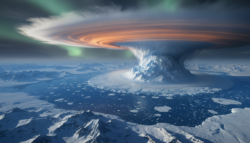
You can only see white at first. A huge, flat glare of Antarctic ice that is so bright it hurts your eyes even when you wear sunglasses. The wind makes a dry, constant hiss against your jacket, and a group of orange tents in the distance shakes like they’re scared to be there. Then someone points to a hole in the ice, which is a narrow, dark throat that goes down three kilometers. “That,” a glaciologist says through a frozen scarf, “is 34 million years of history.”
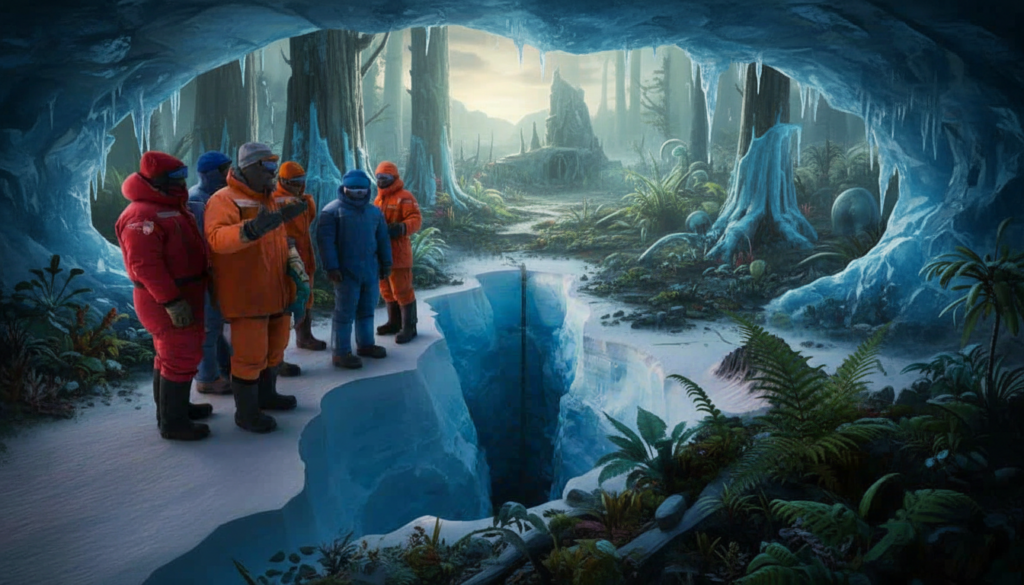
Beneath the thick ice is a world that is older than people. A landscape that has been frozen in place since before our ancestors learned to walk on two legs. Fossils were made from forests. Rivers cut through rock and then sealed it off.
The drill stops, and in the strange silence, a bigger question comes to mind.

A continent that we can’t see under our feet
The first 3D maps of this hidden world look almost like they were made up. The researchers’ screens show Antarctica’s ice peeling away like a see-through curtain, showing mountains, valleys, and even what looks like the ghost of an old coastline. The continent we know as a dead white desert now looks like it’s alive.
This frozen landscape is about 34 million years old, which is when Earth entered a deep freeze and Antarctica became the ice-covered pole we know today. Before that, it was a place with forests and rivers, and the weather was more like today’s Patagonia than the cold we think of when we think of the Moon.
Now that this lost world has been mapped, the question “What do we do with it?” is being asked in labs and ministries all over the place.
Scientists didn’t accidentally find this. They used ice-penetrating radar, satellite data, and gravity measurements, which they sent to supercomputers that slowly put the shape of the rock under the ice back together. The end result is a fossilized landscape the size of a small continent that has been preserved under up to 4 km of ice like a time capsule.
Geologists say that the patterns of erosion look “fresh,” as if rivers had just stopped carving their way through. Biologists see something else: the possible remains of ecosystems that are long gone, and maybe even microbial life that is still alive in small areas. Politicians, energy companies, and mining lobbies, on the other hand, see strategic value and possible resources.
This is where the fight starts, quietly at first, in conference calls and meeting rooms far away from the creaking ice.
It seems like the logic is clear. This landscape is a one-of-a-kind record of Earth’s climate if it has been sealed since the Antarctic ice sheet first formed. Sediments and fossils down there might show us how our planet goes from being green to frozen, what causes tipping points, and how the oceans and atmospheres react.
Climate scientists who are desperately trying to figure out what will happen in the next hundred years think that information is worth a lot. One researcher in Antarctica said it was like “finding a full medical record of a patient just before a heart attack.” We could read the story straight from the source instead of trying to piece it together from bits and pieces.
But every core sample and drilled hole could also disturb a system that hasn’t been disturbed in tens of millions of years.
Find out more, or draw a line?
A familiar argument comes up on one side of the debate: explore, sample, and understand. The goal is to drill deeper, not for oil or gas, but for sediments, fossils, trapped air bubbles, and maybe even signs of unknown organisms. Clean, controlled, and watched over by people from other countries. “Just for science,” as the saying goes.
The suggested method looks like a high-tech medical procedure. Drilling with hot water to make a narrow hole. Equipment that has been sterilized to keep germs from spreading. Robots and probes that go under the ice without people ever stepping on that old ground. The promise: little impact, a lot of knowledge.
Many researchers would feel like they were being careless if they couldn’t get to this archive.
But as soon as you open a door, you can’t fully choose who comes through it. We’ve all been there: a small exception slowly becomes the new rule. The Antarctic Treaty, which was signed in 1959, made the continent a peaceful place for science and banned military activity and resource exploitation. But it didn’t think about the “new world” that was 34 million years old and hidden below.
Some countries are already quietly funding mapping projects that break the treaty. Not drilling, just “looking around.” Not mining, just “assessing potential.” The tone of the writing is careful, but the message is clear: if there are rare earths or critical minerals under that old landscape, who gets to say no?
To be honest, no one reads the fine print of international agreements every day.
Environmental groups say that any physical intrusion, even if it’s for science, goes too far. They are afraid that the first drill will set a bad example that leads to the second, then the third, and so on, until “scientific access” becomes a legal way for businesses to get into the area. Once logistics are in place, bases are built, and routes are carved through ice, the line between research and resource extraction can quickly become very thin.

There is more to their worry than that. This fossil landscape is more than just rocks and dirt; it’s a rare example of a planet’s memory that hasn’t been disturbed. Like a library where no pages have been ripped out or written on the edges. Some ethicists now say that these kinds of perfect archives should be treated like nature reserves for time itself.
In that view, the most polite thing to do is not to open the book. It is to keep it safe while it is closed.
How to keep things safe that we can’t see
One new idea is very simple but radical: call the buried landscape a “no-go heritage zone” before anyone ever walks on it. No drilling. No access to the body. Only remote sensing from satellites and the ground is allowed. In a way, it would take the idea of UNESCO World Heritage to a place that people will probably never visit.
Legal teams are pushing for changes to the Antarctic Treaty system to back that up. The goal would be to create a clear category for “deep-time protected areas” under the ice, with strict, verifiable rules. It would be like drawing invisible lines on a map that only experts can see, but that connect all the countries.
The process is bureaucratic, slow, and a little boring. But this is how new global rules often start.
Researchers propose a compromise: prior to any drilling on that ancient terrain, the scientific community should establish a stringent “minimum necessary sampling” principle. That means small, targeted cores instead of wide access; letting all countries keep secrets instead of letting them keep secrets; and making a clear record of every intrusion.
People who have worked on polar campaigns know how easy it is to get too excited. When the helicopters, ships, and heavy equipment get there, it’s hard to resist the urge to “take just one more sample, just in case.” So, instead of a heroic promise, a boring spreadsheet that shows what is allowed, what is done, and what is not allowed may be the best protection.
Cold, clear transparency instead of warm, vague goals.
The conversation about ethics is slowly catching up with technology. Panels that used to only have glaciologists and geophysicists are now open to philosophers, Indigenous leaders from areas near the poles, and climate activists. One of them put it best in an online forum:
“We’re not just deciding what to do with an old rock,” she said. “We’re deciding how our species acts when faced with a temptation that no one has ever had before: the chance to open a perfectly sealed chapter of Earth’s history, just because we can.”
Some groups want a simple list of things to do before anything happens under the ice:
Is there a way to get similar information without being intrusive?
Will all countries be able to see the results?
Does this action make it more likely that people will be exploited in the future?
Have the local and global communities been asked for their opinions in a meaningful way?
Can we explain clearly why this needs to be done now and not later?
A mirror that shows us our future
The world that is buried under Antarctica won’t move tomorrow. The ice above it is thick, the logistics are hard, and the technology is still too expensive. That delay, on the other hand, gives us something that doesn’t happen often in world politics: time to think before we act. To figure out if this is a story of restraint or just another chapter in the long story of “we found something, so we used it.”
This is a funny kind of irony. The ancient landscape may contain insights into the mechanisms of past climatic collapses or stabilizations, knowledge that could aid our survival in the forthcoming century. Every time someone tries to get there, though, it could make the race, the competition, and the human noise that already makes the polar regions so hard to live in even worse.
The real value of this 34-million-year-old secret might not be just the information it holds. Maybe it’s the uncomfortable question it makes us ask: when do we finally decide that some doors, even the most interesting ones, are better left barely open?
The ice is thick, but our time to choose how we want to act on a changing planet seems much shorter.
Important pointDetailValue for the reader
Antarctic landscape from long agoA world that is 34 million years old and protected by kilometers of ice, with maps made by radar and satellitesHelps you understand how big changes in Earth’s climate can be over long periods of time
Clash of global moralsScientists, governments, and activists are divided between wanting to learn more and keeping what they already know safe.Helps us understand future headlines about treaties in Antarctica, drilling, and politics in the polar regions.
Decisions before actionThere are a lot of different suggestions, from strict “no-go” zones to tightly controlled sampling with full transparency.It makes you think about how people might treat other fragile frontiers, like deep oceans and space. FAQ: Is there really a “hidden world” under Antarctic ice?Not in the sense of forests and animals still living, but there is a huge fossil landscape of mountains, valleys, and river systems that were formed before Antarctica froze over about 34 million years ago.
Is it possible that there is life down there that we don’t know about?Microbial life may exist in subglacial lakes and sediments, adapted to darkness and pressure. It is very unlikely that larger animals or old forests will survive, but their fossils or chemical traces may still be around.
Is anyone trying to dig under the ice in Antarctica?There is no direct mining going on under the ice, and it would be very hard to do with the technology we have now. The Antarctic Treaty prohibits the commercial exploitation of mineral resources, although certain nations are discreetly examining geological potential.
What do scientists want to find out by drilling into this old land?They want to get back sediments and data that show how Earth’s climate changed when Antarctica froze. This could help make models for future sea-level rise and global warming scenarios more accurate.
Can regular people change what happens next?Yes, but not directly. Governments’ negotiations over updates to polar treaties and how much money goes to low-impact research versus more intrusive projects are all affected by public pressure, media attention, and support for strong environmental protections.