The playground gets very quiet at 11:17 a.m. The sky, which was a bright blue a few minutes ago, starts to get darker, as if someone is moving a huge dimmer switch over the town. A group of fourth-graders presses their fingers against the classroom window, leaving smudges on the glass. Their teacher tries to keep her voice calm and practical. “Everyone, eyes down, remember what we talked about.” The kids don’t pay attention.
There is a line of parents outside the fence, with their car engines running. They look nervously up, then at their phones, and finally at the school entrance, which won’t open. Some districts have asked for a full day off. Some people say that class will go on as usual, but it will be a little darker.
This eclipse has turned into a fight over who is really protecting the kids, somewhere between a science lesson and a scary sign.
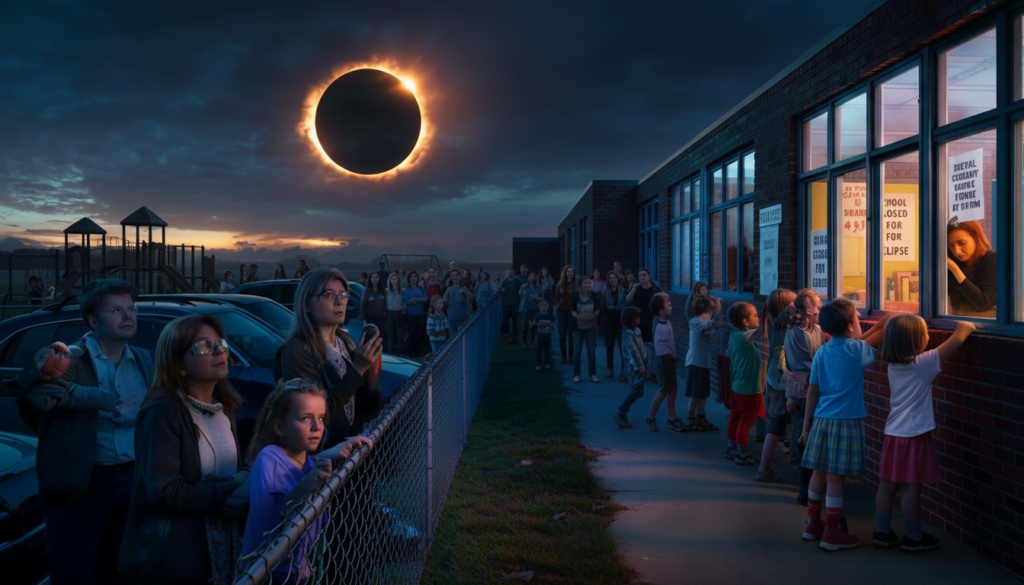
When the sun goes down, schools are in the spotlight.
The upcoming solar eclipse has turned into a hot local drama in towns along the path of totality. It’s a “once-in-a-century” celestial event on paper: the longest solar eclipse of the century, when daylight turns to night for a long, creepy few minutes. In reality, it’s a question that many superintendents are losing sleep over. Close schools and upset families and tests, or keep them open and risk being accused of putting kids’ safety at risk.
Parents are now filling up school board meetings that used to be boring and talk about cafeteria menus. They are holding printed NASA maps and Facebook posts. Everyone agrees that the sky will get dark. When it does, no one agrees on what the adults should do.
A suburban district in central Texas said it would close “for community safety,” and people cheered online within hours. A different district, less than 30 miles away, said it would stay open and “treat the eclipse as a chance to learn.” That letter made a lot of parents angry, and they said things like, “I’m not sending my child into a science experiment.”
Something like this is happening all along the eclipse path, from rural Arkansas to small-town Ohio. Some schools are letting out early so that buses don’t have to drive on dark roads. Some people are planning “eclipse parties” inside with the blinds closed. A few people are giving out approved eclipse glasses and making it the biggest science class of the decade.
Same sky. A completely different answer.
There is a messy mix of real worries and raw feelings behind these conflicting decisions. Administrators are worried about traffic jams, drivers who don’t know what they’re doing, and kids who will try to look at the sun without protection. Parents think of the worst things that could happen: a bus driver who isn’t paying attention, a kid who borrows fake eclipse glasses from the internet, and a crowd of scared people in a dark hallway. Many districts also remember that lawsuits always happen after a big event at school.
But astronomers and eye doctors keep saying the same thing: watching an eclipse is safe and unforgettable if you wear the right glasses and follow the rules. The stress isn’t just about risk. It’s all about trust.
How parents and schools can make a scary moment safe and shared
Plan the eclipse like you would a fire drill. This one simple, concrete step changes the whole mood. Not as a “maybe” event, but as a step-by-step plan that every adult on campus knows about. Who is inside, who is outside, who has the glasses, and who has the keys to the doors? When schools draw it out on a big whiteboard and walk through it with staff, the mood goes from worried to practical.
Some principals are even having a “mock eclipse” the week before. They turn down the lights, talk about the timing, and practice lining up at the right windows or walking to the right place to watch. Kids feel like they know what’s going on instead of being scared. Teachers stop talking quietly in the staff room and start talking to parents with confidence.
Parents are understandably torn between wanting their kids to be safe at home and not wanting them to miss a historic moment. As kids, many people were told, “Don’t you dare look at the sun,” but not much else. That fear is still there. Add fake glasses and “instant blindness” posts that go viral, and anxiety goes through the roof.
The best way to stay healthy is to stay calm and do the following: make sure the glasses come from a trusted source, go over the rules with your child the night before, and as a family, decide where that child will be during totality. Let’s be honest: no one really reads the whole safety sheet every day. But this time, reading it together for five minutes can help you stop worrying for a week.
For teachers who are stuck in the middle, being open and honest and using a human voice are the best things they can do. A simple email is often more helpful than a polished district statement. When the sky gets dark and the classroom gets loud, parents want to know what the grown-up in the room is really going to do.
Lena, a middle school science teacher in Indiana, says, “I told my parents exactly what I told my students.” “We’ll only go outside if it’s safe, and we’ll wear certified glasses. If any kid feels scared, they can stay inside with another teacher.” No one has to be brave about the sky.
Before the day of the eclipse, ask your school in writing what the plan is and who is in charge of each group of students.
During the eclipse, tell kids to remember this simple rule: keep their glasses on when they look up and take them off when they look at anything else.
If your child is nervous, give them a choice: they can watch the livestream, stay inside, or stay home with you.
For schools that haven’t made up their minds yet, think about the real-world risks (traffic, staffing, behavior) and the rare chance to turn this into living science.
Afterward, talk about what they saw or didn’t see and how it felt when day turned into night.
The eclipse will end. The argument over trust won’t
When the moon moves on and the light comes back, pictures of glowing rings, kids in big cardboard glasses, and pinkish twilight at noon will fill social media. The arguments about closing schools will go away almost as quickly as the dark. But there will still be something more subtle: a memory of how the adults around those kids acted when the sky acted strangely.
Some students will always remember watching the eclipse with their teachers on a football field, feeling small and amazed in the best way possible. Some people will remember being locked inside with the blinds drawn and hearing half-whispered warnings about danger outside. Some will remember their parents pulling them out of class at the last minute, their hearts racing, just in case.*In a few years, they won’t remember the exact numbers about retinal damage or the moon’s path around the Earth.* They’ll remember if they felt safe, heard, and told the truth. And that’s what this whole argument is really about: whether or not families think schools can keep their kids safe when the world suddenly goes dark, whether it’s real or not. The eclipse is a test for something bigger, and everyone knows it, even if they don’t say it out loud.
Main pointDetail: What the reader gets out of it
Plans for school are importantClear, step-by-step eclipse plans make staff, students, and parents less scared.Helps you figure out if your child’s school is really ready
Talking to each other builds trust.Emails that are easy to read, question-and-answer sessions, and honest timelines calm nerves more than technical memos.Gives you phrases and questions to start a real conversation with your district
It’s okay for families to make choices.If they are informed choices, it is okay to watch at school, at home, or not at all.It makes you feel better that you’re not “overreacting” or “too relaxed”; you’re just making a choice for your own child.
Frequently Asked Questions:
Question 1: Is it possible for a child to go blind from looking at a solar eclipse?
Question 2: How can I be sure that the eclipse glasses my child gets at school are safe?
Question 3: If the school stays open during the eclipse, should I keep my child home?
Question 4: What can schools do to make things safer during the darkest times?
Question 5My kid is scared of the sky getting dark. What can I do to make them feel less scared?