The street got very quiet at 11:17 a.m. The usual sounds of leaf blowers, scooters, and sirens in the distance got quieter, as if someone had turned the city’s volume down by half. A woman came out of a nail salon with foils on her fingers and a paper receipt over her eyes. A child asked, “Is it time for bed?” and no one laughed. The first bite of shadow was already on the sun, a small dark crescent that was eating the light.
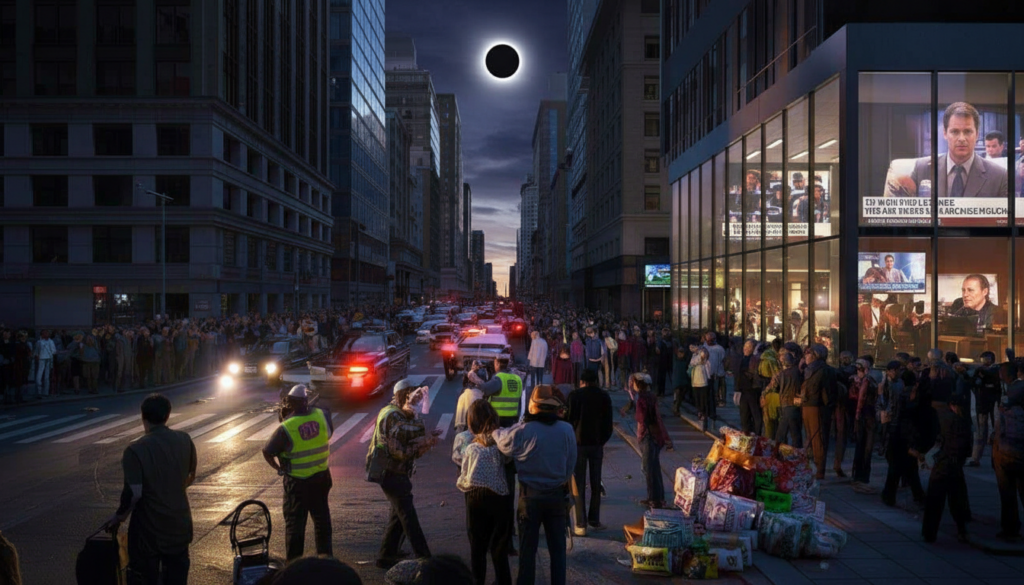
In a few hours, a wide strip of the planet will go from day to night. Astronomers are calling this the longest solar eclipse of the century. Quietly, officials are getting ready for chaos. There are already empty spots on supermarket shelves. There are rumors going around on Telegram and Facebook that phones are going to go dark and that the government is hiding something. Something unusual is going to happen in the sky.
Things that happen on the ground seem much less certain.
The eclipse that makes people more scared than excited
This eclipse is a gift, according to any astrophysicist. Long time, wide path, and perfect conditions for seeing. If you ask a city official, the tone changes quickly. When emergency planners talk about “crowd density,” “traffic choke points,” and “risk amplification,” it’s like they’re giving their own weather report. Astronomers are interested in the same darkness that scares a population that has been reading about crises and worst-case scenarios for years.
The mayor’s office in one midwestern town that is directly in the path of totality has already approved longer police shifts, temporary traffic controls, and more ambulance crews. There were a lot of posts in local Facebook groups last week after a fake screenshot said the power grid would “shut down for three days.” It wasn’t real. Still, gas stations had long lines all of a sudden, and a small pharmacy ran out of batteries and flashlights in one afternoon. One clerk said it plainly: “People came in calm, but their eyes looked scared.”
That’s the disease that officials are worried about. Not a “disaster” like in Hollywood, but a thousand little panics happening right now. A driver who hits the brakes too hard on a highway when it gets dark. A parent who doesn’t send their child to school because a cousin told them about “radiation bursts.” People who think the shadows on their living room wall are a sign of something wrong are calling the hospital a lot. When anxiety spreads faster than facts, it’s harder to make small mistakes.
Officials admit they are scared and blame the media.
Several regional emergency managers say that the eclipse itself isn’t their biggest problem behind closed doors. It’s us. Or, to be more exact, how the event is being covered in headlines, clips, and viral TikToks. One European civil protection agency’s leaked internal memo says that “sensationalist coverage may escalate public hysteria, overshadowing measured safety messaging.” That’s bureaucratic talk for “the drama is drowning out the basics.”
You can already see the two-screen world. On one side, serious scientists take their time to show you how to use eclipse glasses or a pinhole viewer. On the other hand, flashy thumbnails yell about “THE DAY THE SUN DIES” next to stock photos of people running in the street. A national TV segment about traffic pressure slowly turned into a doom edit on social media that said there would be “gridlock, looting, and riots.” The host never said any of that. But the cut-up clips move faster than any fix. That’s how a feeling of unease can turn into a mood you can almost taste.
Officials are also at fault. Some people have used scary language of their own, like “possible system strain,” without really saying what that means. Warnings that aren’t clear stick in your mind and get stronger. Let’s be honest: no one really reads the whole advisory PDF that the government puts on a dusty subpage. They read the headline, look at a push alert, and then scroll on, still worried about something they only half-remembered. That’s a great place for conspiracy theories and late-night YouTube spirals to grow.
How to stay grounded when the sky gets dark
So what do you do when the sun goes down and the streetlights come on at noon? Think about small, real, and local things. The night before, charge your phone. If you’re in a hotspot along the eclipse path and know you’ll be driving, fill up your tank. Make a plan for where you’ll watch and how you’ll get home. Those simple, boring moves are usually much more important than daydreams about “societal breakdown.” The eclipse will only last a few minutes. Your main job is to get there and back without making any noise.
The other useful step is mental, not physical. Choose ahead of time which sources you can trust. Your city’s official account, a well-known science site, or a local radio station. Then quietly mute or skip the countdown threads that make you feel weirdly jittery. We’ve all been there: that time when a casual scroll turns into a bunch of the worst TikToks that stick with you long after the screen goes dark. That doesn’t mean you’re easy to fool. It makes you a person.
People in charge kept saying the same thing to me: “We’re getting ready for crowds, not a collapse.” A public safety director said it best: “The sun is doing something unusual.” When things are uncertain, people do what they always do: think of all the things that could go wrong. He said that the real preparation is about keeping your expectations in check and your emotions steady.
Make sure you have the basics: glasses that are safe for solar viewing, a safe place to stand, and a way to get home that doesn’t depend on last-minute guesses.
Filter out the noise: Only trust two or three sources, and don’t send every dramatic clip to your friends and family.
Plan your mood: Do you want this to feel like a neighborhood event, a quiet solo watch, or a science-geek party? Make that the focus of the day.
A rare chance to look at ourselves, between awe and fear
An eclipse is mostly about shapes and shadows. We respond to it in a completely different way. The fact that a predictable celestial event can make people talk about “chaos” says more about our collective nervous system than it does about the moon. We’ve been through a lot of crises, alerts, and “breaking news” banners over the years. *The sky gets darker for a few minutes, and then all of our recent history is shown on it like a thin film.
That could be the quiet chance hiding in the drama. A test not of infrastructure, but of behavior. Do we go to panic threads and screenshot speculation, or do we talk to our neighbors, be curious, and say “wow” at 2 p.m. twilight? Neither answer is pure or permanent. They can live on the same street and be in the same family WhatsApp group. What you choose will have small effects, like whether a child remembers this as a scary near-disaster or as the day the birds stopped singing and the stars came out at lunch.
Officials are getting ready for the worst, and the media is chasing clicks. Both are betting on the same thing: fear gets people to pay attention. But fear also goes away quickly, leaving you with an emotional hangover. This place has another story that is quieter but stronger. A story about regular people looking at the same sky for once, breathing the same dim light, and realizing how fragile and connected everything is. No motto, no lesson. Just a rare midday night asking, without words, how we want to act when the world seems strange for a short time.
Main pointDetailWhat the reader gets out of it
Longest eclipse of the centuryLonger duration and a wider path draw in a huge audience, put a strain on logistics, and open up scientific opportunities.Helps you understand why people are both excited and nervous about this event
Officials are worried about social, not cosmic, risk.People are worried about traffic, crowds, rumors, and anxiety, not the actual danger of the eclipse.Keeps you from getting caught up in exaggerated disaster stories and lets you focus on real steps.
Your experience is shaped by the media and your mindset.Headlines that are too sensational and edits that are too doomful can make fear worse. On the other hand, simple planning and reliable sources can keep things calm.Gives you a simple way to turn a stressful news cycle into a moment that sticks with you.
Questions and Answers:
Question 1: Is it true that a solar eclipse can mess up power grids or phone networks?No, not usually. The eclipse changes the way light works, not the way infrastructure works. Any problems are much more likely to happen because of too many people (like too many people using their phones in one area) than because of the eclipse itself.
Question 2: Is it safe to go outside during the eclipse?It’s not dangerous to be outside. The danger comes from looking directly at the sun during the partial phases without the right protection. Treat it like a sharp tool: with care, not fear.
Question 3: Why are officials talking about “chaos” if they know what’s going to happen?They are more concerned about how people act than the weather. For example, traffic jams, services that are too busy, false information, and crowd pressure at popular viewing spots.
Question 4How can I tell if my glasses for the eclipse are safe?They should have a certification like ISO 12312-2 and come from a trusted seller or scientific institution. Don’t use the lenses if they are scratched, punctured, or more than a few years old.
Question 5: What kind of attitude should you have on the day of the eclipse?Curious, ready, and a little flexible. Instead of seeing it as a test of your survival skills, see it as a rare moment you share with someone else and let yourself feel both the strange and the amazing.