The first groan comes from the area around the treadmills. As the coach rolls a rack of dusty metal chairs into the middle of the gym, someone says, “Oh no, not those.” A few people act like they are stretching for a long time, hoping the moment will pass. Some people suddenly need water. No one wants to say it, but the phrase “sit-to-stand squats” makes half of the room want to quit right away.
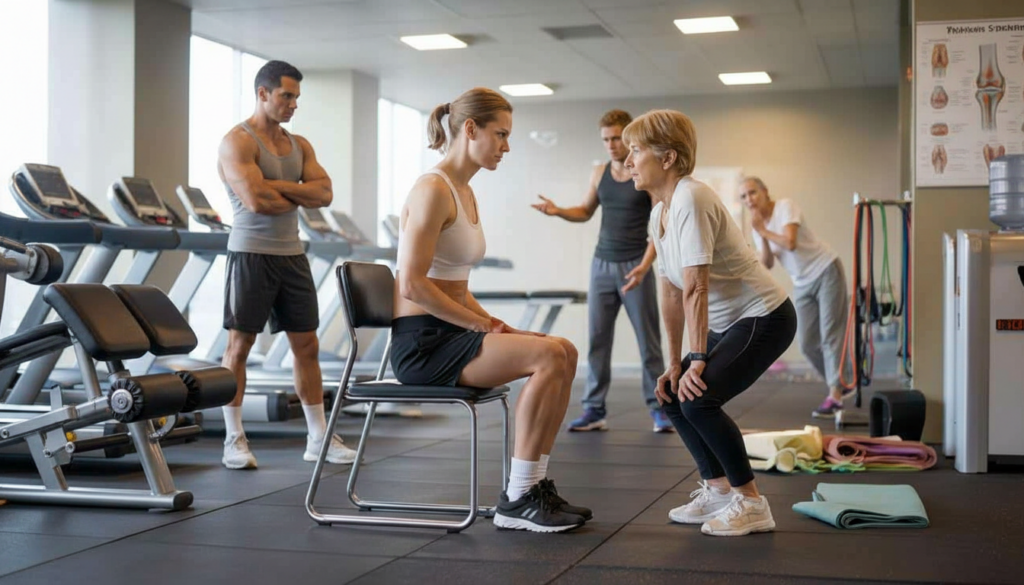
You probably know this action by a simpler name: getting up and down from a chair. The “grandma exercise” that everyone in the group class hates the most. People skip this one because they think it’s too easy, boring, or embarrassing.
But this is what a lot of physiotherapists are now calling “the single best remedy” for knee pain that won’t go away.

People in the room don’t agree.
The “boring” move that won’t go away
If you ask a physiotherapist what they tell almost everyone with sore knees to do, you’ll get the same answer: sit-to-stand. Or the wall sit, which is like it but standing. Over and over again. Every day.
Social media loves showing off deep squats with chains and colorful resistance bands, but the best thing for knee rehab is this simple up-and-down from a chair. No music, no fancy leggings, just you and gravity.
It sounds like nothing on paper. It can feel like a small mountain in real life.
A coach at a gym in the suburbs asked a mixed group to do three sets of 15 chair squats one night. A young man in a tank top rolled his eyes and said, “This is just warm-up stuff, right?” A woman in her fifties moved her water bottle closer without saying a word and stared at the floor.
The guy in the tank top was shaking and slowing down by the second set. The woman in her fifties had found a rhythm: sit, stand, breathe, and start over. She seemed surprised at the end and said, “My knees don’t hurt any more.” That’s… different.
The coach later said, “People will believe me if I call it ‘functional strength work.'” People think I’m calling them old when I say it’s rehab for their knees.
The reasoning behind this “grandma exercise” is very simple. When you stand up from a chair or go down stairs, knee pain often gets worse. The joint handles the load in both cases, but your quadriceps and glutes need to fire in a controlled way.
Sit-to-stand squats teach that exact pattern: a safe range of motion, a vertical load, and a controlled descent. Wall sits put weight on the thighs without moving them, which builds strength without the joint shearing that many people are afraid of.
It’s not magic. It’s the same thing that knees have to do all day: bend, bear weight, and then straighten again without screaming.

How to do the “most hated” exercise in a way that makes your knees happy
Set up simply: sit in a stable chair with your feet flat on the floor and your knees about over your ankles. Move a little closer to the edge of the seat. Bend your torso forward a little, as if you’re about to stand up to greet someone.
Stand up without using your hands and press your feet into the ground. Then, slowly sit back down, as if the chair might disappear. Do 8 to 10 reps, taking a break between sets. If your knees hurt a lot, use a cushion to raise the seat or sit in a higher chair to make the angle less painful.
Not depth is the goal. The goal is to move smoothly and with control, without any stabbing pain.
A lot of people give up here. They push through pain “to be brave,” go too low, or rush the move just to get it over with. The body gets stiff, the face gets tight, and the brain says, “Never again, thanks.”
There is a different way. Don’t think of it as punishing your knees; think of it as retraining your relationship with them. A small range, slow repetition, and honest listening. *Progress is often so slow that you don’t notice it until a staircase suddenly seems less scary.
To be honest, no one really does this every day. But the people who get better are the ones who do it most days, quietly, and without any drama.
Marie, a sports physiotherapist in Lyon, says, “People think that a magic stretch or some strange Pilates move will fix their knees.” “But sit-to-stand and wall sits work the best for me. At first, patients hate them. Then one day, they realize they walked all afternoon without any pain. That’s when they stop fighting with the chair.
Start high, not low: Use a taller chair or add cushions so the first few sessions are almost too easy.
Use your pain scale: It’s okay to feel uncomfortable up to a 3 out of 10. If you feel sharp or persistent pain, you need to make changes.
Play with help: Without putting your weight on it, put a light finger on a table or wall to help you balance.
Instead of counting reps, count breaths: Do this 2–3 times, 8–12 times, standing on an exhale and sitting on an inhale.
Make it part of your daily life: do a set before you drink coffee, one before you brush your teeth, and one more after dinner.
Why no one agrees… and why that could be a good thing
You can see the split on any fitness forum. One side says that squats and wall sits “saved their knees.” The other person blames them for every flare-up and says that only swimming or Pilates feel “safe.” They are both telling the truth. Both are missing some of the picture.
Pain is different for everyone. Two people with the same MRI may react differently to the same workout. Loading the joint makes one feel powerful. The other person gets scared and tightens everything around it at the first twinge. There is a quiet middle path between those two extremes: targeted strength, at the right level, on a joint that is gently asked to work again.
Important point Detail: What the reader gets out of it
Simple strength is better than fancy routines.Chair squats and wall sits work the same muscles that cause knee pain every day.Learn why a “boring” move can make your knees feel different when you go up and down stairs, sit in a chair, or walk.
More than intensity, progression is important.You can change the height of the chair, the range of motion, and the frequency.Make the exercise work for your knees instead of making them worse.
Consistency changes the way the brain and joints talk to each other.Regular, low-drama practice lowers fear and builds trust in movement.Over time, you will feel less fragile and more in charge of your body.
Frequently Asked Questions:
Question 1: Do chair squats really help knee pain more than swimming or Pilates?
Answer 1: They are not “better”; they are more specific. Chair squats are a great way to work out your knees because they directly train the motion your knees use to stand up and sit down. Swimming and Pilates are also great, low-impact options. For a lot of people, that targeted strength makes a bigger difference in their daily pain than just moving around gently.
Question 2: What should I do if my knees hurt when I sit down and stand up?
Answer 2Start with a higher seat, stand up less, and go slower. Pain that goes away quickly after the set and stays at a mild level is usually okay. If you feel sharp, catching, or lingering pain, you should lower the intensity or get one-on-one help from a physiotherapist.
Question 3: How many times should I do it to see results?
Answer 3: A good goal is to do 2–3 sets of 8–12 reps, 3–4 times a week. The last two or three reps of each set should be hard but not too hard. You can keep making progress by lowering the seat, adding a light weight, or slowing down the descent over the course of weeks.
Question 4: Are wall sits better for knees that are sensitive than squats?
Answer 4: Some people find wall sits easier to do at first because they don’t involve movement. You slide your back down the wall until your knees feel better, then you hold. Both exercises can be safe if you change them; many rehab plans use a mix of the two.
Question 5: How long will it be before my knee pain goes away?
Answer 5: Most people who stick with it see changes in 4–6 weeks. For example, stairs become a little easier, standing for a long time becomes less tiring, and getting up from the couch is less of a hassle. Big changes to the structure take longer, but small functional wins can happen surprisingly quickly.