At 11:42 a.m., the street just stops. Cars slow down, people stop talking, and a strange twilight comes in, as if someone has turned down the brightness of the world. The air gets a little cooler. Birds stop talking. A kid on a scooter stops pushing and looks up at the sky, which he was told not to do. The longest solar eclipse of the century is about to happen. Day is about to turn into night, not in a poetic way, but in a “where did the sun go?” way.
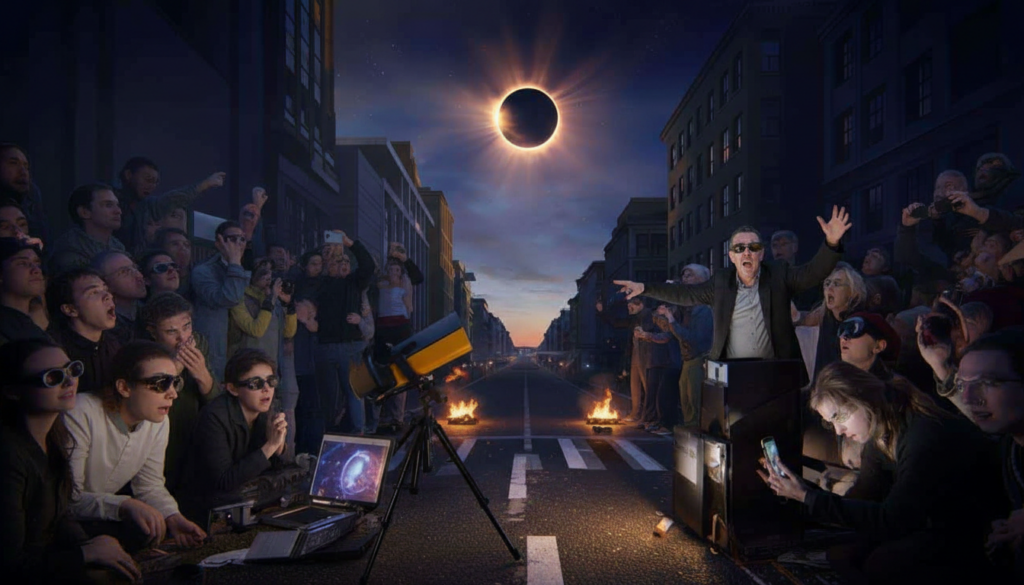
People on balconies and rooftops are both excited and scared. One hand has eclipse glasses and the other has a phone. Some people are watching a rare alignment of planets. People are also reading TikTok threads about signs of the end times, disasters, and omens.
There is a lot of tension building up between the shadow on the ground and the noise online.
The rumors get stronger when the sky gets dark.
People have always been divided into two groups during solar eclipses: those who get telescopes and those who get their gods. This time, with the longest eclipse of the century, that gap seems bigger. Local governments are getting ready for a wave of anxiety fueled by superstition along the path of totality, from big cities to small rural villages.
Depending on who you ask, the eclipse is being seen as a sign, a warning, or a curse. Scientists talk about how things move in space. Street signs talk about bad luck, crops that don’t grow, and babies that are going to die. The sky will be dark for a short time. The feeling of unease could last a lot longer.
Schools in a coastal town that is already in the path of the shadow have sent home flyers telling parents to keep their kids inside. Not to protect them from the light, but from “negative energies.” A local radio host is doing a special “eclipse protection” segment, playing chants between calls from listeners who are worried about miscarriages, accidents, and “broken destinies.”
At the same time, an observatory 20 kilometers away is getting ready to let people look through filtered telescopes and give them free glasses. People are calling their hotline not to make reservations, but to ask if the blackout means the world is “resetting” or if satellites will fall from the sky. In 2026, there are high-precision NASA maps in one tab and viral apocalypse threads in the next.
Scientists aren’t worried about the eclipse itself; they’re worried about its effects on society. They’ve seen this pattern before: when something strange and big happens in the sky, old beliefs suddenly seem new and important. People start to connect random things to the cosmic show, like a power outage here, an earthquake there, or a bad week at work.
This is how myths are made in real time, with live streaming and algorithms. When the sun goes away, our brains respond in an old way: it feels like the rules are on hold. *Anything could happen, so everything seems possible. Panic, superstition, and opportunists all rush in through that tiny crack in certainty.
How to stay grounded when the sun goes down
Planning your few minutes of darkness like you would a big event is a surprisingly useful way to keep your head clear during the eclipse. Pick a place, a group of people, and an activity for that short time. Look at how the light changes on the buildings. Listen to how the city’s hum changes. Pay attention to your own body, like when you get goosebumps when the day turns into night.
Giving those minutes a shape helps your mind stay in the present, on your own street, instead of getting lost in vague worries about “omens” and “signs.” Don’t think of it as a moral judgment coming from the sky; instead, think of it as a weather event you’re watching.
Many people will feel bad for being scared, as if being scared is childish or unreasonable. No, it isn’t. When the sun goes down in the middle of the day, your body is wired to know that something is wrong. Don’t try to get rid of that feeling. It’s important to notice it, name it, and not let someone else use it to get clicks, money, or power.
Be careful of the long, dramatic thread or video that starts with “They aren’t telling you the truth about this eclipse.” It’s a classic trap. Your nervous system is already on edge, so you let your guard down. Let’s be honest: no one really reads the sources at the bottom of those posts every day. That’s how claims that don’t make sense get in and start to seem true.
Dr. Lina Ortega, a solar physicist who is working on getting the word out about this event, says, “Eclipses don’t cause chaos.” “People do. The sky is just an excuse for us.
Look at the sky, then look at the source: Enjoy the show, but when you read a dramatic claim, check the source. Is it a space agency, a university, or an anonymous account?
Don’t doom-scroll too much during totality: For those few minutes, keep your phone in your pocket. First, see the eclipse, then write about it.
Don’t keep your feelings to yourself; if you’re feeling anxious, tell someone nearby. When you share your fear, it becomes less strong.
Learn the basics: The Moon passes directly between the Earth and the Sun, which causes the eclipse. There is no ray, no curse, and no “cosmic punishment.”
Respect beliefs without making people panic: You can let people do their rituals while gently changing the subject when they talk about threats and guilt.
The hardest questions cast the longest shadows.
When the longest solar eclipse
Century casts its shadow over a number of countries, the sun won’t be the only thing that goes dark. People will start to worry again about fate, punishment, and control. This time, though, they’ll be wearing modern clothes and watching viral videos. Some towns and cities will not allow weddings that day. Some will shut down markets. Some will set up group prayers or meditations. Some people will throw eclipse parties on their rooftops with music and pizza.
The same thing happened, but the stories were very different. Some people were angry, some were curious, some were scared, and some were amazed. That split is more about us than the sky. How ready are we to live in a world where science explains almost everything, but we still want mystery and signs? When the light comes back on and the birds start singing again, the bigger question will still be there: what story did we tell ourselves while the world was dark for a short time?
Main pointDetailValue for the reader
Cosmic event versus social responseOrbital mechanics can fully explain the eclipse, but people react in different ways, from awe to panic.It helps you tell the difference between real risk and emotional noise and drama on the internet.
The part that media and algorithms playSuperstitions and doomsday stories spread more quickly during rare events, thanks to platforms.Promotes a more critical reading of content related to the eclipse.
Ways to ground yourself in real lifePlanning when to watch, naming your fear, checking sources, and talking to other people.Gives you real tools to enjoy the eclipse instead of being scared.
Questions and Answers:
Question 1: Is the longest solar eclipse of the century more dangerous than a regular eclipse?No, not at all. The word “longest” means how long totality lasts in some places, not that there is more risk. The only real physical danger is looking at the sun without the right eye protection when the total phase is over.
Question 2: Can eclipses bring about earthquakes, wars, or bad luck?There is no scientific proof that eclipses cause natural disasters or wars. People sometimes think that things that happen at the same time are related, but that’s not always true.
Question 3: Should pregnant women stay inside during the eclipse?No. Many cultures believe this, but modern medical research does not back it up. It’s your choice to stay inside if you feel better doing so; it’s not a medical requirement.
Question 4: Why do animals behave differently when it gets dark?A lot of animals depend on light signals. Birds might stop singing, bugs might start their “night” routines, and pets might look confused. They’re not sensing a cosmic disaster; they’re just reacting to the sudden change in light.
Question 5: How can I talk to relatives who believe in superstitions without being rude?Start by accepting their feelings and customs. Then, softly share simple facts, like how scientists can predict eclipses to the second, and ask them to watch the event with you so that it becomes a shared experience instead of a debate.