When the bars go away, the smartphone in your hand feels different.
There is that familiar little panic when you’re on a mountain road, at a crowded festival, or on a train cutting through empty countryside: no signal, no 4G, and no Wi-Fi to save you. You hold the phone up in the air like an antenna from the 1990s, hoping that an extra centimeter will magically catch a tower behind the clouds. Nothing. There is only a blank screen where your messages should be.
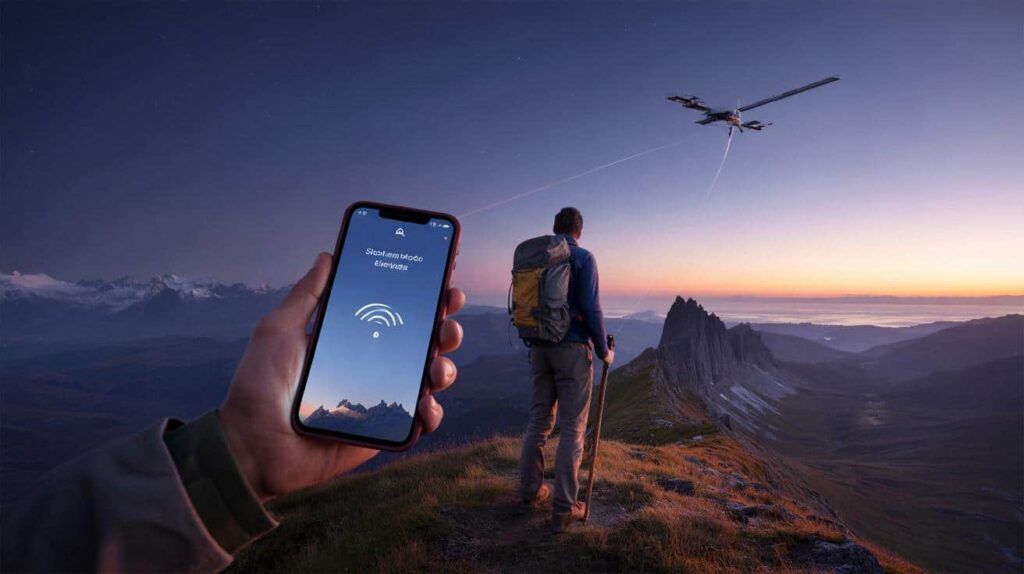
Now picture this: instead of looking at a mast, you look up at the sky.
Your phone connects to a satellite you can’t see, and the internet comes back on without any boxes, technicians, or new devices. Same SIM, same phone. A new world.
The sky suddenly turns into your cell tower.
Starlink just did something that sounds like it came from a science fiction movie, but when you think about it, it makes sense.
The company has turned on **direct-to-cell satellite internet** for regular cell phones. You don’t need a pizza-sized dish on your roof, a truck to bring you gear, or a fancy “space-ready” smartphone. If your operator works with Starlink, your current phone can talk to a satellite directly.

The idea changes the way we’ve been living for years.
Instead of running after the nearest antenna, your network comes from space and follows you over oceans, deserts, and dead zones on the map that used to be technological black holes.
People in the middle of nowhere watching little message bubbles pop up again are the first real signs of this future.
Imagine a hiker who is lost between two ridges and hasn’t had a 4G signal in three hours. They take out their phone, and a small icon shows a link to a satellite. A text goes through. Shared location. Help is on the way.
We’re starting to see trials with basic texting in the US, New Zealand, and a few early zones.
But the plan is clear: calls, data, and video will all come from low-orbit satellites that connect to standard 4G/LTE chips. Not a sci-fi prototype, but a slow rollout that has already begun, even though many of us are still complaining about that one corner of the living room where there is no signal.
In a technical sense, the trick is both easy and crazy.
Starlink sends up thousands of satellites that orbit the Earth at a low altitude and speak the same language as your phone. This makes it seem like there is an extra “tower” floating a few hundred kilometers above your head. The phone doesn’t know it’s talking to space; it just sees another LTE cell.
The problem is that these space cells are slower at first and have limited bandwidth, so they are better for emergency uses like SMS or low-bitrate services.
But this is how it always starts: SMS in the early 2000s didn’t feel like a big deal; it felt like something nice to have. After that, we used it for everything. Mobile satellite internet is likely to follow the same quiet path from interest to habit.
No new phone, no dish, and no technician on your couch
What you don’t have to do is what makes everything else change.
You don’t need to make holes in your wall. You don’t have to put a white Starlink dish on your balcony. You don’t have to buy a new “Starlink phone” or carry a big orange satellite phone in your backpack.
The method is so simple that it’s almost boring.
Your mobile provider makes a deal with Starlink for roaming or integration. A software update comes out, usually without much fanfare. One day, on a coverage map, small gray areas that used to mean “forget it” slowly turn pale blue: satellite fallback. Same SIM, same contract, same action: you just unlock your phone.
Our expectations are what makes things hard.
5G ads that promise super-fast speeds everywhere have set us up to expect that when someone first tries satellite internet on their phone, they’ll probably try to stream 4K on a windy cliff. Then they’ll complain on social media when it stops working.

Let’s be honest: no one really watches ultra-HD shows all day, every day, on the edge of the world.
What matters most out there is a text that goes through, a call that doesn’t drop, and a navigation app that loads one more map tile so you know which valley not to fall into. That’s where Starlink’s new mobile service makes sense: less wow factor and more usefulness that can save lives.
In interviews, Starlink’s engineers say the same thing over and over: “This isn’t about beating fiber.” It’s about linking places that fiber and cell towers will never be able to reach in a cost-effective way.
Tip 1: When your carrier offers this service, the first thing you should do is turn on any “Wi-Fi calling/satellite assist” or similar option in your settings. A lot of the time, it’s hidden in advanced network menus.
Tip 2: Don’t expect miracles to happen inside. Like weak 4G, satellite signals have a hard time getting through thick walls and basements. Go outside, hold the phone up a little, and wait a few seconds.
Tip 3: If you’re going on a trip to a really remote place, bring a small power bank. When you talk to space instead of a nearby mast, the phone may use a little more power.
Tip 4: Download important documents and offline maps before you leave. Satellite is not a way of life; it’s a safety net for people who don’t have local coverage.
Tip 5: Ask older family members about this option. Knowing that their phone can still send a message while they are walking in the country can make them feel safer going outside.
A new normal for “nowhere”
It’s strange to think that “no service” might slowly fade away from our screens.
We’ve been making up invisible lines in our heads for years: the last village with 4G, the last curve of road where you can still get a signal, and the last park bench where you can still make a call. After that, you’re on your own. We’ve all been there: the moment you walk a little too far and the call drops in the middle of a sentence.
With direct-to-cell satellites, those lines get less clear.
They don’t disappear overnight or magically; instead, they get blurry around the edges. Remote schools, fishing boats, hikers, farmers, and aid workers in disaster zones all go from “maybe reachable” to “reachable enough.”
The change in feelings might be bigger than the change in technology.
Parents will be able to follow their kids’ school bus on roads that used to be empty. People who travel alone will think twice about paying extra for heavy satellite gear. If the sky becomes the mast, small villages won’t have to beg for one.
Not everyone wants to be connected all the time and everywhere, though.
Some people will see this as one more thing that keeps them connected to work, notifications, and the noise they want to get away from on that hike. *The line between safety and digital invasion has never been thinner.*
Starlink is testing these first mobile connections more as a social experiment than as a tech feature.
What do we do when the last excuse, “Sorry, no signal,” dies down? Do we feel safer or more trapped? Do businesses see this as a backup link for emergencies, or do they use it as another way to send marketing messages from above?
The truth is that the satellites are going up, whether we like it or not.
We still own the way we use that link on the ground, with a phone in hand, deciding when to look up and connect and when to turn on airplane mode and let the silence win.
| Key point | Detail | Value for the reader |
|---|---|---|
| Direct-to-cell satellites | Starlink satellites talk directly to standard 4G/LTE phones via partner carriers | Understand why you won’t need new hardware or a special “satellite phone” |
| Coverage focus | Priority on dead zones, rural areas, sea, and mountains, with texting first, data later | Know when this tech will actually help you in real life, not just on paper |
| Realistic expectations | Limited speeds at launch, better outdoors, designed as a safety net, not a fiber replacement | Avoid disappointment and use the service where it truly matters most |
Starlink and you get the right software update.
Should I switch my SIM card or mobile plan?
Your operator may make special options or bundles that include satellite coverage, but you won’t need a new SIM card. In the beginning, it might only be able to send emergency texts or make simple calls when the regular network is down or out of reach.
Will I be able to use the satellite link to watch Netflix or TikTok?
Yes, for basic data, but with some restrictions. The first phase is all about SMS and low-bandwidth uses. Streaming and heavy apps probably won’t work until later, and speeds will be slower than 4G or 5G in cities, especially when a lot of people connect to the same satellite cell.
Does mobile satellite internet work inside?
Not very well. Satellite signals are even more sensitive to obstacles than weak 4G signals that have trouble getting through thick walls. You will get better results outside, on balconies, or near windows than deep inside buildings or in basements.
When will this be able to be used in my country?
Local laws and partnerships with operators will determine when the rollout happens. Some areas have started trials, and more countries are being added slowly. Checking your carrier’s announcements or coverage maps over the next few months is the easiest thing to do.