A group of engineers stands on a concrete platform at the edge of the city, where glass towers give way to rusted pipes and scrubland. They watch as water disappears into the ground. The hose shakes, the meters tick, and a steady stream of fresh water flows into an oil field that is more than a kilometer below their feet. For them, it’s a strange win: the land above has been sinking for years, buildings leaning over, and roads breaking slowly. The subsidence curve is finally starting to level out now.
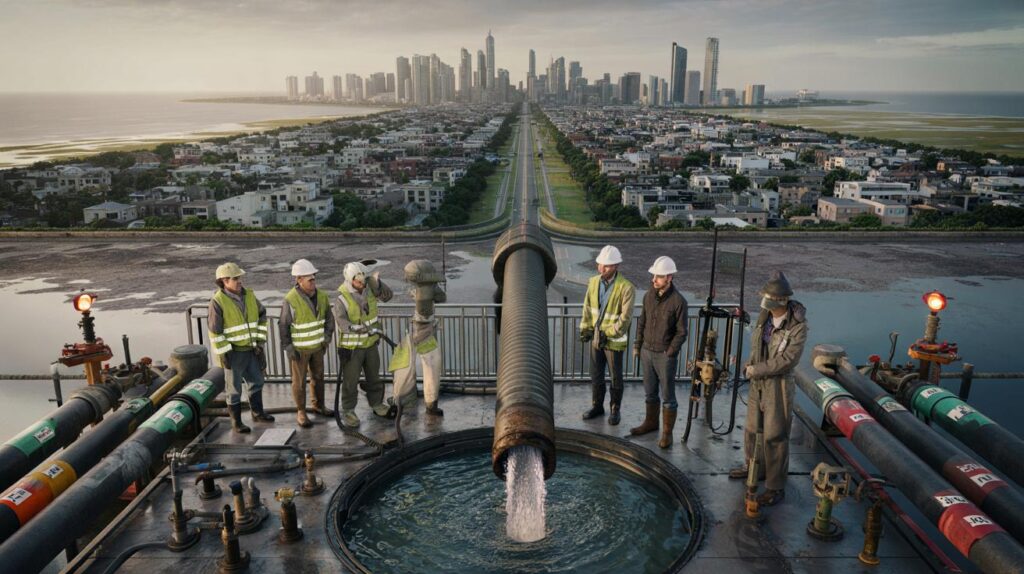
A drone flies overhead, filming the scene for a government video. Someone makes a joke that they are “re-inflating” the city like a mattress that has lost its shape. Not a lot of people laugh.
There’s a question in the air that weighs more than the machines.
Who gets to hit pause when the city starts to sink?
Land subsidence doesn’t usually happen all at once. It moves slowly. One day the door frame doesn’t close all the way, and a year later there’s a crack in the wall that wasn’t there before. Engineers, who are used to working with millimeters and maps, saw those changes across whole neighborhoods and took a drastic step: they flooded the empty oil reservoirs underground with water, rebuilt some of the lost pressure, and slowed the downward slide.

The idea looks good on paper. You fill in fields that have been empty for decades. The land above doesn’t fall apart as quickly. The headlines sound almost heroic, like a Marvel movie with hard hats and technocrats.
But the ground isn’t always as easy as a spreadsheet.
Check out Wilmington, which is in the harbor area of Los Angeles. For most of the 20th century, oil companies took billions of barrels from the fields under homes and refineries. The city started to sag. Parts of the area had sunk several meters by the 1950s, taking streets and pipelines with them. To stop the disaster, operators started pumping water into the tired formations. Subsidence slowed down and then almost stopped. The operation is now being praised as a perfect example of how to do things.
But if you walk those streets today, the story seems less clear. People live above a secret forest of wells, injection tubes, and fluids under pressure. If you talk to older neighbors, they will remember flooded basements, weird bubbles in yards, and the faint smell of chemicals on calm days. *The engineering “fix” didn’t erase the scars; it just moved the drama underground.
From a mechanical point of view, water injection makes sense. Oil doesn’t sit in big lakes underground; it sticks to rocks. When you take out enough of it, the pressure and support inside go down, and the rock layers can get closer together. The top of the surface falls down. Putting water back into these empty formations helps restore pressure and makes the underground “sponge” stiffer, which slows down the land’s collapse.
That’s the promise that a lot of cities are buying into. **Fill the empty fields with water, buy decades of stability, and keep the skyscrapers standing.** But pressure is a blunt tool. Those same fluids can move into faults, change the way stress works, and even cause small earthquakes in some areas. Planners in cities call it subsidence control. Geologists sometimes say that the crust is like a game of Jenga.
The hidden costs of “saving” a city that is going down
The method is technically elegant in some ways. Engineers make balanced injection plans that decide where the water goes, how fast it flows, and what pressures are okay. They keep an eye on wellheads and look at satellite data that shows surface movement to within a centimeter. They mix treated wastewater with seawater in some places to keep from wasting drinking water.
The point is not to fill the oil field back up like a pool. The goal is to move the rock underground just enough so that it stops getting tighter. The subsidence curve bends and then levels off on a graph, which is comforting. Urban officials see that line getting flatter and breathe a sigh of relief, at least for a budget cycle or two.
People make mistakes when they think the story ends there. We’ve all been there: that moment when a quick fix feels so good that you forget why you needed it in the first place. In Mexico City, Jakarta, parts of Shanghai, and Bangkok, whole neighborhoods are sinking because of a mix of groundwater pumping, oil and gas extraction, and the weight of new buildings. Injecting water into exhausted fields can slow the descent, but it can’t undo years of too much extraction or building that wasn’t planned.
People who live there notice the mixed reality first. One block stops going down, but another keeps going down. A newly stabilized industrial zone is now a few centimeters higher than an old residential area, which changes how water drains. Streets that were built to handle a certain amount of subsidence now send floodwaters into places that used to be “safe.” There is always a new imbalance waiting behind each correction.
Let’s be honest: no one reads the whole risk assessment every day. City councils see the win right away. Oil companies now have a new job: protecting the ground. Developers love a story where the “problem is under control” and projects can move forward on land that was previously sinking and is now valuable.
But you can’t change the way cities work with just one smart trick. **Drainage systems, foundations, subway lines, buried sewers, and fiber cables were all made to work with a certain type of ground.** If that type of ground changes suddenly, stress will move to other places. Some hydrologists say that fixing one sagging bowl with pressure could make the flood risk higher in a neighboring district that wasn’t ready for it. Some people are worried about chemical migration because injected water moves leftover hydrocarbons and metals into new cracks and pathways. What looks like a victory over subsidence could also be a quiet change in the weaknesses of cities.

Living on shaky ground and not looking away
There is a more sensible way to deal with this than just cheering or freaking out. One practical step that many cities that want to move forward are taking is to link subsidence control with water policy and building codes from the start. They don’t treat injection as a separate, hidden operation in industrial zones. Instead, they put its effects on zoning and infrastructure plans.
That could mean strengthening important foundations before the subsidence curve levels off. It could mean changing flood maps to show not only where the land is low now, but also where the levels will change if some areas stabilize and others keep sinking. It can even mean keeping some open spaces, like parks, sports fields, and wetlands, above the most unstable areas on purpose so that they can handle movement that would be dangerous under a hospital or metro station. It’s not very exciting. It’s the slow, steady work of getting used to living on shaky ground.
The biggest mistake people make is believing the “fixed” label too soon. When officials say that subsidence has been “brought under control” with water injection, people naturally feel relieved. People buy apartments they wouldn’t have touched before. Insurance companies quietly adjust their rates, and sometimes they don’t even explain why. The good news spreads faster than the bad news.
To be empathetic, you first have to admit that you’re scared and tired. People are tired of hearing about climate and geological threats that will last for a long time and that they can’t do anything about. They only want to know if their house will still be there in thirty years. Some local groups want simple, clear transparency, like public maps that show areas that have stabilized, areas that are still sinking, and areas where there is a lot of uncertainty. Having that map is like getting back a little bit of control when the danger is right under your feet.
“Flooding exhausted oil fields buys us time, not safety,” urban geologist Marta Ruiz told me during a field visit. The problem is that we think a disaster that is delayed is one that has been canceled. Her words hung in the hot air above the monitoring well, somewhere between a warning and a tired confession.
Ask questions about your ground.
Check environmental reports for city-submitted subsidence and injection maps, which are often hard to find. They show where the land is shifting and where the pressure is changing below ground.
Follow small signals at home
New cracks in the walls, doors that suddenly jam, and water that collects after rain: none of these things alone prove subsidence, but when they happen over time, they create a pattern that local officials can’t ignore.
Pay attention to the infrastructure, not just the news.
Small changes to drainage, new pumping stations, sidewalks that are raised in strange ways, or repeated pipe repairs often show where the city quietly feels the ground shifting, long before an official statement comes out.
The uneasy comfort of buying time
It’s almost poetic that the city is trying to rewind a century of oil extraction by pumping water back into the same rock pores where oil used to flow. The stabilization looks like it worked from space: the surface stops slumping and the digital elevation models calm down. Life goes on down on the street. Coffee shops are open, cranes are swinging, and kids ride their bikes past the fenced-off well pads without even looking.
But underneath that normalcy is a question that hasn’t been answered about what kind of safety we’re really building. Are we getting used to living on a planet whose crust and climate we’ve messed up, or are we adding fixes on top of fixes until the system becomes too complicated to understand? Flooding oil fields to delay subsidence is both smart and scary. It reminds us that our cities are not built on solid ground, but on terms that are constantly changing with the Earth.
Perhaps the most honest position is not to oppose or endorse the strategy, but to regard it as a tenuous ceasefire. A decade or two borrowed from the future, during which we decide whether to keep betting on risky ground or rethink where and how we build. The hoses will keep making noise at the edge of town. What do we do with the time they’ve quietly bought?
| Key point | Detail | Value for the reader |
|---|---|---|
| Water injection slows subsidence, not history | Flooding exhausted oil fields restores some underground pressure, flattening sinking trends without erasing past damage. | Helps you read official “success” stories with a more informed, critical eye. |
| Urban risks are being reshuffled | Stabilizing one zone can shift flood, quake, and infrastructure stress toward neighboring districts. | Encourages you to look beyond your own block and think at the scale of the whole city. |
| Citizen awareness is part of the safety net | Tracking small signals, maps and local works reveals how the ground is really behaving under your life. | Gives you practical levers to feel less powerless in front of a slow-motion urban hazard. |
FAQ:
Frequently Asked Questions:
Question 1: Does flooding old oil fields really keep cities from sinking?
Question 2: Can putting water into old oil wells cause earthquakes?
Question 3: Do a lot of big cities around the world do this?
Question 4: How can people who live above an injection field or subsidence zone find out?
Question 5: What are some long-term solutions that go beyond these technical “band-aids”?