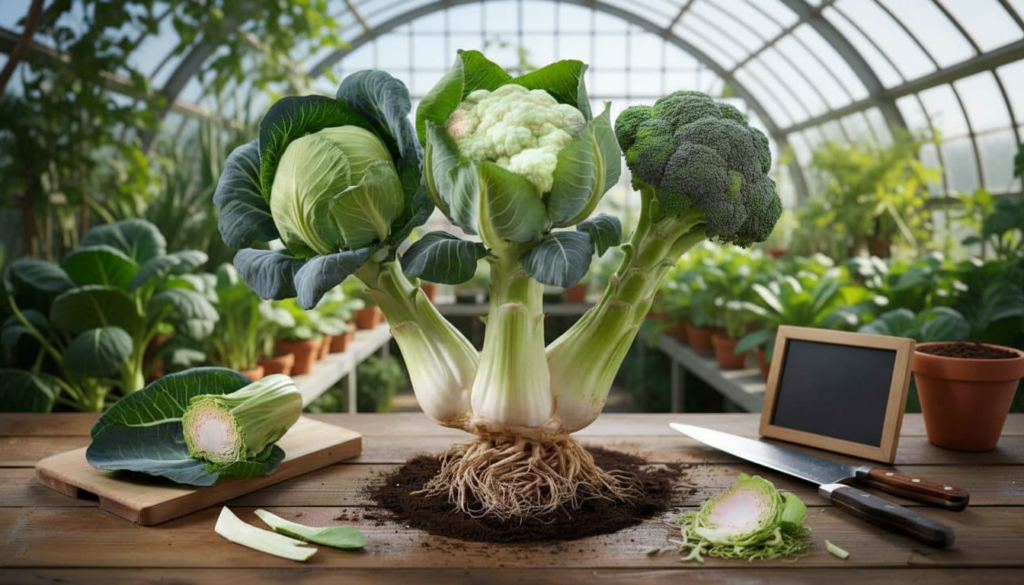
But behind all those tightly packed leaves and green florets is one old species that farmers have shaped over the years. Knowing that we all come from the same place changes how we buy vegetables, how we cook on busy weeknights, and even how we plan a small garden or balcony box.
Not three different vegetables, but one type of vegetable with many faces
Brassica oleracea is the name of the species that includes cabbage, cauliflower, and broccoli. In terms of botany, they are not distant cousins but rather different “versions” of a single wild coastal plant that used to grow on rocky cliffs along the Atlantic and Mediterranean.
Picture a farmer from two thousand years ago walking along a shore that the wind had beaten down. The soil is thin, and the salt spray is strong. A tough plant grows close to the ground and has thick, fleshy leaves. Some people look a little different: their leaves are wider, their stems are swollen, and their flower buds are tighter.

The story begins with those little differences. Every season, farmers did the same thing: they saved seeds from the plants they liked best. No labs, no editing genes. You just need to pay attention to the little things and be patient.
Plants with big, tight leaf rosettes were encouraged, which led to cabbages and savoys with tight heads.
Plants with swollen stems started to look like kohlrabi.
Broccoli and cauliflower came from plants with tightly packed flower buds.
Selection is the name of this slow process. People didn’t make new genetic code; they chose which code to keep. Over hundreds of years, one wild species spread out into many “types” that now fill different shelves in the veg aisle.
Like an actor in different costumes, cabbage, cauliflower, and broccoli show off their leaves, flower buds, and something in between.
The genetic distance between them is surprisingly small. The big differences we see, like the white dome of a cauliflower, the crinkled cabbage head, and the branching florets of broccoli, are all exaggerated versions of the same basic plant structure.
What happens in the kitchen when you see them as a family
This isn’t just a cool fact about plants. They become a flexible toolkit once you treat them like close family. That way of thinking helps when you don’t have a key ingredient, cuts down on food waste, and makes recipes easier to follow.
The “swap-friendly recipe” trick: one base and three vegetables
If you think about texture and cooking time instead of strict names, many dishes work almost the same with cabbage, broccoli, or cauliflower.
When roasting at high heat, cauliflower florets, broccoli pieces, and thick wedges of cabbage all cook well together with oil, salt, and spices at the same time.
Stir-fries: When you put finely sliced leaves, stems, or florets from any of the three in a hot pan with garlic and oil, they all act the same way.
When you cook broccoli stalks, cauliflower outer ribs, and tougher cabbage leaves, they add body and a hint of sweetness to soups and stews.
Instead of just saying, “this is a cauliflower recipe,” it’s better to ask yourself if you need something that holds its shape in the oven, soaks up sauce, or stays a little crunchy in a pan. When you look at it this way, it’s much easier to choose between the three.
When you know how the family is connected, your fridge stops looking like a graveyard of old vegetables and starts looking like a box of cooking tools.
How to use the parts that usually get thrown away
Wild Brassica oleracea changed over time to survive in tough conditions while wasting very little. That can teach us something. Using more of each plant saves money and makes the taste last longer.
Peel off the fibrous outer layer of broccoli stalks, cut them into sticks, and use them in stir-fries or simmer them and blend them into a smooth soup.
To make a chip-like snack, toss the outer leaves of cauliflower with oil and salt, then roast them until they are crisp.
If you have leftover cabbage, shred it finely and use it in salads, taco fillings, dumplings, or as a quick side dish with vinegar and spices.
Because they are all from the same species, scraps from one often stand in for prime parts of another. When making soup that calls for cauliflower stems, you can usually add chopped cabbage ribs or broccoli stalks as well.
Three plants in the garden with the same needs and enemies
People who have grown them next to each other can tell right away that they are the same. Cabbage, broccoli, and cauliflower like cool weather, don’t like sudden heat, and do well in rich soil. They also draw in the same pests.
You will often meet people in a bed just for brassicas:

Cabbage white butterfly caterpillars are bright green larvae that chew ragged holes in leaves. Aphids cluster on tender shoots and the undersides of leaves. Flea beetles are tiny black beetles that leave pinprick holes in young plants.
If you see a bug on one broccoli plant, it’s a good idea to check the cabbages and cauliflowers nearby. To that bug, all of them are just as tasty.
You can use this shared weakness to your advantage in a practical way. You can make one plan to protect the whole “brassica block.” For example, you could use fine mesh covers to keep butterflies away, rotate your crops regularly, and feed them at the same time every day.
Making a brassica corner on a balcony
The family logic still works, even if they only have a small yard. A few rules are helpful:
Use deep containers so the strong stems have a good grip.
Add mature compost to the potting soil because this group needs a lot of nutrients.
To keep plants from getting stressed out, move pots to the shade or partial shade during the hottest parts of the summer.
Mix early and late varieties so that you can harvest for a longer time.
If you think of your plants as one adaptable species, you can change which one you grow each season while keeping the same basic setup.
Nutritional profile: a lot of things are the same, but some things are different that are good.
That shared botanical last name shows up in the way they get their nutrients. All three types of Brassica oleracea provide:
high amounts of vitamin C, a lot of fiber (both soluble and insoluble), minerals (especially potassium), and sulfur-containing compounds that are common in the cabbage family and have been linked to cell protection in research.
There are subtleties. Broccoli usually has more vitamin K and some special antioxidants. Raw cabbage, especially the types with thick heads, can hold a lot of vitamin C by weight. People who don’t like the stronger, brassica-style flavor tend to like cauliflower better because it tastes milder.
If you switch between cabbage, broccoli, and cauliflower throughout the week, you’ll get a wide range of nutrients that are similar but not the same. This way, you don’t have to think too much about what to eat.
One plant, a lot of stories about how we eat
The fact that one species has given us so many different kinds of vegetables makes us think more about what we mean by a “varied diet.” We often think of variety as a lot of foods that aren’t related to each other. But one group of plants, the brassicas, already has a wide range of shapes, textures, and tastes.
This pattern can be seen in other places as well. Tomatoes come in all sizes, from tiny cherry fruits to huge beefsteak fruits, but they all belong to the same species. You can make bread, pasta, or couscous out of wheat. A small number of flexible plants make up a lot of what we eat.
There is also a household resilience angle. If there isn’t any fresh cauliflower in the store, you can use chopped cabbage and a few broccoli stems instead in many dishes, like creamy blended soups or baked trays with cheese.
A short dictionary for people who like brassicas
The scientific name for the group of plants that includes cabbage, cauliflower, broccoli, kale, kohlrabi, and other similar plants is Brassica oleracea.
Cultivated variety: a group of plants of the same species that have been chosen over time for a certain trait, like color, shape, or maturity date.
Selection: the process by which growers choose which plants will produce seeds, guiding future generations toward the traits they want.
Cruciferous: This is a larger group of plants that includes cabbages, rocket, radishes, and mustard. They get their name from their four-petaled flowers that look like crosses.
A real-life example: one plant, one week’s worth of food
Imagine a fridge with only three things from this group: a cabbage, a cauliflower, and a bunch of broccoli. That one type of food can make a week’s worth of very different meals with just a few basic cupboard items.
| Day | Main brassica dish |
|---|---|
| Monday | Roasted tray of broccoli florets, cauliflower florets and cabbage wedges with olive oil and spices. |
| Tuesday | Crunchy cabbage slaw with carrots, seeds and a yogurt-based dressing. |
| Wednesday | Velvety soup using broccoli stalks and cauliflower outer leaves, blended with stock and herbs. |
| Thursday | Stir-fry of shredded cabbage and broccoli tips with soy sauce, garlic and ginger. |
| Friday | “Rice” made from finely chopped cauliflower, mixed with thin strips of cabbage and roasted broccoli pieces. |
| Saturday | Oven-baked chips from cauliflower and cabbage leaves as a snack or side. |
This plant that changes shape is also a great way to teach. When kids see that broccoli “trees” and pale cauliflower clouds are related to the cabbage on their plate, a lesson about healthy eating can become a short story about history, farming, and the choices people make. For adults who have to keep track of their money, that story means something very real: three common vegetables, one place they all come from, and a lot of room to be creative in the kitchen and garden.