While American and Chinese companies show off bigger and bigger models, a French comparison site shows that French-speaking users care more about tone, clarity, and cultural fit than about raw power.
A public tool that works like an observatory instead of a podium
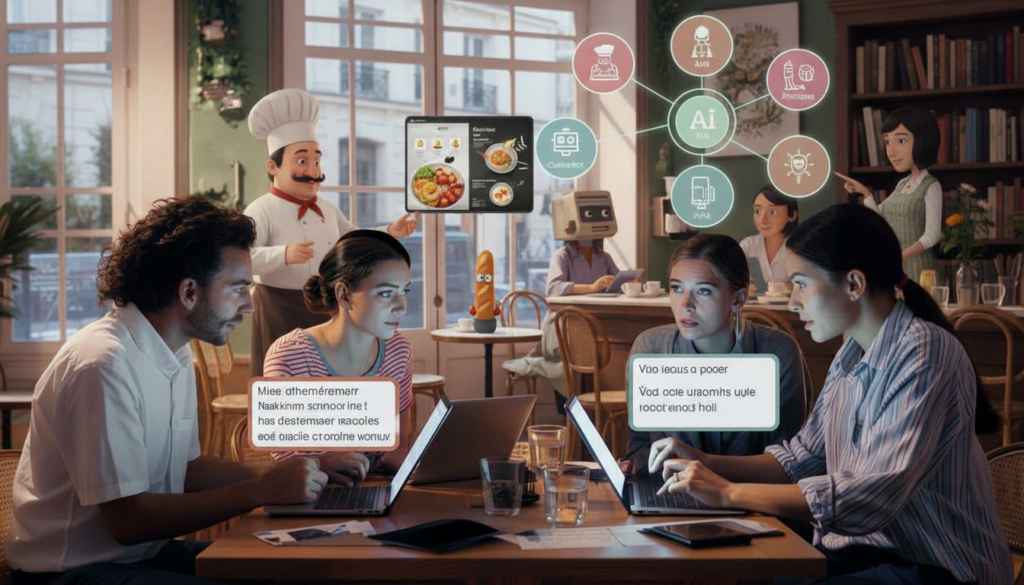
French-speaking people on the internet have been doing a kind of blind taste test for artificial intelligence since October 2024. The platform is called “compar:IA.” It was made by France’s interministerial digital directorate and the Ministry of Culture as a public service, not a business.
The idea is very simple. A user asks a question and gets two answers from two different chatbots. The models don’t have any names. All you have to do is click on the answer that seems clearer, more helpful, or more convincing.
 Many people don’t know this, but cauliflower, broccoli and cabbage are all forms of the same plant
Every time someone interacts with something, they vote in a huge, ongoing popularity contest where people judge how an answer feels, not which brand made it.
Each duel gives you more information. Using the Bradley–Terry model, a statistical method that is often used in sports to turn head-to-head matchups into a league table, these points are used to make a ranking that is updated every week. The way this is done is very different from the technical benchmarks that AI companies usually use, like MMLU for reasoning or GSM8K for math.
compar:IA doesn’t test how well you can think logically, how well you know facts, or how well you can code. It picks up a softer signal, like how useful it seems, how easy it is to read, and the feeling that “this answer works for me.” The platform’s data, which is shared with Hugging Face as open data, is clearly shown as a snapshot of preferences, not an official quality certification.
The system had already recorded over 230,000 votes by early 2026. The dataset is now large enough to show how francophones interact with conversational AI in their own language.
Ranking by how it looks, not how much power it has
The first public results, which came out in November 2025, shook up what people thought. It wasn’t GPT-4, Claude, or Google’s Gemini Pro that won. At the top was the Mistral Medium 3.1, a French model that is a good balance between price and performance.
Mistral Medium 3.1 beat out models made for speed or lightness, like Gemini 2.5 Flash and Qwen 3 Max. None of the high-end, flagship systems that make the news in tech made it to the top of the list.
The models that AI engineers love aren’t always the ones that are easiest for regular people to use when typing in French.
LMArena, an international comparison site that mostly serves English-speaking users, tells a very different story. Claude Opus 4.1, GPT-4.5 Preview, and Gemini 2.5 Pro are usually near the top there. The difference between the two rankings shows how much context, language, and expectations affect evaluation.
When it comes to compar:IA, style is more important than brute strength. This means using fluid phrasing, a conversational tone, and an answer structure that makes sense to French-speaking readers. An AI can sound confident, warm, and organized on the outside, but be less strict on the inside. That might be enough to get someone to click on a quick question every day.
This cognitive bias is brought up in research that the French AI school AIvancity has used. People make decisions based on what they see and feel, not what an expert might later confirm. A response that sounds smooth and fits with local idioms is often better than one that is more accurate but sounds awkward.
Why models trained in France have an edge
In that setting, models that are made in the country and are better suited for francophone users have a clear advantage. They are more likely to get the nuances of politeness, regional references, school-level expectations, and how people ask everyday questions in French.
- They make fewer mistakes when using “vous” and “tu” in formal and informal settings.
- They understand cultural references from French politics, media, and schools.
- Their writing often looks like the writing of local journalists and bureaucrats.
Even though global models are usually trained to speak English, they can still speak French well. But they might miss the subtleties, default to literal translations, or sound a little off-key. In an anonymous head-to-head, those little problems can cost votes.
Digital sovereignty, language, and cultural norms
Mistral’s success on a French public platform is more than just a technical detail. It is part of a bigger talk about digital sovereignty in Europe. French government agencies want to show that there are good options besides the big US and Chinese companies, especially for cultural and public sector uses.
Radio France and other public media have focused on another part of the project: making people more aware of AI’s impact on the environment. Some of the best-rated models on compar:IA come from companies that publish how much energy they use per 1,000 tokens, which is a metric that most users still don’t know about.
Compar:IA encourages users to think about which AI they like best not only for tone but also for carbon cost by making model choice a public conversation.

The ranking doesn’t just reward the systems that use the least energy; it also tends to make people who are willing to talk about sustainability more visible. That adds a new standard to a field that has been dominated by accuracy scores and benchmark charts for a long time.
The language lesson is just as interesting. An AI that is seen as friendly, short, and attuned to French-speaking phrasing has a natural advantage, even if it is not as good at advanced numerical reasoning or complex synthesis. For everyday use, people often choose comfort and familiarity over raw sophistication.
This doesn’t mean that American or Chinese models aren’t working in France. It implies that in an environment devoid of brand labels or formal endorsements, collective behavior delineates an alternative hierarchy, wherein cultural alignment, linguistic proficiency, and writing style possess significant importance.
This is what we learn about how people really use AI.
The French experiment is a reality check for people who build AI. The industry likes clear numbers, like pass rates on tests, coding benchmarks, and leaderboards. Users in real life are messier. They care about how long an answer is, if it sounds arrogant, and if it is at the right level for them.
A model that gives shorter, more direct explanations might do better on a site like compar:IA than one that makes long, technically perfect paragraphs. A chatbot that is honest about not knowing something in simple terms might earn trust even if it doesn’t always choose the best answer.
This also has a risk. When a model hallucinates facts, it can trick users into thinking it is very confident and smooth. The likability bias can hide big problems with safety or reliability.
When style wins the duel, it’s always possible that charm is hiding weak facts.
It’s hard for public agencies that do these kinds of tests to find the right balance. They want to let people have a say in how AI is judged, but they also know that “most liked” doesn’t mean “most trustworthy.” Some experts say that perception-based rankings should be backed up by independent audits that check for bias, security, and factual accuracy.
Making some important ideas clearer
What is the Bradley–Terry model?
The Bradley–Terry model is a statistical tool that uses paired comparisons to figure out how strong competitors are. In sports, it can turn the results of a game into a ranking that shows how likely it is that one team will beat another.
compar:IA uses this logic: every time Model A beats Model B in a user vote, the system changes its guess about how “strong” each model is based on how good the answers are. Even though users never see the math behind it, a stable hierarchy emerges after thousands of comparisons.
Fluency and bias in perception
For a long time, psychologists have studied a phenomenon called the “fluency effect.” People are more likely to believe and trust information when it is easy to understand, like when the language is simple, the layout is clean, or the story is familiar.
This effect, when applied to AI, means that a well-worded but wrong statement can seem more trustworthy than a clumsy but correct one. This bias is very helpful for a chatbot that knows local idioms and rhythm for francophone users.
What this means for regular people
The French experiment gives some useful tips for people who use AI in French, like students, journalists, and small businesses:
- Even if the answer sounds convincing, check important facts against sources that aren’t connected to the story.
- Pay attention to how often a model says it doesn’t know something or gives sources.
- When the stakes are high, like in legal or medical cases, try out different models for the same question.
- Find providers that share information about how they use energy and handle data.
- Think about a teacher getting ready to teach French literature. An AI that works well with French speakers might make explanations
that are ready for the classroom, references to local curricula, and authors who are relevant. A bigger global model might give more historical context, but it might not meet the specific school standards. Using both together—style from one and depth from the other—can give you a better result.
Compar:IA gives policymakers and regulators a model to follow. Other languages, like German, Spanish, and Arabic, could also use similar blind comparison tools to see how AI works in real life in different communities. Those results could eventually be used to make rules for buying things, guidelines for the public sector, and discussions about when it’s better to use local models than global giants.