The machine stops working with a soft, mechanical sigh.
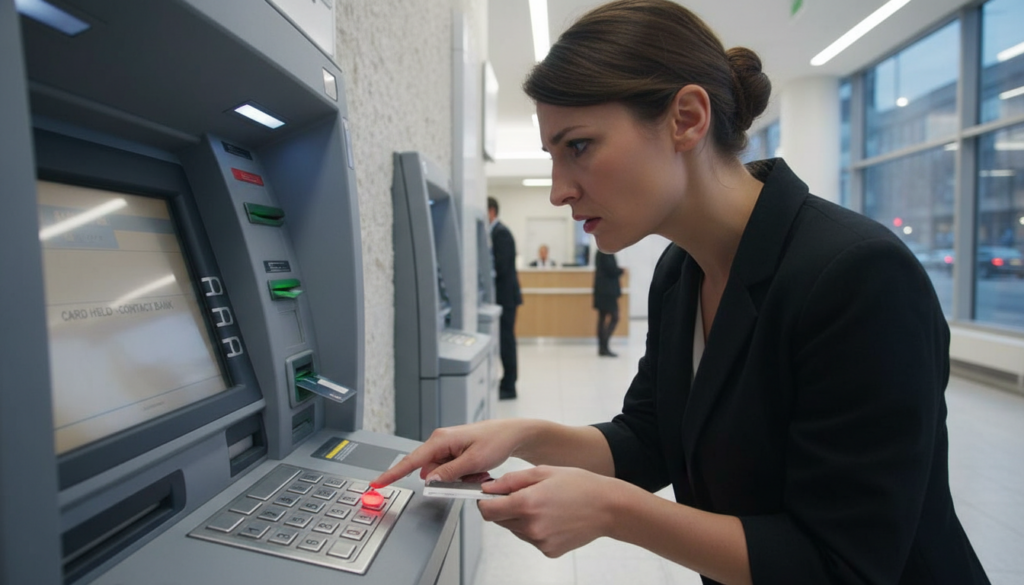
Your card is inside, your balance is on the screen, and no one answers the help button. All of a sudden, you’re the person stuck in front of an ATM with a long line behind you. You can feel the guy’s eyes on you even though he’s only two steps away. Your fingers are hovering over the keypad for no reason. Do you leave? Do you wait? Do you hit the “cancel” button like a gamer?
It’s strange how cash machines can make you feel both safe and unsafe at the same time. Yes, protected, but also a little cruel when they decide to eat your card.
And at that very moment, one quick move and one button can change everything.
Why do ATMs “eat” perfectly good cards?
If you’ve ever had an ATM keep your card, you probably thought about what you did wrong later. You typed in your PIN carefully. You didn’t hit the keys too quickly. You didn’t even curse at the screen. But the shutter closed, and your card disappeared with a cruel little whirr. The machine doesn’t say anything; it just goes back to the home screen as if nothing happened.

A bank worker in Paris told me that these are called “retained cards” and that they happen a lot more than people think. A dad who is distracted takes too long to get his card because he is holding a stroller. A nurse who is tired from working the night shift enters the wrong PIN three times. A traveler uses a card that expired yesterday. The ATM isn’t being emotional; it’s following a strict set of rules. If you enter the wrong PIN, use it in a suspicious way, damage it, or just run out of time, the card stays locked in its metal stomach.
There is a reason for this cold behavior. The machine is set up to keep you safe from theft, card cloning, or someone standing behind you and waiting for you to leave. Many ATMs will pull a card back in after 20 to 40 seconds if it is left sticking out. If the bank thinks there is fraud or the card is blocked, it will be kept for safety reasons. It makes sense from a distance. It doesn’t seem like a good idea at all when it’s your only card at 10:45 p.m. in front of a closed branch.
The fast move and the button that can save your card
When the ATM starts acting weird, the first thing you should do is stay where you are and hit the **cancel** button. It’s that easy. Firm and calm, not just once but several times in a row. This forces the transaction to end on many models and starts a final attempt to free the card before the mechanism decides to keep it. The little red key could be your last chance in the short time the software gives you.
Don’t look away or check your phone if the screen freezes. Keep your eyes on the machine, cover the keypad with your hand, and watch the slot. When the cash comes out or the receipt prints, a lot of people step back and get distracted, forgetting that their card is still there. The countdown is awful; after a short wait, the ATM “thinks” the card has been left behind and takes it back. Let’s be honest: no one really pays attention to the little messages on the screen that warn about this every day.
The second reflex happens right after the panic spike. Don’t get mad and leave if the card doesn’t come out. Check the ATM’s frame for a bank logo and a hotline number, or a small sticker with emergency instructions. If there is a help or call button, press it. Then, while you are still in front of the machine, call the number.
Claire, who works in customer support for a big European bank, says, “The first thing we ask is, ‘Are you still at the ATM?'” If so, we can write down the exact terminal, the time, and often see what the machine has recorded in real time.
If the ATM freezes or feels “off,” press cancel a few times right away.
Stay in front of the machine until it goes back to the welcome screen completely.
Before you leave the area, call the bank or card hotline.
Take note of the time, place, and ATM ID that are printed on the frame.
If you even think there might be fraud, block the card.
The secret danger that no one talks about is leaving too quickly.
Bank employees talk about one scene over and over again: a customer comes in and yells, “The ATM stole my card.” Security looks at the video. The person on the screen finishes the withdrawal, takes the cash, looks at their phone, puts the notes in their pocket, and then walks away. The machine quietly eats the card that was left behind ten seconds later. No problem, no theft, just a brain that was going too fast and a card that was sticking out by a few millimeters. *We are often not where we think we are.
That’s why the “quick move” is really a slow one: stop for five seconds before you leave. Look at your hand. Do you have your card? Your cell phone? If you got a receipt, please show it to us. Then take another look at the slot. It sounds like something a kid would say. But those extra seconds can save you days of trouble, like waiting for a new card, changing your online payments, or telling your landlord why the rent transfer will be late again.

When the ATM keeps their card, some people feel bad, like they’ve done something dumb or suspicious. They run away because they are ashamed instead of asking for help or calling the number on the sticker. Most banks don’t want to talk about how often things like this happen. There is a simple truth here: banks have built complicated machines that act in rigid, automated ways, but they expect people in front of them to act perfectly rationally when they are tired, stressed, or in a hurry.
A small kit to help you get through the next time the ATM doesn’t work right
You never look at ATMs the same way again after you’ve had a card swallowed. You begin to create small routines. One tech-savvy person I met in London sets a silent 30-second timer on his smartwatch every time he puts his card in. He knows something is wrong when the watch buzzes and the ATM still hasn’t given it back. He then hits cancel right away. Another young woman I talked to always keeps her card between two fingers, ready to pull it out, until the screen goes back to the welcome page. It’s a tiny gesture, but it keeps her focused.
When the worst happens and the card is lost, the next steps are to limit the damage. Call the bank while still on the spot, and say clearly: “My card has just been retained by ATM number XXX at this address, at this time.” Ask if the terminal belongs to your bank or another network. If it’s your bank, the card might be retrieved and stored at the branch for a few days. If not, assume it’s gone and request a new one straight away. Try not to blame yourself too harshly. We’ve all been there, that moment when a simple errand turns into a bureaucratic headache.
There’s a quiet rule experienced customers follow: never leave an ATM problem undocumented. Take a quick photo of the machine, the ID number on its frame and the screen if there’s an error message. Jot down the exact time. Those tiny details can turn a painful claim into a routine case. One customer service manager told me:
“When someone calls us with the ATM ID and the minute it happened, we can trace the log in seconds. Without it, we’re digging for a needle in a haystack.”
Develop a personal ritual: countdown, card between fingers, eyes on the slot
Call support while still at the machine, not an hour later from home
Photograph the ATM ID plate and any strange messages
Ask clearly whether the card can be retrieved or is permanently blocked
Update any automatic payments once you know a new card is coming
Living with machines that control our money
Step back for a second and you see the strange balance: a grey box on a wall decides when you can touch your own money, and on bad days, it literally keeps the plastic key to your finances. These machines are built for speed, security and predictability, not for human hesitation or messy real life. Yet real life is exactly what shows up at 7:02 a.m., half-awake, trying to grab twenty euros before catching the bus.
Knowing the quick move and the right button doesn’t turn you into some banking ninja, but it gives you a little more control in a space where people often feel powerless. Press cancel with intention. Stay in front of the screen until the story is clearly over. Call while you’re still there. These are small acts, almost mundane, that quietly shift the balance from panic to agency.
And maybe that’s the real lesson hidden in these awkward moments with cash machines: technology may be rigid, but the way we stand in front of it is still ours to choose.
Key point Detail Value for the reader
Use the cancel button fast Press cancel several times as soon as the ATM freezes or feels abnormal Gives the machine a last chance to release your card before retention
Stay in front of the ATM Wait until the screen returns to the welcome page, card in hand Reduces the risk of the machine retracting a “forgotten” card Document and call on the spot Note the ATM ID, time and call the hotline while you’re still there Speeds up support, protects against fraud and simplifies any claim FAQ:
What should I do immediately if the ATM keeps my card?
Stay in front of the machine, press cancel several times, then call the bank’s hotline number shown near the screen or on the frame, giving the ATM ID and exact time.
Can someone else use my card if the ATM swallowed it?
In most cases, no. Retained cards are held inside a locked compartment. Still, it’s safer to ask the bank to block or replace it, especially if the ATM looked tampered with.
Will I get my card back from the branch?
Sometimes. If the ATM belongs to your own bank and is attached to a branch, staff may retrieve and hold the card for a limited period. If it’s a different bank or network, it’s often destroyed.
Why did the ATM keep my card even though I did nothing wrong?
Common reasons include taking too long to remove the card, a slightly damaged chip, an expired card, or a security flag on your account that you weren’t yet aware of.
How can I avoid this happening again?
Have a simple ritual: focus on the slot, keep the card between your fingers, wait for the welcome screen before leaving, and use banking apps or contactless payments when possible to reduce ATM use.