Your card is still inside. Your balance is frozen on the screen. The help button does nothing. Behind you, the line grows longer and heavier with silent impatience. You can almost feel someone staring at the back of your neck. Your fingers hover over the keypad with no clear plan. Do you walk away? Do you wait it out? Do you mash “cancel” like it’s a reset button in a video game?
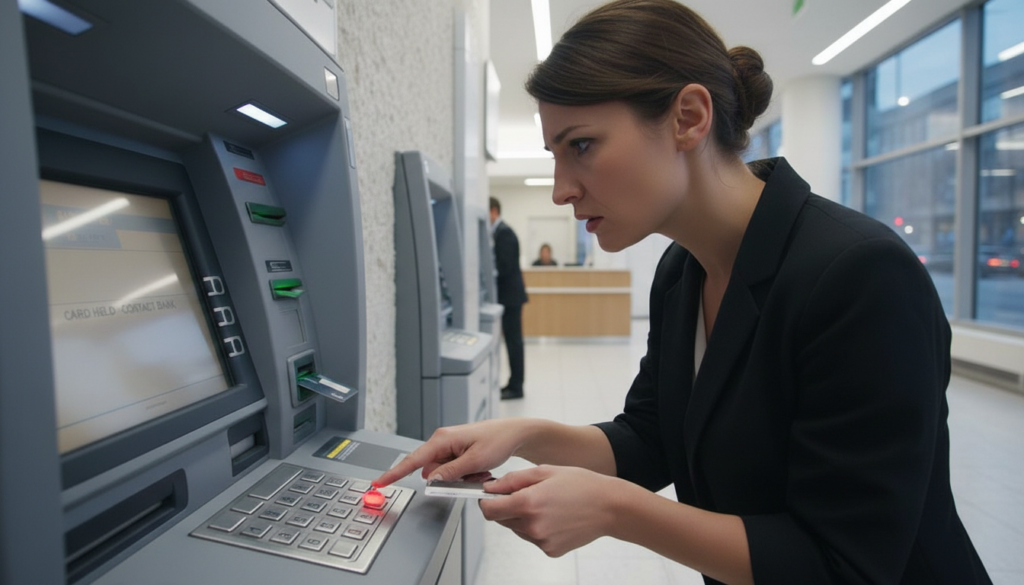
ATMs have a strange power. They make you feel secure and exposed at the same time. Safe because it’s your bank. Unsafe because one small glitch and the machine can swallow the only card you have.
Why ATMs Suddenly Keep Perfectly Working Cards
If an ATM has ever “eaten” your card, you probably replayed the scene later wondering what you did wrong. You entered your PIN carefully. You didn’t rush. You followed every instruction. Yet the slot closed with a soft whirr, and your card vanished. The screen calmly returned to the welcome page, as if nothing unusual had happened.

Bank employees call these cases “retained cards,” and they’re more common than most people realize. A distracted parent takes too long to grab the card. A tired nurse enters the wrong PIN three times. A traveler inserts a card that expired yesterday. The machine isn’t emotional or dramatic. It follows strict programmed rules. Too many wrong attempts, suspicious activity, expired data, physical chip errors, or simply running out of time — and the card stays inside.
Many ATMs automatically retract a card after 20 to 40 seconds if it isn’t removed. From a security perspective, this makes sense. It protects against theft, cloning, or someone grabbing a forgotten card. But when it happens late at night in front of a closed branch, logic doesn’t make the situation feel any better.
The One Fast Move That Can Still Save Your Card
If the ATM starts freezing, lagging, or acting strangely, your first move should be simple: press the cancel button. Do it firmly. Press it more than once. On many machines, this forces the transaction to end and can trigger a final attempt to release your card before the system locks it in.
Do not step away. Do not check your phone. Keep your eyes on the slot. Many people take their cash, glance at their receipt, and instinctively walk off — forgetting the card is still partially inserted. A few seconds later, the machine assumes it was abandoned and pulls it back inside.
If the card does not reappear, stay calm and stay put. Look for the bank logo on the ATM frame and find the hotline number. If there’s a help or call button, press it. Then immediately call the support number while standing in front of the machine.
Customer support agents often ask one key question first: “Are you still at the ATM?” If you are, they can log the exact terminal ID, time stamp, and check what the system recorded in real time.
Here’s what to do step by step:
– Press cancel multiple times as soon as something feels off.
– Remain at the machine until it fully resets to the welcome screen.
– Call the bank immediately before leaving.
– Note the ATM ID number and exact time.
– If you suspect fraud, request an immediate block.
The Hidden Mistake Most People Don’t Notice
Bank staff describe the same scenario again and again. A customer insists the ATM “stole” their card. Security footage shows something different. The person withdraws cash, pockets the money, glances at their phone, and walks away. Ten seconds later, the machine retracts the forgotten card. No malfunction. No crime. Just distraction.
We often think we are fully present, but our attention is already somewhere else — the bus schedule, a text message, the meeting we’re late for.
The smartest “quick move” is actually a slow one. Pause for five seconds before leaving. Look at your hand. Is the card there? Is your phone there? Check the slot again. That tiny habit can prevent days of inconvenience: waiting for a replacement card, updating subscriptions, explaining delayed payments.
Many people feel embarrassed when this happens. They assume they made a careless mistake and rush away instead of asking for help. But the truth is simple: highly automated machines expect perfect human focus — even when we’re tired, stressed, or distracted.
Your Personal Safety Routine for the Next ATM Visit
After experiencing a retained card once, people often develop small rituals. One frequent traveler sets a silent 30-second timer on his smartwatch every time he inserts his card. If it vibrates and the card hasn’t come out, he presses cancel immediately. Another person keeps two fingers lightly gripping the card edge until the screen fully resets. That physical awareness keeps her focused.
If your card is truly retained:
– Call your bank immediately and state the ATM ID, address, and time.
– Ask whether the machine belongs to your bank or a third-party network.
– If it’s your bank, the card may be retrieved and stored temporarily.
– If not, assume it will be destroyed and request a replacement.
– Update any automatic payments once the new card is issued.

Always document the situation. Take a quick photo of the ATM ID plate and any error message on the screen. Write down the exact time. Those small details can speed up investigations dramatically.
An experienced support manager once said:
“When customers give us the ATM ID and the exact minute, we can trace the log almost instantly. Without that information, it becomes much harder.”
Living With Machines That Control Access to Our Money
Step back and it’s almost surreal. A metal box on a wall decides when you can access your own funds. These machines are designed for security, speed, and strict logic — not for human hesitation or distraction.
Yet real life shows up at 7:00 a.m., half-awake, needing cash before catching a bus. That’s where small habits matter.
Press cancel with intention. Stay in front of the screen until the process clearly ends. Call support before walking away. These actions are simple, almost boring. But they shift the balance from panic to control.
FAQ:
What should I do immediately if an ATM keeps my card?
Press cancel several times, remain at the machine, and call the bank hotline while noting the ATM ID and exact time.
Can someone use my card after it’s swallowed?
Usually no. Retained cards are stored in a locked compartment, but it’s still safest to block or replace it.
Will I get the card back from the branch?
If it belongs to your bank and is attached to a branch, sometimes yes. If it’s another network, it is often destroyed.
Why did the ATM keep my card if I did nothing wrong?
Common reasons include delayed removal, expired cards, chip damage, security flags, or too many incorrect PIN attempts.
How can I reduce the risk in the future?
Stay focused, keep your hand near the slot, wait for the welcome screen before leaving, and use digital banking options when possible.