Marie pushes open the door at 9:15 on a Tuesday morning, and the salon is already buzzing. She is 64 years old, and her cardigan is falling off one shoulder. Her roots have grown out about three centimeters. She sighs and sits down, then runs her fingers through her salt and pepper hair. “I don’t want to hide it anymore,” she says. “But I don’t want to look older either.”
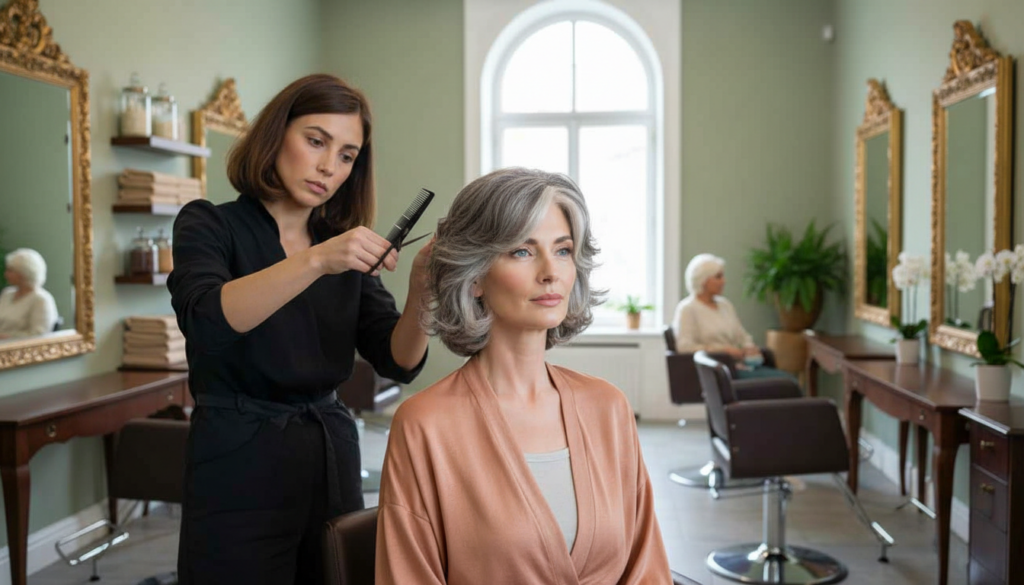
The hairstylist tilts her head and looks closely at Marie’s cheekbones and the way the silver catches the light near her temples. She grins. “We’re not going to hide anything,” she says. “We’re going to frame your face so that the gray hair does the talking for you.”
Around them, the dryers hum, the scissors snap, and the coffee cups clink. This small rebellion against hair dye is happening in many salons.

And the right cut can make a big difference.
The cuts that make salt and pepper hair look shiny, not “tired”
Many women over 60 are afraid of the same thing: showing the gray will make their face look older. The truth is often the other way around. If the cut is modern, structured, and airy, salt and pepper hair looks like a choice instead of a surrender.
Anaïs, a hairstylist who has been cutting hair for 20 years, says it simply: “The wrong cut makes gray look dull, the right cut makes it look expensive.” Most of the time, she tells her clients not to wear heavy helmets or bobs that are too perfect. Hair needs to move, have small bumps, and be a little soft around the neck and jawline.
The goal is not to get rid of the years. The goal is to get them to shine.
She loves the short layered crop on naturally wavy salt and pepper hair. She talks about a 67-year-old client named Odile who came in with a long, straight, dyed brown hair and a line of bright white roots along the part. Anaïs says, “She told me, ‘I feel like I’m wearing someone else’s hair.'”
They cut it above the shoulders, added soft layers, and kept the brightest white streaks around the face. The effect was instant when Odile put her glasses back on: her cheekbones looked higher, her eyes looked sharper, and her jawline looked clearer. She looked like herself, but the light made her look better.
People who saw her walk out would have thought she spent more time on her style than on hiding her age.
This makes sense in a simple way. Gray and white hair reflect light much better than colored hair. That reflection can make a block of “flat brightness” on a flat, straight curtain of hair that doesn’t match the lines of the face. With a layered cut, a soft graduation at the nape, and a few lighter streaks near the eyes, that same light becomes sculpting, almost like contouring with hair.
A bob that is too blunt at the jaw level can make the features look lower. A bob that is slightly shorter in the back and has a subtle taper instantly lifts. Short pixies with a little length on top add volume at the crown, which evens out any slackening along the jawline.
The right structure can turn your natural salt and pepper pattern into a built-in highlight kit.
The hairstylist’s specific advice, from the first cut to styling every day
Anaïs never rushes to the scissors when a woman over 60 says, “I’m ready to stop dyeing.” She looks at the natural pattern first: a darker neck, silver temples, and white streaks at the crown. After that, she suggests a cut that fits with that map.
Her basic recipe is to cut the length by at least 5 to 8 centimeters, add soft layers around the face, and stay away from very straight lines. She trims the ends of thick hair so that the gray doesn’t look heavy. She keeps the edges of fine hair a little fuller and adds volume at the roots.

A long layered bob that touches the collarbone is the best length for many people. Long enough to look feminine, short enough to make salt and pepper look sharp and planned.
She says that the biggest mistake is holding on to the “old” cut that was meant for dyed hair. Color camouflage often makes it possible to make shapes that are very small and uniform. As soon as the gray shows up, those shapes look old.
Another trap is going “very short” too quickly, like a punishment cut. It works for some people, but others say it takes away their sense of self. It often feels nicer to switch in two or three cuts. You cut off the old color a little at a time, let the natural salt and pepper grow, and then shape the hair as it comes out.
Let’s be honest: no one really does this every day, but Anaïs loves to show how to do it with a round brush and a little mousse. You can change “woke up like this” to “on purpose” in ten minutes by lifting the roots and smoothing the ends.
Gray also has an emotional side to it. Some mornings, the mirror is not my friend. Some days, the silver feels like armor. *The right cut can help things go your way on those better days.
Anaïs is adamant about one thing:
“Salt and pepper hair is not a problem to hide; it’s something to work with. My job is to cut the lines where your gray is already pretty.
Before they leave, she often gives her clients a small “cheat sheet”:
If your features have softened, pick soft gradients instead of sharp, geometric lines.
- Add “light near the face”: either a naturally whiter front section or a subtle shine on the front locks.
- Keep the fringe moving: curtain bangs or a side-swept fringe look better than a straight line that doesn’t move.
- Don’t use a violet or blue shampoo every time you wash your hair. Do it once a week to even out the yellow tones.
- Don’t ask for a salon blowout that you won’t be able to do again. Instead, ask for a dry finish that you can do at home.
Living with your salt and pepper cut: style, who you are, and that new kind of confidence
When a woman leaves the salon with her salt and pepper hair fully styled, something changes. The cut is no longer just about hair; it also affects clothes, lipstick, and posture. A lot of clients come back and say they’ve changed their glasses frame, tried a bolder red, or finally gotten rid of clothes that never really fit them.
We’ve all had that moment when we see ourselves in a store window and it matches how we feel inside for the first time. The best salt and pepper cuts can give you that alignment after 60. A pixie that shows off the neck, a layered bob that follows the jaw, and a long shag that plays with waves are all ways to say “this is me, now” without saying a word.
| Key point | Detail | Value for the reader |
|---|---|---|
| Adapt the cut to the gray pattern | Observe where hair is darker or whiter and place layers and lengths accordingly | Transforms “random gray” into a deliberate, flattering color effect |
| Light layering and movement | Soften edges, lift the crown, free the neck, add a fringe or face-framing locks | Gives a younger, more dynamic silhouette without chasing youth |
| Simple, realistic styling routine | 10-minute blow-dry with light products and occasional toning shampoo | Makes the cut look salon-fresh more often, with effort you’ll actually sustain |
Question 1What are the best haircuts for people over 60 with salt and pepper hair?
Question 2Should I cut my hair very short right after I stop dyeing it?
Question 3: How can I keep my gray hair from looking yellow or dull?
Question 4: Can long hair still look good with salt and pepper?
Question 5: How often should I change my cut when my hair is turning gray?