I saw a fried egg lose a fight with a pan the other morning.
The white stuck to the metal, and when I tried to slide a spatula under it, it ripped. The yolk burst and bled all over the surface. All of a sudden, breakfast for one looked like food from the hospital. I had used a non-stick pan, carefully drizzled oil, and even waited for the right temperature. And still: egg stuck, stressed cook, dirty sink.
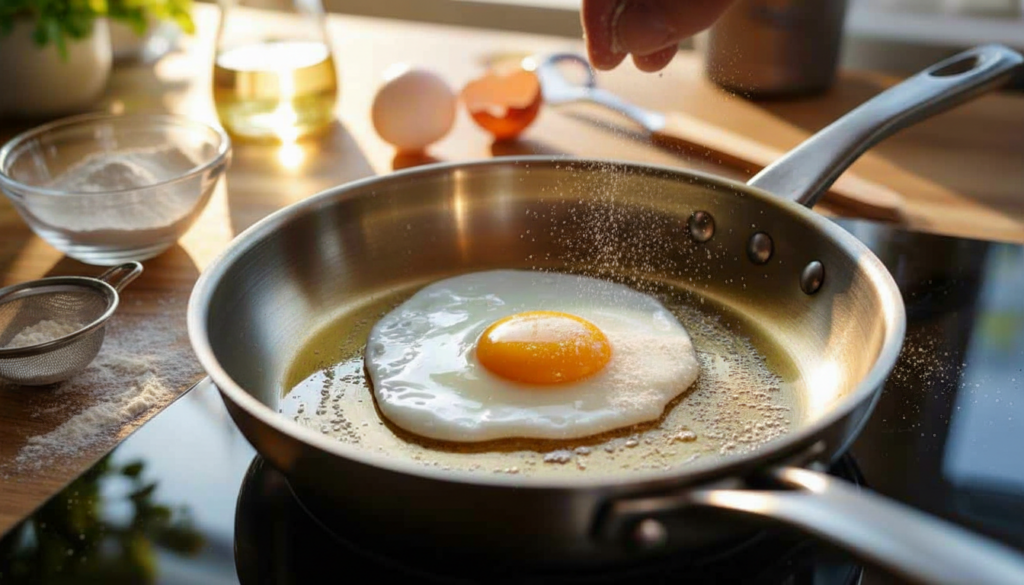
Then an old neighbor said something that sounded like a myth: “Next time, dust the pan with flour.” No water, no butter. Only flour.
I gave it a shot.
It looked like the egg was sliding on ice.
The pan that bites back: the quiet enemy of fried eggs
There’s a tiny drama that plays out in kitchens every morning.
You break an egg and hear the soft hiss as it hits the pan. You can already picture the plate: white set, shiny yolk, and slightly crisp edges. Then you go to flip or slide it out, and everything sticks. The white rips, the yolk smears, and then you have to scrape off the burned protein from the bottom like a food archaeologist.
You feel like you got ripped off, especially if you bought that pan because the label promised a lot.
It shouldn’t be this hard to make a fried egg.
One woman I talked to told me about her “Sunday egg ritual.”
Same pan, same sunflower oil, and the same amount of time. On some days, the egg came out perfectly, but on others, it stuck like glue, as if the pan was punishing her. She even tried the well-known trick of putting a spoonful of water and a lid on top to steam it. Yes, the egg cooked, but the bottom often stuck, leaving a thin, burned “skin” on the metal.
She thought about getting a new pan because she thought hers had “lost its non-stick soul.”
Not the pan, but a spoonful of flour changed everything.
You need to picture what happens on the pan’s surface to understand why.
Even the smoothest metal has tiny scratches and pores that you can’t see. The proteins in the white sink into those tiny holes and stick to them when the egg hits, especially if the heat is too high or the fat layer is too thin. That’s when the scraping starts.
The flour trick gets between the egg and the pores.
It makes a dry, super-thin barrier that grabs the oil and makes a kind of instant, edible shield. The egg sits on that shield instead of sticking to the metal. The result feels like cheating.
The flour trick: how to make a fake non-stick pan in 10 seconds
The method is surprisingly easy.
Get your pan ready. It could be steel, enamel, or even that old “non-stick” pan that isn’t so non-stick anymore. Put a little bit of oil on the bottom, just enough to coat it lightly. You don’t need to be exact or use scales; just add a pinch of plain flour. Then gently tilt and rotate the pan so the flour spreads and mixes into the oil, forming a pale, thin, almost invisible film.
Set the heat to medium and let the mixture warm up and start to change color.
Then break your egg right on top of this movie and listen.
The first surprise is something you can see.
The egg white sets up nicely, leaving a clear outline instead of bleeding into little torn edges. You don’t feel much resistance when you run a spatula underneath. It’s like taking a sticker off of glass instead of tearing tape off of cardboard. The second surprise is at the plate: the bottom of the egg has a light, subtle texture that feels almost like a whisper of crisp batter, but it doesn’t feel like bread or heavy.
For people who avoid butter for dietary or taste reasons, the trick is a small revelation.
Just oil and flour give you the feeling of “cooked on a well-seasoned plate.”
There is a very simple lesson in kitchen physics behind this little trick.
The flour soaks up some of the oil and makes a thin layer that keeps the egg proteins from touching the hot metal directly. This layer starts to brown, like the start of a roux, before the egg is even done cooking. The egg clings to that sacrificial layer instead of welding itself to the pan. The film lets go when you slide it out, and the egg follows.

Let’s be honest: no one really checks the temperature of their stove with a thermometer every day.
The flour trick lets you make small mistakes, like the pan being a little too hot or having a little too much oil, and still lets you release smoothly.
Common mistakes, easy fixes, and what cooks really mean
A few gestures are important for getting this to work every time.
For a small pan, use about a pinch of flour; for a big pan, use about a half-teaspoon. Make sure to spread it out well so that there aren’t any thick clumps where the egg might taste like paste. Set the heat to medium, not full blast. When the flour-oil film starts to look a little golden and watery, you’re in the right place. Then slowly crack the egg near the pan so that the yolk stays whole and lands softly on the cushion.
If you like the edges to be crispy, let the film brown a little more before you add the egg.
Add the egg a little earlier if you want a softer, smoother bottom.
Being impatient with the heat is the most common mistake.
If the egg is too low, it will soak up the flour film, making it soft and a little sticky. If the temperature is too high, the flour will burn before the egg cooks, leaving black spots and a bad taste. Another way to get caught is to fill the pan with oil. The goal is not to deep-fry the egg, but to make a thin, stable emulsion of oil and flour.
We’ve all been there: the time when you’re trying to make breakfast and you have to deal with toast, coffee, kids, emails, and a pan that seems like it wants to ruin it.
This trick makes it feel like someone is quietly turning down the volume on chaos on those mornings.
A home cook from Lyon told me, “I thought the flour idea was silly.” “Then I tried it once, and my egg literally slid out of the pan whole, like in a commercial. I now keep a jar of flour next to the stove just for eggs.
Use flour that isn’t too strong
Wheat flour without any extras works best. Wholemeal can also work, but the taste is stronger.
Pick a flame that isn’t too strong.
- The big flames burn the flour before it can do its job. Take thirty extra seconds for a more gentle, even heat.
Add seasoning after cooking - Put the egg in the pan or on the plate, not in the flour film, and then salt and pepper it.
Change the texture - For a slightly crisp base, let the flour-oil film brown a shade more before adding the egg.
- Be smart about how you clean the pan.
Rinse while the water is still warm; the thin layer of flour comes off easily, so you don’t have to scrub hard.
What a simple egg can tell us about our kitchens, beyond the trick
This small hack shows us something bigger about how we cook at home.
We buy more and more advanced pans in search of the promise of food that never sticks. But sometimes the answer is as simple as a spoonful of flour in the back of the cupboard. *You can feel cause and effect almost right away when you fry an egg. The whole outcome changes when you change one gesture.
The flour trick won’t make every breakfast look like it came from a restaurant, and that’s not the point.
It gives you control and a quiet confidence: you can get that clean, bright egg on the plate even with an old pan and no butter or fancy tools. And after you see it slide and hear that soft “shhh” of release instead of scraping, you start to think about other recipes in a new way.
You could tell a friend who always complains about burned eggs how to do it.
You could try it out in a small rental kitchen or while eating a late-night snack by yourself. The kitchen feels less like a battlefield and more like a place where small, clever things can still happen between the flour dust on the counter and the first intact yolk.
| Key point | Detail | Value for the reader |
|---|---|---|
| Flour creates a barrier | Mixed with a little oil, flour forms a micro-layer between egg and pan | Eggs release easily without needing butter or water |
| Medium heat is crucial | The flour film should lightly brown, not burn or stay raw | Reduces sticking, keeps flavor clean and pleasant |
| Works with older pans | Even scratched or tired pans regain a “fake non-stick” function | Saves money and stress, extends the life of existing cookware |
Questions and Answers:
Question 1: Does the flour trick change how the fried egg tastes?
Answer 1Very little, and usually for the better. The bottom can taste a little like toast, like a very light batter. Most people won’t notice it if you only use a light dusting of flour and neutral oil.
Question 2: Is it possible to use olive oil instead of neutral oil for this?
Yes, the answer is yes. Olive oil works well, especially if you use medium heat so it doesn’t smoke. You still get the flour film, and the olive oil gives it a slight fruity flavor and makes it non-stick.
Question 3: What kind of flour works best with this method?
Answer 3: The easiest type of flour to use is classic all-purpose wheat flour. You can use wholemeal or spelt, but they will make the taste stronger. Rice flour and other gluten-free flours can also work, and they often make things even crispier.
Question 4: Can you use this method on more than one egg at a time?
Answer 4: Yes, as long as the pan is big enough and the flour-oil film covers the whole surface evenly. Spread the film on the pan, then crack the eggs one at a time, making sure they don’t touch too much.
Question 5: Can I use the same layer of flour for a second batch of eggs?
Answer 5Make a new film each time for the best taste and texture. The first layer gets darker and picks up egg residue, which can burn on the second round. To reset the pan, all you need is a pinch of new flour and a few seconds.