A woman in her mid-forties studies her reflection on a damp Tuesday afternoon inside a packed London salon. Her once-glowy balayage, perfect under summer light and social media filters, now feels dull. Along her parting, fine silver strands flash like tiny streaks of lightning, exposing every postponed appointment. The stylist gently lifts a section and pauses. “We can refresh it… or we can rethink it.” She leans closer to the mirror and lowers her voice. “What if we stop battling the grey altogether?”
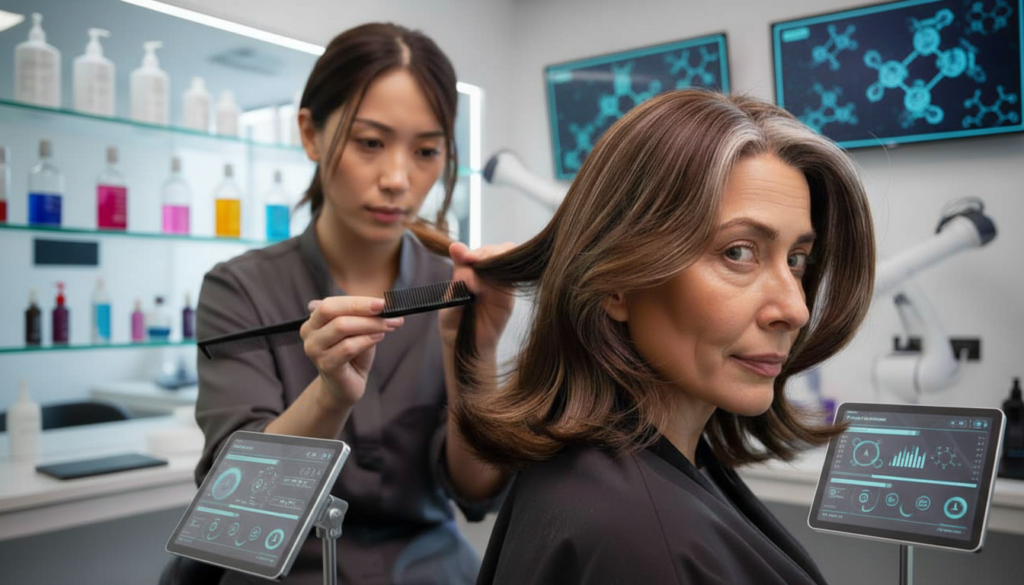
What’s shifting in salons: covering grey hair or redesigning it?
For years, balayage was the go-to camouflage for early greys. Lighten the mid-lengths, soften the contrast, and hope the eye skims past the silver. Under warm lighting, it worked beautifully. But real life — office elevators, harsh daylight, 4K phone cameras started telling a different story.
Colorists began noticing the change in requests. Instead of “brighter” or “more sun-kissed,” clients asked for “lower upkeep,” “softer regrowth,” and bluntly, “no obvious root line.” The promise of effortless balayage clashed with root touch-ups every three to four weeks. The maintenance no longer matched the mood. Women didn’t want trendier hair they wanted calmer hair. That demand opened the door to something more precise and less dramatic.

The phrase now circulating in high-end salons from Paris to New York is “micro-fusion coverage.” It may sound technical, but the idea is simple: apply pigment exactly where the grey lives, almost strand by strand, instead of painting broad highlights. Think pixels, not brush strokes.
Rather than lightening randomly and hoping the grey blends in, colorists map each silver zone and adjust tone with surgical accuracy. Permanent pigment is used only where needed, then softened with demi-permanent gloss around it. The harsh regrowth band fades into a whisper. Appointments stretch from four weeks to eight or even ten. Clients don’t walk out looking blonder. They walk out looking like themselves — just without the silver spotlight at the roots.
Inside the chair: how this targeted grey method actually works
If you ask for “that subtle grey blending thing,” don’t expect foils stacked high or a balayage board. Instead, your stylist reaches for a tail comb, a detail brush, and often a bright ring light. Hair is sectioned into small grids — not glamorous, but incredibly deliberate.
Each grey cluster is isolated and matched with a customized formula. If your base runs warm, the pigment is cooled slightly. If it tends to look flat, warmth is reintroduced strategically. Around those micro-zones, a sheer veil of gloss blends everything together so there’s no visible break between new growth and colored hair.
One 47-year-old client described it as “having my hair edited instead of dyed.” After years of solid root touch-ups that left her with a helmet-like brown, she tried micro-fusion coverage before a big event. Three days later, people didn’t say, “Did you color your hair?” They said, “You look refreshed.” No stark band, no obvious shift — just softer light reflection and seamless depth.
Technically, it sits between balayage and traditional root dye. Balayage ignores stubborn root greys. Full root dye blankets the scalp in a single block tone. Micro-fusion blends both philosophies — precision at the root, transparency through the lengths. The result feels lived-in, not lacquered.
How to speak to your colorist about ditching balayage stress
The trick isn’t memorizing the buzzword. It’s changing how you describe your problem. Instead of asking for “natural balayage,” talk about your tolerance for regrowth. Point to where the silver is strongest — temples, crown, parting. Be honest about how often you’re willing to return.
Ask for targeted grey coverage with soft blending, not a dramatic color overhaul. That subtle shift steers your stylist away from trend-driven brightness and toward longevity.
Also, skip the guilt. You don’t need to apologize for overdue roots. Instead, explain your pain points. Is it the sparkle of silver by week three? The harsh stripe when you tie your hair back? The way fresh color looks perfect on day one but artificial by week ten?
And be realistic. If you’re not going to maintain purple shampoo routines or monthly toners, say so. A good colorist will design something that survives real life — gym sessions, rushed mornings, unexpected events — without collapsing.
One London stylist even gives clients a small “hair sanity checklist”:
– Request targeted grey micro-coverage, not full-head dye.
– Space visits every 8–10 weeks when possible.
– Use a gentle, sulfate-free cleanser.
– Avoid tight styles that expose root contrast.
– Schedule quick face-frame refreshes before major events.
A new relationship with grey: neither surrender nor denial
This technique doesn’t freeze time. Grey will still grow. But the emotional cycle changes. Instead of panic-cover-panic-cover, there’s a quieter rhythm — subtle refinements spaced over months.

Balayage once symbolized endless summer brightness. For many, that no longer aligns with how they want to feel. Micro-fusion coverage isn’t about pretending grey doesn’t exist. It’s about managing it intelligently, letting it coexist without dominating.
Some women will embrace full silver. Others will erase every strand. Between those extremes, a middle path is forming — one where grey becomes texture, not trauma.
Eventually, the question stops being, “How do I hide this?”
It becomes, “How do I want this to grow with me?”
Core Feature |
Description |
Why It Matters |
|---|---|---|
Precision Grey Blending |
Color applied carefully strand by strand |
Creates a soft and natural-looking root transition |
Longer Gap Between Visits |
Planned for an 8–10 week grow-out cycle |
Reduces salon trips and overall maintenance cost |
Lifestyle-Centered Consultation |
Color strategy based on daily routine and habits |
Ensures shade and upkeep match real-life needs |
FAQ:
Question 1: Is micro-fusion coverage just another form of balayage?
Answer: No. Balayage focuses on lightened pieces for dimension. Micro-fusion coverage targets grey strands directly and blends them invisibly into your base color.
Question 2: Does it permanently stop grey growth?
Answer: No technique stops greying. This method simply softens how new grey appears, making regrowth far less noticeable.
Question 3: Is it safe for fine or fragile hair?
Answer: It can be gentler than full root dye because pigment is applied only where needed. Always inform your stylist about hair sensitivity.
Question 4: What if my salon doesn’t know the term?
Answer: Describe the result you want — targeted grey coverage with soft blending and longer grow-out — instead of focusing on the name.
Question 5: Can I transition from balayage without drastic change?
Answer: Yes. Your stylist can use existing highlights as a base and gradually introduce targeted root blending over one or two sessions.