Every time you open the cabinet door, you hear a soft clatter that tells you the bathroom is a mess. A shower of bobby pins, tweezers slipping into the sink, and that nail clipper you thought you lost three months ago. You blindly search the counter for those little metal things, already late and annoyed, knowing that they are under a layer of makeup crumbs and toothpaste dots.
We put up with it longer than we should because “it’s just a few pins,” until the mess starts to wake you up more than your alarm.
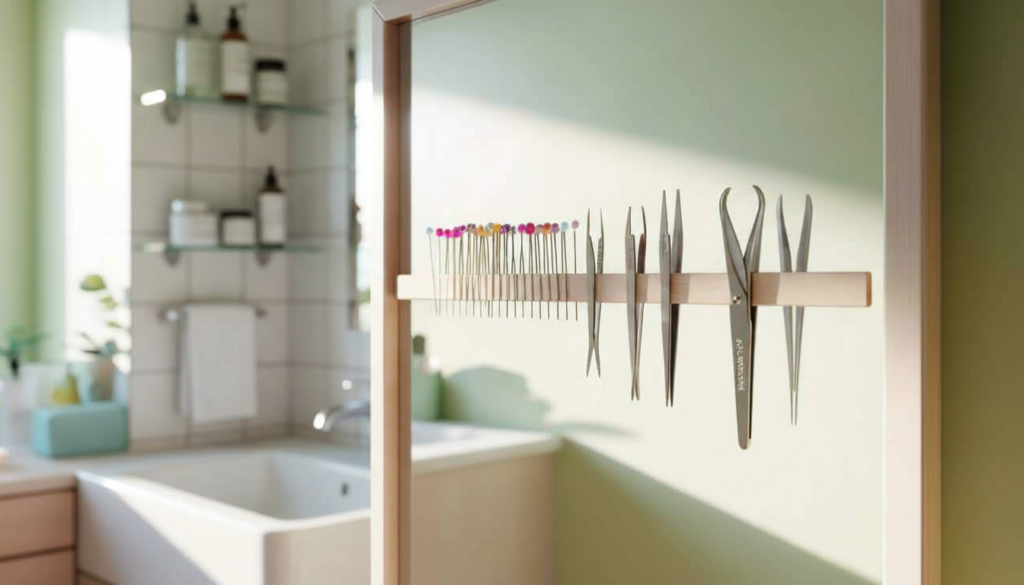
Then, one day, you see a picture online of a bathroom cabinet door with a simple magnetic strip that keeps bobby pins in neat rows. Tweezers standing up like tiny soldiers. Peaceful where there used to be chaos.

And all of a sudden, you can’t unsee it.
The secret weapon that is hiding on the back of your cabinet door
The inside of a bathroom cabinet door is one of the most useless spaces in the house. We close it hard, put everything on the shelves behind it, and forget about the door. But it’s right in front of your eyes, just a few inches from your hands, and it opens and closes with you every day.
Now picture that door working for you instead of just swinging. A thin magnetic strip that is almost invisible runs along the inside. Bobby pins are neatly lined up in rows, and tweezers and nail scissors are stuck in a safe place where you can grab them without thinking. No digging around. No balancing act. Every time you open the cabinet, you get a little bit of order.
Think about a busy weekday morning. You have five minutes to look like a person before the video call. You open the cabinet and reach down without thinking, but your fingers touch nothing. No more tweezers. What is your favorite hair clip? Most likely behind the shampoo, where the dust lives.
Now play the scene again, this time with a magnetic strip. The door swings open. You can find all the metal tools you need every day, like bobby pins, tweezers, nail clippers, and eyebrow scissors, right there. You get what you need in half a second and shut the door. No digging, no swearing at 8:03 a.m., and no panic about where I put that again. Even though you only changed one strip of space, the whole routine feels different.
This trick feels so good for a reason. Our brains like it when “floating chaos” becomes “visible order.” Bobby pins and other small things are classic visual noise because they move around, pile up, and disappear into corners. Putting them back in your line of sight and giving them a clear home is as easy as sticking them vertically on a magnetic strip.
That change—from flat, scattered surfaces to vertical, contained space—also makes room on your shelves for the bigger things that really need it. And there’s another small benefit: when things have a specific parking spot, your hand will automatically put them back there without you having to think about it. It’s not just a place to put things; it’s a small push to clean up.
How to make a magnetic strip that really works for you
Use a simple, thin adhesive magnetic strip, like the ones that come with knives or tools. You should measure the inside of your cabinet door to see how long you can use it without hitting shelves when it closes. If you need to, cut the strip, peel off the backing, and stick it at eye or hand level. Press down hard along the whole length to make sure it sticks well.
The next part is the fun part. Put your metal tools, like bobby pins, tweezers, nail clippers, small scissors, and maybe that metal nail file you keep losing, in one place. Put things in groups along the strip so that your hand knows where each one is. The door now has a purpose other than just hiding the mess.

This trick is easy to do, but there are a few simple ways to mess it up. The first is putting too much weight on the strip. When you cover it from end to end, it stops looking calm and starts looking like a hardware store. Leave small spaces so your fingers and eyes can “breathe.”
Another common mistake is to use a cheap, weak strip and then blame the idea when your tweezers slip down every time you open the door. Choose a strip that says “strong” or “heavy duty” on it, and then test it with your heaviest item before you buy it. Clean the surface of your cabinet really well and let it dry before putting anything on it if it is old or painted. In a bathroom, dust and humidity are bad for adhesives.
Léa, a 34-year-old graphic designer who swears by the magnetic strip trick, laughs, “Buying new organizers wasn’t the turning point.” “It finally gave my “lost” things a real address. If a bobby pin isn’t on that strip, I know I left it somewhere else, not “mysteriously vanished” into the universe.
- Pick a magnetic strip that is strong, thin, and has good glue.
- Put it at a height that is easy for you to reach things without having to stretch.
- Keep it to small metal things like bobby pins, tweezers, nail clippers, and tiny scissors.
- Make sure there is space between groups so it doesn’t look messy.
- At night, do a quick 5-second reset: put everything back on the strip.
- When one small strip makes your whole bathroom feel different
After a few days of using the strip, you notice a small change. You don’t get ready for a flood of tiny things when you open the cabinet. You can see that the tools are all lined up and ready to work. That little bit of control you have at the beginning and end of the day spreads to other parts of the space. You might clean the sink more often or finally throw away the old cream at the back.
Let’s be honest: no one really puts their bobby pins in a little box every day. That’s why this vertical, easy-to-use solution works so well. It meets you where you are, not where an Instagram picture-perfect bathroom thinks you should be.
You might even show your friend who uses your bathroom the trick: the satisfying snap of the tweezers onto the strip, which looks like a row of tiny black commas. It’s very normal and strangely enjoyable at the same time. *It’s grounding to turn a daily annoyance into a small dose of quiet productivity.
You start looking around your house for other “dead spaces” that could use more work, like the inside of a kitchen cabinet, the side of a metal shelving unit, or the frame of a mirror. One small hack can often lead to a series of small improvements.
The best thing about this magnetic strip is that it doesn’t have any flashy features, but the effect can feel huge. You’re not getting a new piece of furniture; you’re changing the way the space you already have works. Making things that aren’t visible useful is the key to smart organizing.
We’ve all been there, when a room starts to feel like the noise in your head. It’s clear that a small row of bobby pins on a door won’t fix everything in your life. But it can give you one small, repeatable moment of “ah, that’s better” twice a day.
And sometimes, that’s the kind of small win the week needs.
| Key point | Detail | Value for the reader |
|---|---|---|
| Use vertical space | Place a slim magnetic strip on the inside of the bathroom cabinet door | Frees up shelf and counter space without adding bulky organizers |
| Group tiny metal items | Stick bobby pins, tweezers, nail clippers and small scissors directly onto the strip | Stops daily “where is it?” searches and reduces morning stress |
| Keep it simple and visible | Leave small gaps and limit what lives on the strip | Makes the system intuitive, easy to maintain, and visually calming |