She was 67 years old and wore a cashmere cardigan and pearl earrings that will never go out of style. She sat up straight with her hands in her lap and stared at the mirror as if it might tell her the truth. She said to the hairdresser, “Just the usual.” “Not too fancy, short, and clean.” I don’t want to look like I’m trying too hard.
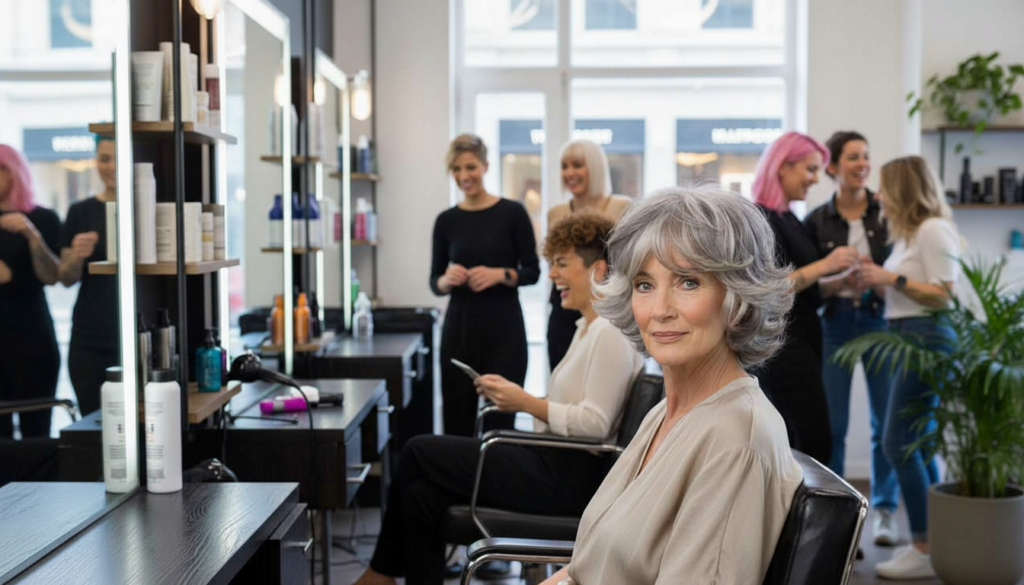
The stylist stopped and held the scissors.
There was a picture on the small tray next to them that she had brought with her. It was half-hidden by a magazine. It had a long, sweeping fringe and a silver, textured shag cut. New. Fun. Brave.

She liked the picture so much that she made a copy.
But she still said, “Just the usual.”
The stylist smiled and asked in a very quiet voice, “Are you sure?”
Why “respectable” hair after 60 is often based on fear, not style
If you go to a busy city salon for an afternoon, you’ll hear the same thing from women over 60. “I don’t want anything too crazy.”
What they really mean is: don’t cut it too short, don’t leave it too long, don’t make it too textured, and don’t leave any hair out of place. They say things like “classy” and “age appropriate” when they see a safe, rounded bob or a carefully styled helmet of curls.
When the clients go outside, ask the pros, and they’ll tell you a different story. Most of these “conservative” cuts don’t have anything to do with taste that lasts. They’re about hiding.
Nina, a London hairstylist, talks all the time about a client she’s had for 20 years. The woman was in her early 50s and had a blowout that was shoulder-length and looked like it belonged in a corporate boardroom in 1998.
Totally smooth. The color is a perfect mix of beige and brown. Not something to remember.
When she was 72, she was still telling Nina to “keep it like always.” After a long time, Nina finally spoke up and asked, “What would you ask me for if no one from your old office ever saw you again?”
At that moment, the woman looked ten years younger when she exhaled. She took out her phone and, with a shy smile, showed a picture she had saved. It was a messy fringe on a chin-length, layered, salt-and-pepper crop. She had taken a picture of it months before. She just didn’t have the guts to say it out loud.
This is something that hairdressers see every day. The “classic” cut is like a safety blanket for some people, just like they hold on to dark, shapeless clothes.
The outside looks classy, subtle, and even trendy. Underneath, it’s often driven by quiet panic: fear of being seen as “mutton dressed as lamb,” fear of what other women will say, and fear of being noticed for the wrong reasons.
*The truth is that many women use conservative hairstyles to hide who they really are. Not to look better, but to fit in with a world that likes young people. When stylists gently suggest something more free, the first thing people say is usually not, “I don’t like it.”
People often say, “What will people think?”
The silver shag with an attitude: the daring cut that makes people think twice
If you ask a group of experienced hairstylists what cut shows that hair after age 60 can be daring and still look great, you’ll hear the same thing over and over: the modern silver shag.
Not the 1970s style with feathers. The new shag is all about movement, soft layers, and a texture that works with gray hair instead of against it. It often has a long curtain fringe or a bang that sweeps to the side and frames the face, drawing attention to the cheekbones and eyes.
The shape is a little off on purpose. It’s not a hard blowout. That’s why it looks so new on an older face.
Picture this: a retired teacher who is 64 years old walks into a neighborhood salon with brown hair that is box-dyed and shoulder-length. She has had a strict side part since 1992. Her short message is clear: “I’m tired.”
The color looks dull, the ends are fried, and every time she tries to “hide the grey,” her roots become more obvious.
Her stylist says she should get a silver shag. They slowly lift the old dye, mix in her natural white strands with some cool highlights, and cut her hair into long layers that fall just above her jaw and collarbone. The fringe is soft and a little messy, and it keeps brushing her lashes.
People don’t say, “great cut for her age,” when she walks out.
They just think, “Great cut, period.”
Why does this style look so good after 60? It doesn’t fight what the hair wants to do this time. Gray and white strands are usually drier, lighter, and have their own texture. The silver shag celebrates that lightness instead of forcing them to submit with endless blow-drying and sprays.
The layers break up any “helmet” effect and keep the face from looking heavy. The fringe makes forehead lines less noticeable without covering them up. The end result looks modern without trying to look like a 25-year-old influencer.
Astrological predictions for 2026 say that a small number of zodiac signs will get rich, while the rest will be angry and poor.
And here’s the quiet change in the mind: a cut like this says, “I’m here, I take up space, and I’m allowed to be seen.” That means something very different than the polite, conservative bob that doesn’t move in the wind.
How to ask for a bold post-60 cut without feeling silly
The first step isn’t to sit in the salon chair. It’s right in front of your bathroom mirror. Just stand there with your hair the way it is and ask yourself, “If I didn’t care what people thought, what would I secretly like to try?”
 Protein-Rich Broth Habits That Slowly Enhance Skin Moisture, Tightness and Resilience Naturally
You don’t need to have the right answer. It could be “shorter than this,” “let the grey show,” or “something with more fringe.” Take that little wish and look for pictures of real women on Pinterest or Instagram, not just famous people. Save three to five pictures of cuts that have a similar vibe, but not necessarily the same shape.
Then take those pictures to your stylist and say what most professionals would love to hear: “This is how I want to feel.” Is it possible for you to change it to fit my hair and face?
One of the worst things women over 60 do is say they’re sorry for wanting things to change. They sit down and make a list of what they don’t want, which is often full of self-criticism: “I know my hair is awful, I know my face is sagging, just do whatever is least noticeable.”
Stylists don’t work alone; they work with you. The best way to use them is to tell them how you live. Do you blow-dry your hair once a week or not at all? Do you have glasses? Do you pull your hair back when you cook, garden, or watch kids?
To be honest, no one really gets a salon-level blowout every day. If you are honest with your stylist, they can give you a bold cut that looks like you put some thought into it and dries well in the air.
One afternoon, a senior Paris colorist summed it up for me as she cut a 70-year-old woman’s silver fringe into shape:
“Class isn’t about having boring hair,” she said. “Class is about making choices on purpose instead of letting fear choose for you.”
Then she gave us the short list she gives to every woman over 60 who wants to get a modern shag or any other statement cut:
Does the cut move when you do, or is it stuck?
Can you style it in less than ten minutes on a normal day?
Does it make your eyes look great?
Does it work with the way your skin looks and feels, not against it?
Do you see yourself in the mirror, or a carefully hidden person?
One “yes” is a good start. Five yeses usually means you’ve found the perfect balance between being bold and being truly easy.
What if the real rule for hair is joy instead of “age-appropriate”?
If you spend time with women who have fully accepted their hair after age 60, you’ll notice something surprising. People stop asking themselves, “Is this okay for my age?” and start asking, “Does this feel like me right now?”
The silver shag is just one example. For some, the brave choice is a very short crop that shows off their neck and jawline. For some, it’s letting their hair grow longer than it has since their thirties, with loose waves and a natural silver ombré. Some people make their hair bright white on purpose and wear it like the coolest accessory in the room.
The length or color doesn’t connect them all. They stopped calling it a “respectable” prison.
You don’t have to go to a salon and ask for a big change to get your hair back. Sometimes all you have to do is ask your stylist, “What would you do if I let you ignore my old rules?”
Sometimes it’s about keeping your favorite bob but making the lines softer, the blowout looser, and adding some texture so you don’t look like a “news anchor” but more like a “French film director.” Sometimes it’s finally saying yes to the bangs you’ve wanted since you were 19.
The real change happens inside when you stop dressing a certain way to avoid hurting someone’s feelings and start dressing a certain way to feel good about yourself. At that point, the conservative cut stops being a shield and becomes a choice again.
And that’s the kind of quiet boldness that people notice long before they realize it’s “just” a new hairdo.
Key point: What the reader needs to know
Conservative cuts often hide insecurity. People choose many “classic” bobs and stiff blowouts because they are afraid of what others will think, not because they like them. Makes you think about whether your current style really shows who you are now
The modern silver shag looks good on real gray hair. Soft layers, movement, and a fringe work with the natural texture and color of your hair instead of against them. Gives you a real, stylish choice to talk about with a stylist after 60
Being honest with your stylist makes a big difference. Sharing photos of your lifestyle, limits, and sources of inspiration can help you get bolder but still useful cuts. Makes going to the salon less stressful and the results more personal and wearable.
Questions and Answers:
Isn’t it too much to have a bold hairstyle after 60?Not if it fits your personality and way of life. When you “try too hard,” it usually means copying someone else. A haircut that fits your features and texture makes you look confident, not desperate.
Can a shag cut work for hair that is fine or thinning?Yes, but only with the right change. A good stylist won’t put on too many layers and will keep some weight where you need it, like around the crown, to give your hair lift without making the ends look scraggly.
What if my friends or family say it’s not right for my age?You don’t have to tell anyone why you did it. You could say, “I wanted a change, and I love how it feels.” They usually feel better after they see how confident you are.
Do I have to stop coloring my hair to be brave?Not at all. Some women have a deep chocolate crop or a shaggy copper hairdo. The most important thing is that the color and cut look good on your skin tone and are easy to take care of, not that they are too expensive or take too much time.
How can I find out if my stylist knows how to cut gray hair?Check out their photos on social media or in their salon. Find pictures of people your age who have modern shapes and textures that are easy to see. You might want to try someone else if everything looks stiff or like it has too much spray on it.