People in the UK and the US are looking for ways to stay warm inside without turning up the thermostat to levels that hurt. Physics gives you a few surprisingly simple options: stop the leaks, push more heat into the room instead of the walls, and use the heat you already have in smarter ways.
Why your house feels cold even when the heater is on
It’s not just the number on the thermostat that makes you feel cold at home. The temperature of the air, the surfaces around you, and how much air is moving all affect how comfortable you are.
Your body has to work harder to stay warm when the windows are thin, there are gaps under the doors, and the floors are icy. When your skin feels cold surfaces or drafts, it sends a signal: put on a sweater or turn up the heat.
 A psychologist insists: the best chapter of life begins when you start thinking in this way
You can feel more comfortable by working with conduction, radiation, and convection, which are the three main ways heat moves. You don’t have to change the settings on the boiler.
The three low-tech tricks below are not magic. They just slow down the heat loss, move the heat you already pay for, and add small but steady sources of warmth.
1. Close the door smartly so the heat stays inside.
Heat likes to get out easily. Cold air can get in through cracks around windows, warped doors, and gaps in floorboards. Some studies in Europe show that these small leaks can cause up to a third of the heat loss in some older homes.
This is a classic case of heat conduction and air infiltration. Warm air inside meets a cold surface or slips out through a gap, and your boiler has to replace it over and over.
Quick fixes that don’t cost much and stop heat loss
Put self-adhesive foam or rubber seals around windows and doors that leak.
At the bottom of doors, especially at night, use draught excluders, “door snakes,” or even a rolled-up towel.
As an extra thermal barrier, hang thick curtains over windows and, if you can, over front doors.
If you spend a lot of time sitting in your living room or bedroom, put rugs on the bare or tiled floors.
The jobs are small, but the effect on the senses is big. In a room that isn’t well insulated, a thick rug can make the temperature at your feet feel a couple of degrees warmer. Your body thinks that “warm feet” means “the room is fine,” so you are less likely to turn up the heat.
Cutting draughts makes a room feel warmer long before the thermometer shows a big change.
There is one thing you should never do when draught-proofing: block the ventilation grilles that are made for gas appliances, boilers or stoves. Not for comfort, but for safety, those vents are there.
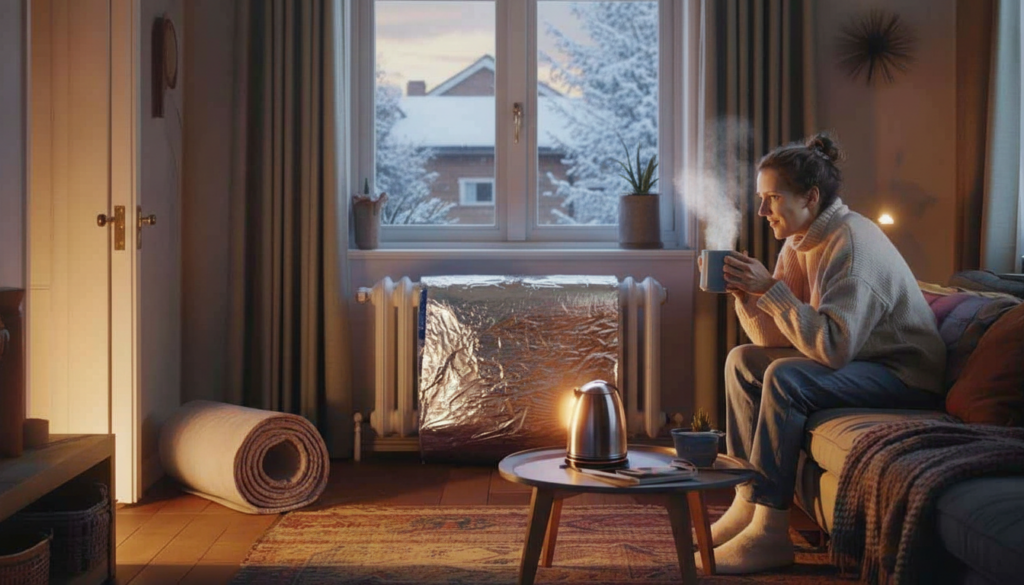
2. Use aluminium foil to move more heat from the radiator into the room.
The name “standard radiators” is not very good. Not only do they give off heat, but they also warm the air that moves around them. But a lot of this heat goes right into the wall behind, especially in older homes with solid brick walls.
That’s where aluminium foil comes in. Shiny aluminium doesn’t absorb heat radiation; it reflects it. When placed correctly, it sends warmth that would have gone into the wall back into the room.
How to make a heat reflector yourself
You don’t need special equipment. In many cases, a simple homemade panel works:
Find out how wide and tall the part of the radiator that faces the wall is.
Cut a piece of cardboard that is a little smaller than that area.
Use kitchen aluminium foil to wrap the cardboard, with the shiny side facing out.
Slide the panel down behind the radiator, leaving a small space for air to flow through.
With the same boiler setting, a well-placed reflector can keep more heat inside and less heat outside.
Commercial reflector panels, which are usually made of foil on foam or plastic sheets, work on the same principle but last longer. For basic kits, prices start at a few pounds or dollars per radiator and go up to more complex systems that cover whole walls.
When foil works and when it doesn’t
In these situations, foil reflectors work best:
Radiators attached to outside walls that aren’t insulated.
Rooms that are not very wide and have radiators close to beds, desks, or sofas.
Older hot-water radiators that work at moderate to high temperatures.
In some situations, you shouldn’t do the hack:
Very modern low-temperature radiators that have reflectors built in.
Rooms with a lot of humidity, like bathrooms that don’t get enough air flow, where condensation can damage foil and walls.
When the foil would touch electrical parts or block thermostatic valves.
Never let the foil or cardboard touch a flame or an electric heating element. The goal is to move heat, not start a fire.

3. Use the heat from people and things around the house, like bodies and kettles.
A person sitting quietly in a room gives off about 80 to 100 watts of heat, which is like a small heater. When a lot of people are in one room or when you’re cooking, the temperature and comfort levels change a lot.
The trick is to keep that warmth where you need it instead of letting it go to waste in empty parts of the house.
On cold days, spend time in fewer rooms.
On the coldest nights, many families already do this without thinking: everyone ends up in the living room or kitchen. That instinct is right on from a physics point of view.
Close the doors to rooms you don’t use so that your heating and body heat don’t go to waste.
Spend more time in one or two “core” rooms that you keep warm.
To get rid of that “cold wall” feeling, put throws and cushions on chairs near outside walls.
A few bodies, a pot on the stove and a closed door can raise the temperature of a medium-sized room by a few degrees over the course of an evening.
The kettle trick: little energy, big effect
Hot drinks do two things at once: they warm your hands and core and add a little extra heat to the room. An electric kettle is usually one of the best ways to heat water, especially when you compare it to a big pan on the stove.
Energy agencies in Europe say that an efficient kettle can use up to a third less energy than boiling the same amount of water on many old-fashioned stoves, as long as you only heat what you need.
A few rules make that benefit real:
Put only the amount of water in the kettle that you need.
Limescale builds up on the element and makes it work harder, so clean it often.
Quickly use the hot water for tea, soup, or to warm up a mug or hot water bottle.
If you let boiled water cool down in the kettle, you waste the energy you just used. Using it right away or putting it in a thermos makes that short burst of electricity more useful.
What kind of difference can these three tricks make?
No one piece of advice will make a drafty Victorian terrace or an American farmhouse into an eco-friendly home with low energy use. When you put the gains on top of each other, they show up.
Energy agencies say that these small changes, when used together, can cut the need for heating by several percent in a typical two-bedroom flat with basic insulation. They also say that these changes will make the flat feel much more comfortable. That might sound small, but when you add up the costs of gas or electricity over a long winter, it can add up to a lot of money.
Important ideas that need to be explained quickly
There are three things in physics that explain all of this:
Conduction is when heat moves through solid objects, like when a warm room loses heat through a cold wall or window frame.
Convection is when warm air rises and cold air sinks, which makes currents that you can feel as drafts.
Radiation is heat that moves in waves, like from a radiator or a person’s body to nearby surfaces.
Aluminium foil mostly interacts with radiation by bouncing heat waves back into the room. Draught proofing works by stopping cold air from coming in and warm air from leaking out. People and hot kettles give off radiation and warm up the air around them by convection.
Real-life winter situations at home
Think about a normal January night. It’s almost freezing outside. You set the thermostat to 19°C inside. The room may still feel like 16–17°C on your skin, even though the floors are bare, the windows aren’t sealed, and the radiators are pushing half their heat into the wall.
Now picture the same room, but with the gaps sealed, a rug over the cold tiles, foil reflectors behind the radiators, and the family spending time in the living room instead of all over the house. The thermostat still says 19°C, but your body says it’s closer to 20–21°C. That’s the difference between wanting to wear an extra jumper and being happy with the one you already have.
None of these things can take the place of good insulation or modern heating systems. They do, however, offer quick wins for winter 2025 that you can put in place over a single weekend with cardboard, foil, a kettle, and some tape. Plus, they make each unit of energy you pay for work.
| Action | Typical benefit |
|---|---|
| Draught proofing windows and doors | Less cold air movement, feeling of extra warmth of 1–3°C in living zones |
| Foil behind radiators on external walls | More heat directed into the room, lower boiler run time for same comfort |
| Grouping activities + efficient kettle use | Local temperature boost and better personal warmth from hot drinks and food |