You don’t expect the ice to make a sound.
Not a soft crunch, but a deep, hollow crack that goes through your boots and up your spine. A small group of researchers stands in a circle on the Antarctic plateau, their faces red from the wind. They watch as a cable disappears into a hole that looks like a portal drilled straight into another time. The drill rig shakes, the air is so cold that your breath fogs up, and the laptops are balanced on a crate. The coffee gets cold too quickly to drink.
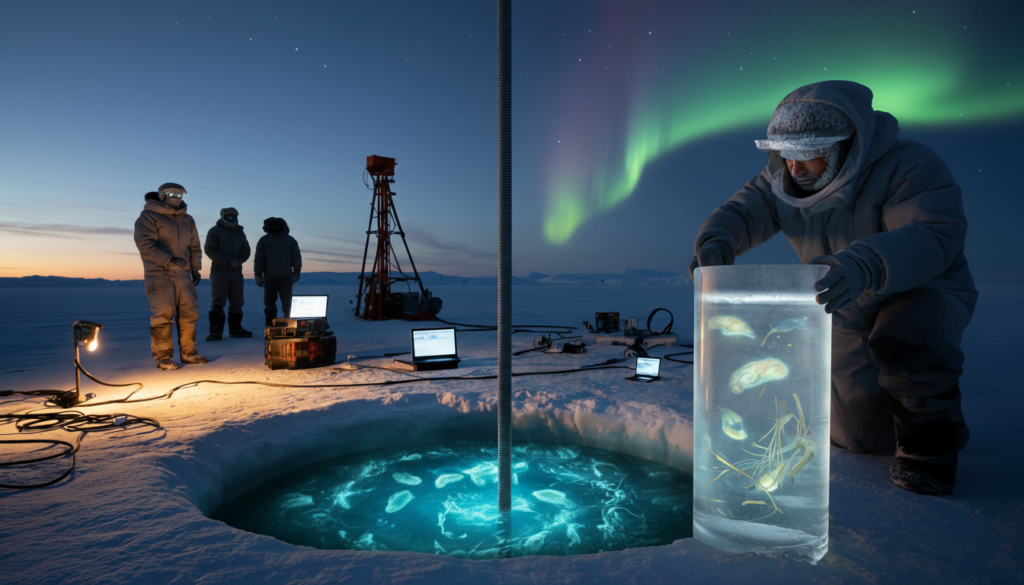
Dark water has been cut off from sunlight for more than a kilometer below their feet since before people walked upright.
They’re going to wake it up soon.
The day an old lake finally spoke back
Everyone stopped talking when the first cloudy tube of water finally came out of the drill line.
No one wanted to be the one who coughed at the wrong time and ruined thirty-four million years of quiet. The sample came from a hidden lake under the Antarctic ice and didn’t look like much at first glance. It was cloudy and had fine sediment in it, like melted snow left in a dirty bucket.

But the room felt charged, like it was holy.
“Say hello to the Eocene,” someone said in a low voice, half-joking.
You could feel the tension: excitement mixed with something that felt more like fear.
Years of planning and stubborn obsession led up to that day.
Scientists used planes to map the ice sheet, bounced radar waves through it, and followed faint ripples that suggested something alive and liquid was below. They found it under several kilometers of ice: a huge lake that is as big as a small European country and has been sealed off since Antarctica froze over about 34 million years ago.
This water was already old news when the first dinosaur fossils were being laid down.
The team drilled through ice at temperatures that can kill skin in minutes. They used hot water at high pressure to melt a hole without getting anything below it dirty.
Every meter down was a battle between curiosity and danger.
The samples started to tell their story when they were looked at closely.
Unusual microbial cells that can handle crushing pressure and stay in the dark all the time. Chemical signs that pointed to a quiet, closed ecosystem that has been recycling the same elements for millions of years. This wasn’t a dead vault at the bottom of the world; it was a stubborn pocket of life.
That’s where the fight began.
Because once you show that something is alive, someone will want to know if we should leave it alone.
Or use it.
On purpose, opening a time capsule that is 34 million years old
The main idea behind this Antarctic quest sounds easy in theory: melt your way down, pull water up, and don’t damage the thing you’re trying to study. In real life, it’s like doing surgery in a storm while wearing mittens and being in a freezer. Researchers depend on ultra-clean hot-water drilling systems, sterilized hoses, and lab-grade filters put together in tents that flap in katabatic winds.
Every connection is cleaned with alcohol, every gasket is put in a bag, and every plastic tube is rinsed six times before use.
They wear layers of gloves, masks on their faces, and numb fingers, knowing that even one tiny microbe could ruin the results. *Sterility turns into an obsession and then a kind of paranoia.
We’ve all been there: that moment when your best-laid plan depends on little things you can’t fully control.
Here, those details look like snow blowing sideways into the hole, a piece of cloth that was left behind, and a researcher who was too tired to clean at 3 a.m. In the early 2000s, scientists had to be careful because there were lakes where drilling fluid polluted the water they wanted to sample, making them throw away data and start over.
The community then changed the rules.
They switched to “clean-access” protocols, which are meant to keep any water that touches the lake as clean as possible and never cycle back up without being filtered. It’s easy to understand: if you’re going to knock on an old door, don’t track mud onto the carpet.
Even with all of these protections, the debate is still going strong in the warmer parts of the world.
Researchers on one side say that the possible benefits are huge: learning how life survives in sealed, extreme environments could change the way we look for life on Europa or Mars. Some of these microbes might have new enzymes, new biochemical tricks, or even molecules that help us fight disease or clean up pollution.
Some people say that being curious isn’t a way to get out of jail.
There may be organisms in Antarctic lakes that have never been to our world or ours to theirs. A subglacial microbe is unlikely to cause a global pandemic, but it’s not impossible, and the idea of low risk but unknown tends to grow in people’s minds.
No one really reads every single risk assessment from start to finish.

Where the need for scientific knowledge meets the right of an ancient ecosystem to exist
The ways that scientists “wake up” these microbes in the labs are surprisingly gentle.
Scientists bring the water up, keep it cold, and then slowly change the conditions: they add a little more warmth, a little more oxygen, and tiny amounts of nutrients to see who stirs. It’s more like gardening than Frankenstein; you have to be patient. They can even study what’s there by sequencing DNA, like reading a library without taking the books off the shelf.
Some teams now prefer non-culture methods: they scan the genetic code, digitally model the metabolisms, and let most of the old organisms sleep.
It’s a compromise between wanting to try new things and not wanting to accidentally set fire to a frozen archive.
The emotional fault line in this argument often lies between what people want and what actually happens.
Researchers aren’t like villains in comic books who want to let loose a “zombie microbe.” They’re people who have spent decades quietly keeping track of strange bacteria that no one can say. Experts do say, though, that it’s easy to get too sure of yourself, especially when bold claims get you jobs, money, and headlines.
Ethicists have stepped in and asked some tough questions: Who owns an ecosystem that has never seen a human? Before we change it, do future generations have a say? And what if companies see those enzymes and start talking about patents?
These worries are not just ideas. Drug and biotech companies are already digging up deep-sea vents and Arctic soils. A 34-million-year-old gene that eats plastic or lives through radiation would be a gold rush.
One polar microbiologist said to me, “We’re not just opening a window into the past of Earth.” “We’re starting a discussion about what we can do and what we should do.”
Ecosystems that are hidden under Antarctic ice might be as far apart from each other as moons in our solar system.
We could learn how life survives in darkness, pressure, and isolation by bringing microbes back to life.
The speed of drilling technology and genetic analysis is faster than the speed of ethical frameworks.
People can quickly lose faith in scientists if they think they’re after fame instead of safety.
Real oversight, not just self-policing, is becoming the new must-have.
A world that remembers more than we do
You feel very small very quickly when you stand at the edge of a drill site and listen to the wind blow across the ice. Antarctic subglacial lakes don’t care about our arguments. They’ve seen continents move, oceans cool, and forests grow and disappear without a ripple on their surface. We’re coming very late to a story that has been going on in the dark for tens of millions of years.
Some of these hidden worlds may come to light as climate change eats away at the edges of the ice sheet, whether scientists find them or not. You can choose between “open” and “seal forever,” but you can also choose between planned exploration and random exposure.
Some experts now say that we should treat some lakes as “protected wilderness” and never drill them. These lakes would be used as controls to show us what untouched nature looks like. Others want the Antarctic Treaty to have clear, global oversight so that no one country or company can make decisions about these ecosystems on its own.
There is a quiet, growing feeling that studying ancient microbes is not just a technical issue for microbiologists.
It shows us how we, as a species, deal with power, temptation, and uncertainty.
The story that is happening under the Antarctic ice is also about whether we can learn to live with mysteries without needing to own them.
No one knows which microbe will be the first to go from being a secret to being used in a lab, factory, or even a hospital. We don’t know which lake we’ll regret disturbing or which one will save lives with a strange molecular trick.
We do know this: the next time a drill goes into the Antarctic ice and the cable goes into the dark, we won’t just be listening for the sound of ice breaking. We’ll be listening for our own answer to a question that has suddenly become very important to us.
How much are we willing to risk waking the past in order to learn more about who we are now?
Main pointDetail: What the reader gets out of it
Old lakes in Antarctica are like living time capsules.Sealed ecosystems have been under ice for up to 34 million years, and they are home to strange microbes.It explains why scientists are so interested in “ancient microbes” and what the headlines are about.
There are moral and safety concerns that come with scientific progress.Possible discoveries are at odds with worries about contamination, bio-risks, and corporate exploitation.Helps readers think about how to balance scientific curiosity with caution in a realistic way
We’re trying to figure out how far we can go into the last untouched places on Earth.New DNA and drilling tools come out faster than rules or public debate around the world.Asks readers to decide for themselves what should stay frozen and what shouldn’t.
What is a lake that is under the ice?It’s a body of water that is trapped under an ice sheet. The pressure from the ice above and the heat from the Earth’s interior below keep it from freezing solid. Some are huge, going on for hundreds of kilometers, and haven’t seen the sun or touched the surface in millions of years.
Could microbes from ancient Antarctica really cause a new disease?Most experts say the chance is low, in part because these organisms evolved in very harsh, isolated environments and might not do well in our bodies or the air around us. The worry isn’t so much about a plague like in Hollywood as it is about how unpredictable interactions with modern ecosystems and lab settings can be.
Why are scientists so eager to study them?These microbes may show how life can change when it is very far away from other living things, has very few nutrients, and is always dark. This is similar to icy moons like Europa. Their enzymes and molecules could lead to new drugs, ways to clean up pollution, or ways to store carbon and make things in factories.
Are there rules about drilling into these lakes that are hard to find?Yes, but they are still changing. The Antarctic Treaty System and scientific committees set rules for “clean access” that limit pollution and require studies of the effects on the environment. As technology gets better, a lot of researchers are asking for stricter, legally binding protection.
Will climate change make these ecosystems more vulnerable anyway?As ice sheets get thinner and move back, some of them may eventually connect with the ocean or surface meltwater. That’s one reason why many scientists say we should study them carefully now: so we know what’s there before warming makes it impossible to see.