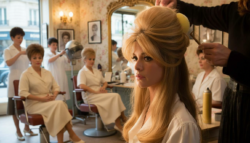
At 9:15 a.m., a woman in her early fifties sits down in a small salon off the main street. She feels both hopeful and scared, which is what a hair appointment always makes her feel. She sees the same thing in the mirror that she’s seen for months: long, tired hair that she keeps scraping into a bun, a fringe that never quite behaves, and a face that she suddenly finds herself looking at more closely than before. “I don’t want to look younger,” she says to the stylist. “I just don’t want to look tired.” The hairstylist grins, tilts her head, and says, almost as if she knows something: “Forget the shortcuts.” We’re going to make your face look better.
The cut that hairstylists swear by after 50 to make them look younger
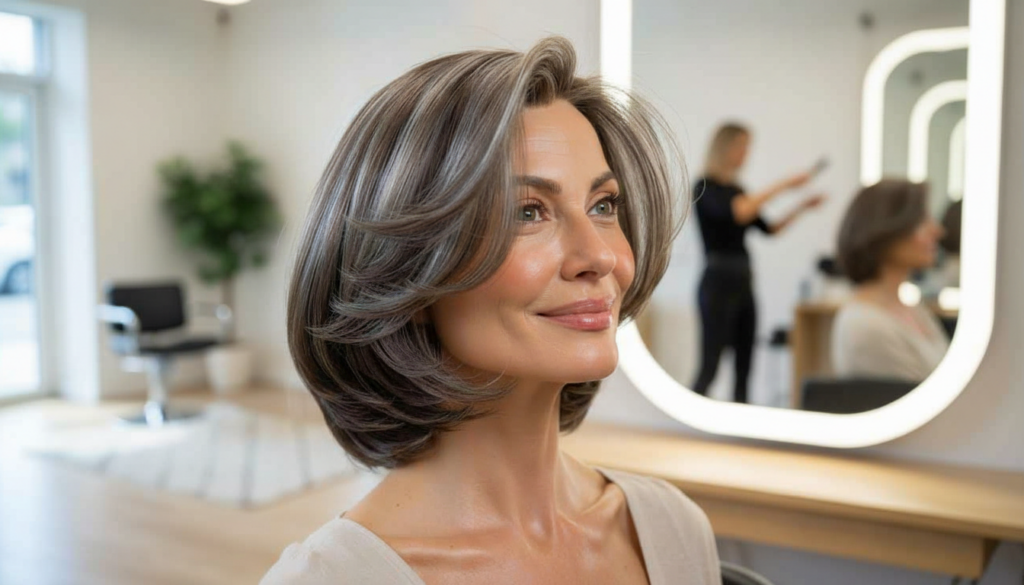
When I asked Paris-based pro Élodie Martin, the stylist I talked to, what cut she recommends most often after 50, she didn’t hesitate. She doesn’t even put down her scissors when she says, “A soft, layered long bob, just at or slightly below the collarbone.” Not a short pixie cut or a ponytail that says “I’ve given up,” but a structured shape that moves. She calls it her “instant lift” cut. The length isn’t the only thing that makes it magic. The way the layers are placed around the jawline and cheekbones makes all the difference, like someone had changed the lighting on your face.
Claire, who was 56 years old and one of her regular clients, had worn her hair halfway down her back for years. It was her safety net. But at some point, that curtain of hair started to pull her features down instead of making them look softer. She laughs and says, “I felt like my hair got there five minutes before I did.” Something strange happened when she finally agreed to the long bob. People didn’t say, “Your hair is shorter.” Instead, they said, “You look so fresh” or “Did you go on vacation?” The cut didn’t make her look younger. It made her energy show up again. That’s the quiet strength of a shape that really flatters.
This style is almost perfect for hair that changes with age from a technical point of view. A lot of women notice that their hair gets thinner after they turn 50, especially around the temples and crown. A heavy, one-length style tends to fall apart and show that loss of density. The long bob looks like it has body without being stiff because it has soft, invisible layers and a slightly fuller line at the bottom. The length around the collarbone adds enough weight to keep it classy. The pieces that frame the face can be moved around like a spotlight to draw attention to the eyes, smooth out nasolabial folds, or hide a slightly sagging jaw. It is architecture, but not harsh.
How to style this long bob so it really makes you look younger
The simple gesture that changes everything is to ask for layers that start around the cheekbone instead of the chin. When the front pieces are cut too low, they pull the eyes down. They draw attention to your eyes when they start higher. Élodie often draws an imaginary line from the outside of the client’s eyebrow to the corner of her mouth. She puts the softest part of the layer somewhere along that diagonal. That’s where the movement starts, like a soft comma that makes the whole thing lighter. The back stays a little longer, almost touching the tops of the shoulders, to keep the look clean instead of messy.
The day after going to the salon is when most people make the mistake. You wake up, brush your hair like you always do, and then flatten everything. Then you start to wonder where the magic went. This kind of bob is meant to have some texture in it. Not messy, just a little bit undone. Put some volumizing mousse on the roots, tilt your head forward, and blow-dry your hair quickly. Then, twist the brush a few times to flip the ends slightly outward or inward. That’s all. Let’s face it: no one really does a full round-brush blowout every day. The good news is that this cut doesn’t need it to work.
The emotional trap is to say, “I’m over 50, I should cut everything short, right?” Every week, Élodie fights against that idea.
She says, “Age doesn’t determine length.” The scissors follow your features, your neck, the way you dress, and your way of life. The only rule is that your hair shouldn’t cover your face or pull it down.
 “I’ll keep purchasing it into my 90s”: a skin specialist names her preferred supermarket cleanser
To help her clients picture this, she often writes down a few things to look for in the mirror:
- Does the length stop at the collarbone, not the middle of the back or the ear?
- Do the front layers start near the cheekbones to make the face look better?
- Is the nape a little lighter so that the hair doesn’t clump together?
- Does the parting happen naturally, or do you have to fight gravity to make it happen?
- Do you still look like yourself, but a little brighter and more “awake”?
*If she checks off two or three of those boxes, she knows she’s found the right balance between “done” and “casually chic.”
Beyond the cut: the quiet change this hairstyle can cause
Not only the before-and-after pictures are interesting to hairstylists about this long bob. It’s how women sit a little differently in the chair when the extra length is gone. There is a slight change in posture, a new way of tucking a strand behind the ear, and a quicker smile at their own reflection. We’ve all had that moment when a small change on the outside lets something inside you that you didn’t know was stuck. This kind of cut doesn’t scream “anti-aging.” It says softly, “Here I am, and I still want to play.”
The long bob after 50 also gives you more mental space in a very practical way. You won’t have to keep arguing about whether to grow it out or cut it off. You’re in that middle ground where it looks good with both a blazer and a sweatshirt. You can wear it in a low, loose ponytail to the gym, twist it into a half-updo for dinner, or let it air dry with some cream on your days off. You don’t have to worry about being stuck in “maintenance hell” that keeps you from going to the hairdresser for months. You just go back every eight to ten weeks to dust the ends and keep that flattering line, like you would with a favorite jacket.
That’s why a lot of stylists call it a “confidence cut” instead of just a hairstyle. It works with grey hair by adding a little shine spray, with colored hair by adding subtle highlights, and with natural texture, whether it’s wavy, straight, or lightly curly. It doesn’t make you play a part. You don’t have to “try to look 30,” “hide behind a curtain,” or “give up on practical but harshly short.” It sits in that rare middle ground where style and comfort really do get along. And that might be the most refreshing thing of all: instead of apologizing for your age, you should wear it with pride.
| Key point | Detail | Value for the reader |
|---|---|---|
| Face-framing layers | Start around the cheekbones, not the chin, to redirect attention to the eyes | Subtle “lifting” effect without invasive tricks |
| Collarbone length | Ends around or just below the collarbone for movement and elegance | Balances refining facial features while keeping styling options |
| Soft styling, low effort | Light texture, volume at roots, simple blow-dry or air-dry routine | Everyday look that feels polished yet realistic to maintain |
Questions and Answers:
Question 1: Is this long bob okay for my very fine hair?
Yes, as long as the layers are soft and not too choppy. Tell your stylist to keep the edges a little full and add some subtle layers inside to make the hair look fuller without making the ends look thin.
Question 2: Is it okay to wear this cut with my natural gray hair?
Answer 2: Yes, for sure. The way the bob is cut makes grey hair shine. A gloss treatment or hydrating mask can keep your hair from looking dull and make it look more modern than “granny chic.”
Question 3How often should I cut my hair like this?
Most people can get by with 3 every 8 to 10 weeks. That rhythm keeps the line around the collarbone clean and lets the layers grow in softly without changing shape.
Question 4: Do I need to blow-dry my hair for it to look good?
Answer 4: No. You can let it air-dry with a light cream or foam. Then, for a few minutes, use a brush or flat iron to refresh the front sections and make the face-framing pieces look better.
Question 5: What should I say to my stylist to make sure we’re on the same page?
Answer 5: Ask for a bob that goes to your collarbone and has soft, face-framing layers that start near your cheekbones and move gently. Don’t ask for a blunt cut. Show them one or two pictures and tell them you want a new look that “lifts” your hair, not a big cut.