Every year, the first cold snap reveals the same small war at home. One person quietly raises the thermostat “just a notch,” and the other sneaks by and pushes it down again, grumbling about the energy bill. “Set it to 19 °C, that’s the norm” is a saying that still goes around in many homes like a family rule. No one knows where it came from, but it’s like a spell that says 19 °C over and over again, like it’s written on our birth certificates.
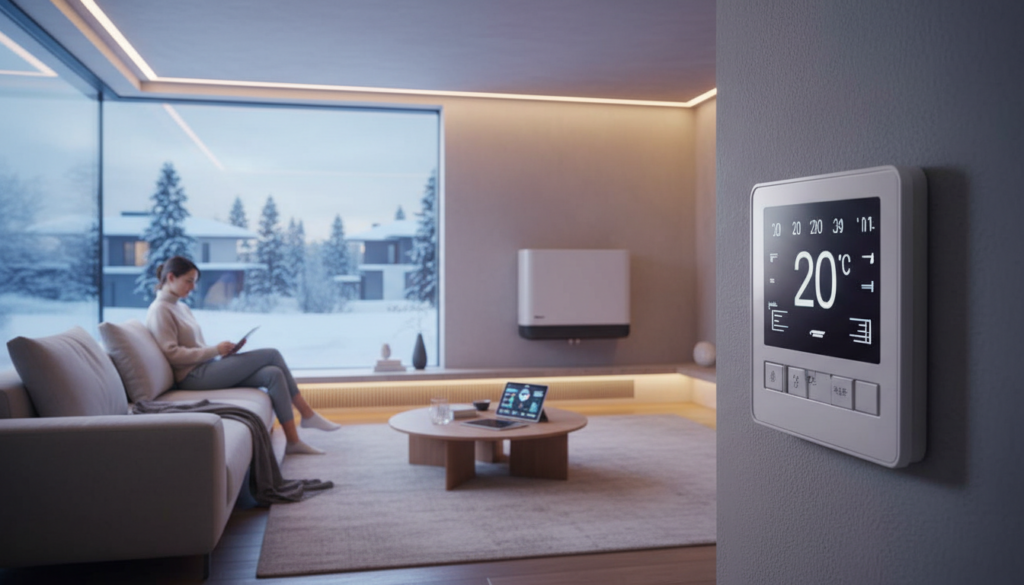
But when you talk to people, very few of them are actually comfortable at that temperature. They put on a second jumper, boil another kettle or sit in front of a small fan heater all night. Something isn’t right.
Why the 19 °C rule doesn’t work in real life anymore
For a long time, people thought it was their duty to follow the famous 19 °C advice. Public campaigns pushed it on TV, in offices, and even in schools. Set the dial to 19, be a good citizen, and save the planet and your money. But if you go into a real home in the middle of winter, you’ll often find the thermostat quietly set to 20, 21, or even 22 °C.

The difference between the rule and what really happens is too big to ignore. People are colder, homes are different, and our days don’t look like they did in the 1980s.
For example, Laura and Marc live in a new flat with big bay windows. Last winter, they tried to “follow the rule.” Set the thermostat to 19 °C, put on an extra jumper and wear thick socks. They quit after two weeks. Their toddler’s hands were always cold, the windows let in a thin line of cold air, and evenings on the couch felt more like camping than relaxing at home.
So they slowly raised the temperature. First it was 19.5 °C, then 20 °C, and finally it stayed at 20.5 °C in the living room and 18.5 °C in the bedrooms. Their heating bill didn’t go through the roof, and all of a sudden the mood at home changed. They weren’t heroes of energy sobriety, but they weren’t shaking anymore either.
Building physics experts say out loud what many people already know: 19 °C was not a universal truth, but a symbolic number. It came from research done on fairly normal, well-insulated areas and adults who were fairly active. Today, homes can be anything from old stone farmhouses to lofts with lots of glass. People also move around less. We sit in front of screens for hours without moving much.
It doesn’t make sense to blindly follow a rule about a certain temperature. The real comfort level comes from a combination of the air temperature, humidity, insulation, and how we actually live in the space. Finally, the talk is changing.
The experts in the new comfort range really do recommend
Many energy and health experts in Europe now agree on a more detailed recommendation. They don’t talk about a single sacred number; instead, they talk about a “comfort bracket.” They suggest a range of 19.5 °C to 21 °C for living areas where we sit, talk, watch TV, or work from home, with 20 °C being the best temperature for most people.
For bedrooms, they are more comfortable at 17 °C to 19 °C, depending on age, bedding, and how you feel. The main change is that the goal is no longer to “hit 19” at all costs. Instead, it’s to find the lowest temperature where you really feel good, not like a hero.
Think of a simple test that lasts for a week. You set the living room to 19.5 °C on days 1 and 2, 20 °C on days 3 and 4, and 20.5 °C on days 5 and 6. You pay attention to how you feel: do you keep your coat on, get a headache, fall asleep on the couch or rush to the kettle every hour?
Most families who try this find that their “real” comfort point is just above or below the mythical 19 °C, sometimes by as little as 0.5 °C. That small change can make the whole night different. Instead of pacing around looking for warmth, you’re more likely to read, talk, or play with the kids. It’s not a luxury. It’s comfortable to use.
Energy experts say that every degree you raise costs money, but every degree you lower when you’re already uncomfortable also costs money. You don’t move as much, you get tense, and you get sick more easily. You can’t see that bill on your gas statement, but it’s there.
This is where the “outdated” part of the 19 °C rule becomes clear. People thought of it as a moral gauge. If it was too warm, you were careless. If it was too cold, you were good. The new rule is more practical: keep living spaces at about 20 °C, make small changes by room, and focus on insulation, drafts, and smart use instead of feeling guilty. Let’s be honest: no one really checks the temperature in every room every day.
How to heat your home better without getting cold or going broke
The new expert talk is more about habits than numbers. One of the best things you can do is to keep the temperatures in the day and night separate. During the day, keep the temperature in your living spaces close to 20 °C, which is usually comfortable. When you’re not home or at night, turn it down by 2 to 3 degrees, especially in rooms you don’t use.
Programmable thermostats and valves that are connected help do this on their own. You set the times, and the system slowly warms up before you wake up or get home. The goal isn’t to turn the dial back and forth every hour; it’s to give your heating a steady rhythm that matches your life.

We make a lot of mistakes that we don’t even notice, and they drive us crazy. Curtains over radiators, furniture blocking airflow, windows left open for half the day to “air out,” or the classic fan heater that runs all night in one room while the central heating stays too low.
A lot of people also feel bad if they don’t keep it at 19 °C, so they take hot showers, use electric blankets, and drink a lot of tea to make up for it. The body never really settles down. Instead of judging yourself based on an old rule, it’s better to ask, “Can I sit for two hours at this temperature, dressed normally, without getting cold or sleepy?” You can change if the answer is no. Being comfortable is not a moral failure.
Experts say that there should be a simple, step-by-step path, not a revolution that happens overnight.
An energy consultant who checks homes all winter says, “Forget the magic number.” “Find the range where your family really lives, and then work down slowly over time by making your home better, not by hurting your body.”
Set the temperature in your main living areas to about 20 °C and in your bedrooms to 17–19 °C.
Lower it by 2–3 °C at night or when you’re not home, not all day.
Make sure all the radiators are free by moving furniture out of the way and taking down long curtains.
Instead of leaving the windows open, let the air out completely for 5 to 10 minutes with the windows wide open.
Before you buy new heating systems, make sure you seal up drafts and add basic insulation.
A new way to think about how to stay warm at home
The question changes once you stop following the strict 19 °C rule. “Am I at the official number?” is no longer the question. but “Does my home really help my body feel better with less energy?” That’s a more personal, softer, and almost intimate question.
At 19.5 °C, some people will be comfortable in a warm jumper and thick socks. Some people will need 20.5 °C because they sit all day next to a window that isn’t well insulated or because they have problems with their circulation. There isn’t just one right answer. The most important thing is to stay in a comfortable place. Then, little by little, work on the outside of the house, the small habits, and the air leaks that you cover with a strip of foam or a heavier curtain.
There is more going on behind the thermostat wars than meets the eye: our relationship with comfort, effort, and guilt. It was easy to follow the old rule. But it made people either cheat or stay quiet about their problems. Today’s expert speech is a little messier, more complicated, and more like real life. It tells us to talk to each other at home: “What temperature do you really like?” Where do you feel the cold drafts? Which room feels wet?
That kind of talk doesn’t belong in a government slogan. It fits around a table at night, when someone finally has the guts to say, “You know what, I’m actually cold at 19.” Things can move from there. You might try 20 °C for a week, get a small thermometer, or talk to friends about what works for them. You might even find that comfort and saving energy can go hand in hand once you stop feeling guilty.
| Important Point | Detail: What the Reader Gets Out of It |
|---|---|
| A new range of comfort | Living rooms: 19.5–21°C, Bedrooms: 17–19°C—helps set realistic goals instead of strict rules |
| Better use | Turn down heat by 2–3°C at night or when not home—lowers bills without sacrificing comfort |
| First, make improvements to your home | Seal drafts, free up radiators, take care of curtains, and air out rooms—stops wasting energy before investing in new systems |
Questions and Answers:
Question 1: Is it completely wrong now that it’s 19 °C?
Answer 1: No, 19 °C is not “wrong”; it’s just not the same for everyone. Some active adults in well-insulated homes may find it comfortable, but most people prefer it to be a little warmer, around 19.5–20 °C.
Question 2What is the best temperature for the inside of a house these days?
Most experts say that living rooms and workspaces should be between 19.5 and 21 °C, and bedrooms should be between 17 and 19 °C. These numbers should always be changed based on age, health, and insulation quality.
Question 3: Does it really cost a lot more to raise the temperature by 1 °C?
Answer 3: Depending on the house, turning the thermostat up by 1 °C can make heating use go up by 7% to 10%. That’s why it’s important to find the lowest temperature at which you still feel good.
Question 4: Should I make all the rooms the same temperature?
Answer 4: No, you can choose what to do first. As long as there is no risk of damp or frozen pipes, keep living areas warmer, bedrooms and hallways cooler and storage rooms that are almost never heated.
Question 5: Is it better to turn off the heat completely when I leave?
Answer 5A drop of 2–3 °C is usually enough for a short time away. You can lower the temperature more for longer trips, but you should avoid a full freeze so that the building doesn’t cool down too much, which would take more energy to heat back up.