The floor feels cool against your forearms. Your toes hold onto the mat, your legs are working, and your breathing settles into a steady rhythm. With your core tense and your mind focused, you start to wonder, “How long should I hold this plank?” Ten seconds? 30? Two minutes that seem like they will never end? Planks don’t fit everyone. As you get older, they change as your body and gravity interact with each other. What feels strong at 18 can be hard at 48 or need more care at 68. Your core is the foundation of your body at all ages. It supports your spine, protects your back, and lets you move freely. To figure out the best length of time for a plank, you need to know how your body is right now.
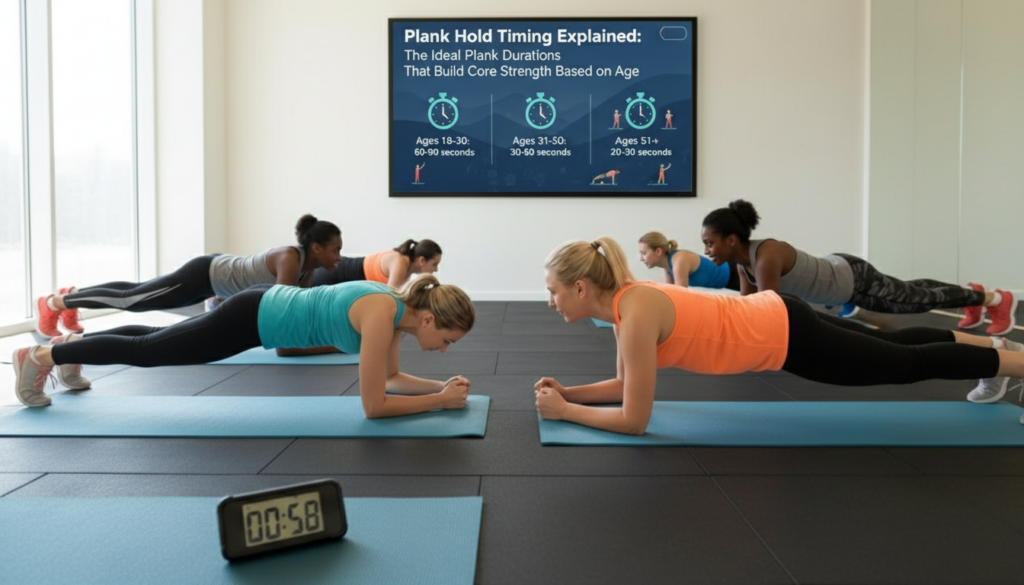
How Plank Hold Timing Works: The Silent Strength Within
Planks come in quietly, unlike workouts with loud feet or weights that clash. Your body makes a long line, with your shoulders stacked on top of your elbows or wrists, your heels reaching back, and your head floating naturally. It looks easy from the outside. But a quiet storm starts up inside. The transverse abdominis tightens like a supportive belt, the multifidus protects the spine, the diaphragm connects breathing to effort, and the pelvic floor gives steady support from below. These muscles do best with calm, exact work that is done over and over again.
Because of this, quality is more important than length. A tense, collapsing one-minute plank is less helpful and more dangerous than a clean twenty-second hold done with good alignment and control. Time is important, but it should end when your form starts to slip, not when you push through pain.
Also, check out this great 35-minute lower-body and core strength workout that will help you change your body composition.
The Real Story About Long Planks
Fitness culture often glorifies extremes, like two-minute holds, five-minute challenges, and viral videos of people shaking and holding on with willpower. In real life, it’s quieter: after a certain point, holding a plank for longer makes you more tolerant of pain than it makes you stronger. Both research and expert coaching agree that doing short, precise holds on a regular basis is better for your core strength and spinal health than doing long marathons every once in a while.
Also check out An Expert Helped Fix My Thinning Hair: Here’s What Worked and the 13 Best Products for 2026.
This doesn’t mean that long planks are bad for you; it just means that the benefits go down and the risk of misalignment from fatigue goes up. The question changes from “How long can I last?” to “How well can I help my body right now?” as time goes on.
The Plank Equation, Age, and Gravity
The body’s response changes as we get older. It takes longer to recover, tissues get stiffer, and you need to pay more attention to your balance. A plank that used to be easy may now take effort, and that’s because of biology, not weakness. Instead of a single rule, it’s better to follow flexible ranges that depend on your form and ability.
Plank Hold Times by Age: Teens (13–19): 20–40 seconds, 2–4 sets, 2–4 days a week
20s to 30s: 30 to 60 seconds, 2 to 4 sets, 3 to 5 days a week; 40s: 20 to 45 seconds, 2 to 4 sets, 3 to 4 days a week; 50s: 15 to 40 seconds, 2 to 3 sets, 2 to 4 days a week; 60s to 70s+: 10 to 30 seconds, 2 to 3 sets, 2 to 4 days a week;
These ranges are just suggestions, not rules. The most important thing is how good each second you hold is.
Also, check out Full Body Dumbbell Workout for Women Over 40 Who Want to Get Stronger.
In your 20s and 30s, you have unlimited strength.
People in this age group heal quickly, their tissues are strong, and they get stronger naturally. Thirty to sixty seconds is usually the best amount of time. The biggest risk is small problems, like hips dropping, shoulders creeping, or lower back pain. It’s better to break up your work into several shorter, controlled holds than to try to do it all at once.
Your 40s: Strong but Aware
Your body talks to you more clearly by the time you’re 40. Old injuries, stiffness, and tightness show up faster. Most productive holds now last between 20 and 45 seconds and are done a few times. Some days it’s better to stop sooner, while other days it’s okay to hold longer. The focus changes over time to sustainability and supporting posture.
Your 50s, 60s, and beyond: Strong, not foolish
We need to rethink strength in the years to come. Planks are still useful, even if your muscle mass goes down, your balance changes, and it takes longer to recover. Short holds of 10 to 30 seconds with good alignment can be very helpful. Knee or incline planks are smart changes to the original. Each well-supported second keeps your posture, balance, and confidence in movement.
Knowing when to stop
When a plank becomes dangerous, your body will tell you by making your lower back sag, your shoulders tense, your breath hold, or your face strain. It’s not quitting to stop at the first sign of form loss; it’s smart training. This method helps your nervous system work better and stops it from breaking down over time.
Also check out the Best Shampoos for Fine Hair in 2026 that add volume without weighing down strands.
Making Planks a Part of Your Daily Life
Planks don’t have to be over the top. You can sprinkle them throughout the day: one before coffee, one after work, and one before bed. These small, consistent efforts add up over time to make you stronger. The goal isn’t to break a record; it’s to stand taller, move with confidence, and support your body every day. Hold as long as the form feels right. Take a break. Do it again. That’s where the core strength that lasts lives.