The sound is the first thing you notice. Not the roar of takeoff, but a low, constant murmur that sounds like thunder that won’t stop. On a hazy afternoon at a big air base, rows of fighters sit nose-to-nose with huge transports and refueling giants. The sun has already set behind the hangars, and the canopies of the fighters reflect the light. Young pilots walk with a mix of confidence and routine, while ground crews move tool carts between steel giants. On a control-room screen, all of this is just dots and numbers. We see headlines about “air superiority” on our phones, but for the people who live under these wings, it’s a loud, smelly, and exhausting reality every day. Counting planes suddenly seems less like a number and more like a person.
And the numbers behind those wings tell a very different story than the slogans do.
Why counting planes is still a good way to measure air power
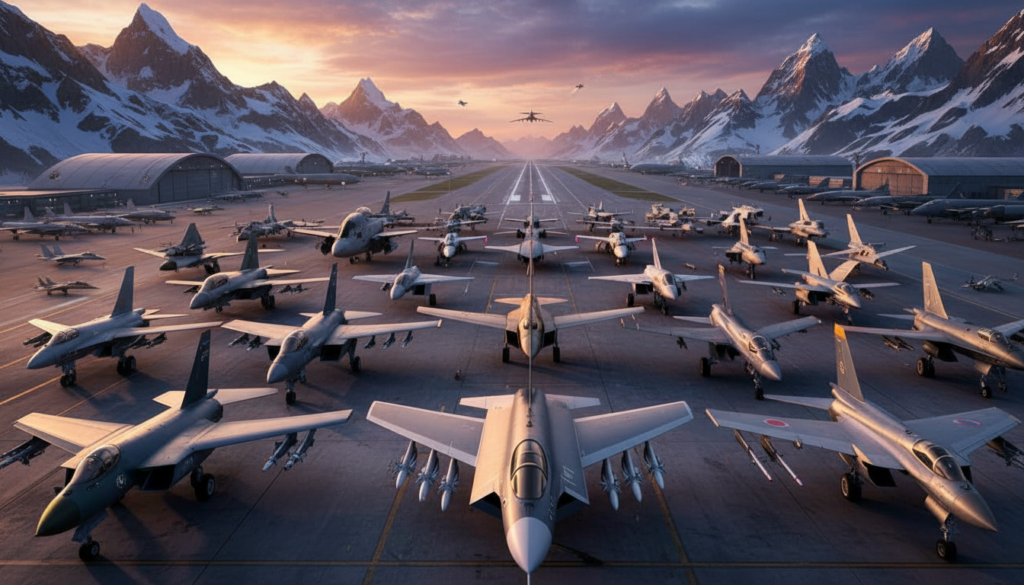
You can feel the weight of quantity as soon as you step onto almost any big air base, even before anyone shows you a spreadsheet. Parking aprons are like parking lots the size of small towns, with fighters lined up wingtip to wingtip and gray transport planes that look like flying warehouses on either side.

That physical mass is important. Every new jet means one more patrol in the sky, one more crew on call, and one more bargaining chip in a tense phone call between capitals. Raw numbers don’t tell you everything about an air force, but they do affect almost every decision that is made about it.
The United States still has a huge lead in this picture. When you count fighters, bombers, tankers, transports, trainers, helicopters, drones, and special-mission birds, the U.S. has about 13,000 to 14,000 military aircraft. Russia and China have fleets in the low to mid-thousands, which is less than the US.
Think of it this way: the U.S. doesn’t just have more planes; it has whole types of specialized planes that most countries can only dream of. That’s why American airfields in other countries can look like smaller versions of home: in terms of numbers, they are.
A fleet of 4,000 jets with bad maintenance and poorly trained crews won’t last long against 1,200 modern planes that are well-supported and always flying. At this point, the top ten air forces begin to diverge. When you look at the total number of planes in a country, the U.S., China, Russia, India, and the U.K. may seem close. But when you take out old trainers, grounded relics, and barely flyable museum pieces, the real gap opens up. *The harsh truth is that some air forces look bigger on paper than they do in the air.
The top 10 air forces right now, based on the number of planes they have
To get a better idea of global air power, start by making a list of the countries that have the most planes that are ready or almost ready to fly. After that, you can ask about age, training, and technology. Based on recent defense reports and open-source databases, the rough top 10 by total military aircraft looks like this:
1. United States
2. Russia
3. China
4. India
5. South Korea
6. Japan
7. Pakistan
8. Egypt
9. Turkey
10. France
Each of these countries has a story to tell in metal and jet fuel. For example, India. The air force is at the crossroads of old and new. French Rafales and Russian Su-30MKIs fly alongside MiG-21s from the Cold War that still rumble off the runway even though they are old. Crews often work near hot borders with Pakistan and China, so those plane counts aren’t just numbers on paper.
People are also surprised by Egypt’s ranking. There are a lot of American F-16s, French Rafales, and Mirage jets in the sky, as well as a large fleet of helicopters. Egypt looks like a bridge between Africa and the Middle East on a map. It feels like the center of every arms deal that has happened in the last 40 years from the cockpit.
Why do some countries with a lot of people end up with such big fleets? The count is based on geography, how people see threats, and politics. North Korean missiles and a growing Chinese navy threaten South Korea and Japan, so they have a lot of planes for their size. Pakistan has fewer resources than its huge neighbor India, but it still spends a lot of money to stay ahead in the sky.
There is a simple truth that defense analysts don’t often say out loud: **Many of these planes are there because countries don’t trust each other to stay friendly forever.** People buy numbers as a kind of insurance policy, with limited funds and long arguments, and then park them in huge shelters along the runway.
How to really “read” those numbers on planes
One way to make sense of any air force ranking is to divide the big number into smaller, clearer groups. Instead of looking at “1,500 aircraft,” ask, “How many are frontline fighters?” How many of them are trainers? How many of them are helicopters, transports, or drones? This mental sorting makes a fuzzy number into a fleet that you can see in your head.

Next time you see a defense infographic, try to picture peeling off the fighters first, then the heavy transports, and finally everything with rotor blades.
Another mental trick that works is to always keep “in inventory” and “actually flying often” separate. We’ve all been there: the car that “works” but hasn’t started in six months. Planes are worse. Some air forces have dozens of jets that are technically still in service but don’t fly very often because they don’t have the right parts, fuel, or trained crews.
Don’t let those ghost planes fool you. If you read that a country has 400 fighters, keep in mind that some of them might be used for parts or be in long-term maintenance.
Analysts sometimes forget that there is also a more human way to look at the numbers. There is a job, a culture, and a way of life behind each type of airplane:
A retired European fighter pilot once told me, “You can count the planes, but you can’t count the nights you spend waiting by the phone.” “The real size of an air force is how often people are ready to go.”
- If you see a mix of fighters, transports, and helicopters, you can tell if a country is ready for war, peacekeeping, or disaster relief.
- Look at the age: fleets with a lot of ships from the 1960s or 1970s show that there is a difference between reputation and real ability.
- Pay attention to the upgrades: keeping things up to date is often more important than getting new jets every ten years.
What these rankings say about the world we’re going to
It’s hard to forget what you saw once you know how the skies are organized. The US still has more people than any other country, but China is quietly adding new planes every year. Russia still has a big fleet, but it’s getting old. Turkey, Egypt, and Pakistan are examples of countries that are economically stronger than they should be. They fill their ramps with hardware they hope they never fully use.
And below these top ten, dozens of smaller countries depend on a few squadrons of old fighters or a few transports to show that they are in the sky.
The twist is that drones and long-range missiles are changing what “largest air force” means. A country with fewer manned jets but a lot of armed drones and smart weapons might be able to hit a lot harder than its aircraft count suggests. But no one is throwing away their fighters just yet.
For now, the rankings still seem familiar: big states, big fleets; tense neighborhoods, and crowded skies.
Maybe the real point of looking at these numbers isn’t to cheer for the side that’s “winning” the arms race. It’s to see how much fear, anxiety, and history are packed into the phrase “total military aircraft.” When you read a headline that says one country is “modernizing its air force,” you should know that behind that neat line are fights over contracts, tight budgets, overworked crews, and hangars that have been fixed up and are still echoing with the sound of engines on test.
You might also wonder which of those thousands of planes will ever fire a shot and which will spend their whole lives just flying around, as very expensive reminders of what could have been.
| Key point | Detail | Value for the reader |
|---|---|---|
| Top 10 air forces | Largest fleets belong to the U.S., Russia, China, India, South Korea, Japan, Pakistan, Egypt, Turkey, France | Gives a quick global picture of who dominates the skies |
| Numbers vs. capability | Raw aircraft totals hide gaps in maintenance, training, age, and upgrades | Helps you read past surface-level stats and headlines |
| How to “read” a fleet | Break down by mission type, age, and real flying hours, not just total counts | Makes any future air power story or ranking easier to understand |
Questions and Answers:
Question 1Which country has the most planes in its air force right now?With about 13,000 to 14,000 military planes in all branches and roles, the United States is by far the largest.
Question 2: Are all of the planes on these lists actually in use? No. Many rankings include planes that are in storage, in long-term maintenance, or only barely flyable, so the real strength on a day-to-day basis is lower.
Question 3: Do drones and UAVs count as part of the air force?Some databases have them, while others keep them separate. Drones are becoming more common, and people are starting to see them as an important part of air power.
Question 4: Why do some smaller countries have such big air forces?They often sit in tense areas or on important chokepoints, so they spend a lot of money on air power to keep people from attacking them and as a bargaining chip.
Question 5: Is technology more important than how many planes there are?Both are important, but a smaller, more modern, well-maintained fleet with skilled crews can do better in real combat than a much bigger, older fleet.