The sea looks calm enough to be bored on a grey morning off the coast. A few fishing boats move slowly across the horizon, and gulls circle and complain. Nothing suggests that survey ships are tracing the start of a project that sounds like science fiction just a few dozen meters below. Engineers read sonar lines like doctors read heartbeats while leaning over screens in small cabins. A metal probe goes into the water with a loud splash, as if someone had just dropped a key into the door of another continent.
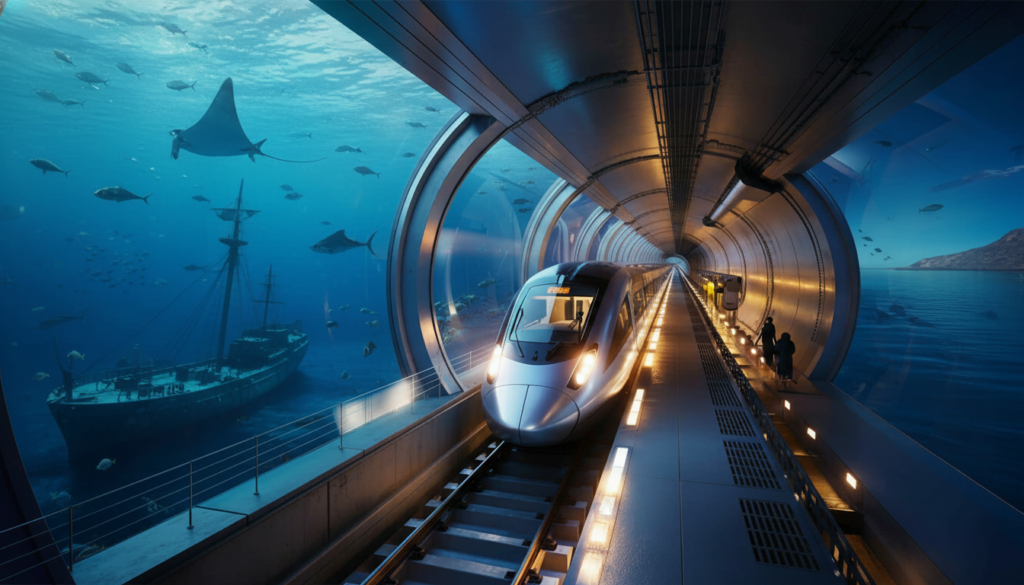
There is a plan forming under this calm surface that could change the way people travel.
A train that goes under the sea at the same speed as an aeroplane.

The bold idea: crossing continents without getting off the ground
Imagine this. You finish your coffee in one country, walk down to a sleek underground station, and less than two hours later you step out into the sun on a different continent. No lines at the airport, no bumpy rides, and no slow shuffling through security. The only sound is the soft hum of a high-speed train moving through a tunnel under the sea.
This is the promise of what is being called the world’s longest underwater high-speed rail project. It is now going from a dream to a detailed design. The size is almost ridiculous, but the mood in engineering offices and transport ministries is strangely calm. People talk about it like they would about building a new ring road. But this ring road goes over an ocean.
On paper, the idea is simple: a high-speed rail line that connects two continents through a submarine tunnel that is hundreds of kilometres long, combining deep-sea engineering with bullet-train speeds. In reality, it’s a long race of soil samples, political deals, and budgets with numbers that are too big to say out loud.
Early test campaigns have started. Survey ships are going back and forth along the proposed route, drilling into the seabed to find out what the tunnel will be anchored to. One project manager said it was like “trying to build a basement before you’ve finished drawing the house.” The public only sees a headline about a tunnel that broke records. Teams are measuring every grain of sand behind it.
Why push so hard and so deep? Partly because airlines are the main way to travel long distances between continents, and governments are under pressure to lower emissions and offer more choices. A high-speed link under the sea could cut down on regional flights, speed up freight and connect labour markets that now seem as far apart as planets.
There is also a raw geopolitical side to it. The continent that builds and controls such a link doesn’t just own a piece of infrastructure. It has a story of connection, strength, and freedom from weak air corridors and busy ports. An underwater rail line is less of a tunnel and more of a quiet, concrete message: we can still talk to each other even when the skies are closed.
How do you really make a tunnel for a bullet train under the sea?
It looks almost too simple on a whiteboard in a project office: draw two coasts, connect them with a line and add some loops and emergency exits. In the real world, every kilometre needs a different trick. Engineers are now considering two main options: boring deep into stable rock or putting together huge prefabricated tubes and sinking them into a trench on the seabed.
When there are earthquakes or storms, deep-bored tunnels feel safer. It’s easier to check and expand immersed tubes later. Both need ventilation, pressure control, waterproofing, and escape shafts that passengers never see. The real project is a series of small, boring choices about drainage pumps, fire doors, and cable routing that take place between the seafloor and the tech brochures. *That’s the point at which the fantasy slowly becomes real.
We’ve all been there: the train ride is going smoothly when it suddenly stops in a dark tunnel and everyone looks up, waiting for the announcement. Now, think about how far that worry will go under the sea, maybe 100, 200, or even 300 kilometres. Designers are trying to get rid of that feeling before anyone gets on board.
To avoid popping ears and panic, they’re running evacuation drills in fake tunnels, simulating fires in supercomputers, and testing how pressure changes. One interesting thing is that emergency exits might not go “up” to the surface at all. Instead, they might go sideways into safety tubes that run the length of the queue. You can think of it as a secret tunnel next to the main one that you only use on the worst day. To be honest, no one really reads the safety card before takeoff, so these systems need to work even for people who don’t pay attention to any of the announcements.
The plain numbers already sound like a type of science fiction poetry. Trains going more than 250 km/h under thousands of tonnes of water. Walls that can handle pressure and are thick enough to keep a shipwreck from happening. Ventilation systems that move air quickly enough to keep passengers comfortable but not so quickly that smoke spreads if something goes wrong.

One senior engineer said it best on a call that kept dropping out as he went from meeting to meeting:
He said, “We’re not just digging a hole.” “We’re making a city that moves and lives underwater.”
Around him, teams break the monster down into smaller parts that are easier to handle:
Choosing a route means staying away from unstable seabed areas and fragile ecosystems.
Choosing materials: concrete mixes and steel alloys that can handle decades of salt and pressure
Passenger experience: lighting, windows (real or virtual), and soundproofing to keep the ride calm
Operations: how often trains can run, where they can pass each other, and how delays affect trains on other continents
Every bullet point looks dull. Together, they make the difference between a great press release and a queue that people really trust enough to ride.
What this underwater link could mean for people in their daily lives
This project is really about time and habit, if you take away all the hype. A trip from one coast to the other that used to take half a day could now fit in between breakfast and a late lunch. That kind of compression changes choices in a quiet way. If the times are the same but the stress is lower, a business traveller who flies today might switch to rail. Families who save up for one trip abroad every five years could make it a more regular trip without getting tired at the airport.
There is also a story about goods. Faster, more reliable cargo rail under the sea can move trucks off of highways, clear up ports, and speed up delivery times for everything from fresh food to important medical supplies. The tunnel becomes an artery, moving people and goods in both directions, even when storms are raging above and planes are grounded.
| Key point | Detail | Value for the reader |
|---|---|---|
| Record‑breaking underwater length | Planned to be the longest submarine high‑speed rail tunnel ever built, stretching hundreds of kilometers | Signals a leap in what’s technically and politically doable, not just a marginal upgrade |
| High‑speed, low‑carbon travel | Designed for airplane‑like journey times with far lower emissions per passenger | Opens a future where intercontinental trips feel cleaner, calmer, and less airport‑dependent |
| Resilient link between continents | Protected from storms, airspace closures, and overloaded ports | Offers more reliable mobility for work, tourism, and supply chains in an unstable world |
FAQ:
Question 1How fast will the trains in this underwater high‑speed tunnel actually go?
Question 2When could passengers realistically start using a line like this?
Question 3Is traveling under the sea at high speed really safe?
Question 4Will tickets be more expensive than flying between the same two regions?
Question 5What kind of environmental impact will building such a long submarine tunnel have?