It was raining in that fine, sideways drizzle that soaks you without you knowing it. I was standing under the market awning, looking at a huge pile of vegetables. There were tight white cauliflowers, dark green broccoli, and shiny cannonball cabbages stacked like helmets. A kid pulled on his mother’s sleeve and asked, “Why do they all look like cousins?” The seller laughed and said, “Cousins?” They’re more like two people. The mother smiled politely, clearly thinking he was just being nice to get another head of broccoli.
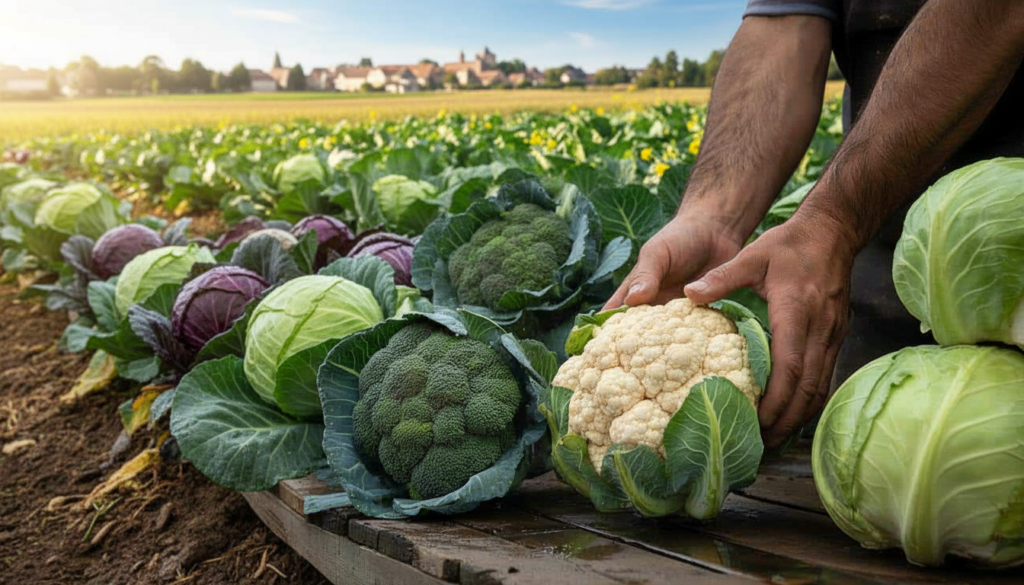
He wasn’t kidding.
After a few stalls, I couldn’t stop thinking about that idea. What else on this table isn’t what we think it is?

One plant, three “different” kinds of vegetables
Most of the time, we just walk by the brassica aisle without thinking. You can roast cauliflower, eat broccoli on “healthy days,” or make coleslaw or that soup you promise to make one day. They are in different boxes, have different recipes, and even seem to live in different parts of our brains.
But botanists will tell you something that sounds like a magic trick: Brassica oleracea is the same species as cauliflower, broccoli, and cabbage. Three different people, but the same plant and DNA. It’s like meeting three identical triplets who have all chosen different paths in life.
If that sounds too vague, think of this. A tough, wild cabbage plant fights the salt and the cold on a windy cliff along the Atlantic. People started to grow it again and again, saving seeds from the plants that had the traits they liked best. One village liked plants with big leaves. Another person chose the ones with tight heads. Someone else fell in love with flower stalks that were thick and crunchy.
A few thousand years later, that one wild ancestor has turned into the patchwork we know today: round cabbages, branching broccoli, and brainy-looking cauliflowers. Same place of origin. Just generations of people making quiet, patient choices.
The species didn’t change; only the parts we chose to focus on did. Broccoli is the flower buds of the plant that grow on the tops of long stems. Cauliflower is also a bunch of flower buds that are frozen in time, small, and pale. Cabbage is when the leaves curl up into a tight, dense ball.
Selective breeding took each trait to its limit. Farmers saved seeds from plants that had a little more leaves, a little more “florety,” and a little more density. If you do that over and over, you’ll get “different vegetables,” which are really just different parts of the same organism that have been pushed into the spotlight. *After you see that, you’ll never look at your plate the same way again.
How this secret family can change your kitchen
Knowing that these three are siblings gives you a quiet superpower when you cook. You stop thinking about strict recipes and start thinking about structures. Cabbage leaves that are tight? When cut thin and flash-fried, they act a lot like firm broccoli stems. Florets of cauliflower? You can use them in place of big pieces of broccoli in almost any dish.
One easy way to do this is to cook them all together as if they were one big vegetable with different textures. Put some rough pieces of cabbage, cauliflower florets, and broccoli tops on a tray and roast them with oil and salt. The edges of the cabbage get charred, the cauliflower gets caramelized, and the broccoli gets crunchy. Three textures, one pan, same plant.
This is a short scene from a Tuesday that went on too long. You come home tired and the fridge is almost empty. There is a sad half of a cabbage, a small head of broccoli, and a piece of cauliflower left over from Sunday. You had three different recipes in mind, but you didn’t make any of them. We’ve all been there, when dinner feels like a puzzle that makes us feel bad.
You cut everything up into small pieces and put them in a frying pan with garlic, leftover rice, and soy sauce. It smells like the kind of food you wish takeout always sent you ten minutes later. That is Brassica oleracea saving your weeknight without any drama.
This is where science and everyday life come together. Since they are the same species, they also have a lot of nutrients in common, such as fiber, vitamin C, and plant compounds that protect them and taste a little bitter. The differences you taste have more to do with how thick or thin they are than with whether they are “good” or “bad” vegetables.

If we’re being honest, no one really weighs out their broccoli and cauliflower every day to get the perfect balance. You really just cook what’s there. When you think of them as cousins who can be switched out, you waste less, try new things, and stop worrying about whether tonight should be a “cabbage night” or a “broccoli night.” Three different ways to tell the same story.
Shopping and cooking like someone who knows Brassica
Do a little experiment the next time you go to the market or grocery store. Instead of just grabbing “a head of broccoli,” stop and think about which part of this plant you want to focus on tonight. Leaves, buds, or a thick heart? That one simple question changes how you move your hand at the shelf.
Cabbage is a good choice if you want something crunchy in your salad. Choose broccoli if you want florets that are soft and bouncy and can hold sauce. Cauliflower is a good choice if you want something meaty and roastable. **Instead of buying three random vegetables, you’re choosing the mood of one very adaptable plant.**
One thing that happens a lot is that we hold on to food biases we learned as kids. Someone says, “I hate cabbage,” and their face twists as they remember how bad boiled school dinners were. Or “broccoli is boring” because they only know how to cook it to death. The same species is underneath those labels, waiting for a second chance.
You don’t feel bad about that. Stories, not just buds and leaves, give things their flavor. The easy thing to do is to change just one thing: roast instead of boil, stir-fry instead of microwave, or shred raw instead of cooking at all. A few small changes can make the same plant taste completely different on your plate.
One farmer I met in Normandy, whose arms were green from picking, said it this way:
He laughed and said, “People think we grow a lot of vegetables, but half of this field is the same plant in different jackets.”
When you cook, his words stay with you.
Here’s a quick pocket guide that you can save as a screenshot or in your mind:
Best uses for cabbage: slaws, long braises, stuffed leaves, and crunchy stir-fries.
Broccoli is best for quick stir-fries, pasta, creamy gratins, and grilling until charred.
Best uses for cauliflower: roasting steaks, turning them into “rice,” and making smooth soups.
A mix of all three is best for sheet-pan dinners, curries, casseroles, and cleaning out the fridge.
If a recipe calls for one, you can usually use another and just change the cooking time a little.
A new way to think about what’s on your plate
The vegetable aisle looks less like a catalog and more like a family photo once you realize that cauliflower, broccoli, and cabbage are all different kinds of the same plant. You begin to see the similarities, like how the veins in the leaves are the same and how the stems branch out in the same way. That little bit of information stays in the back of your mind and changes how you shop, cook, and even how you think about trash.
You might want to try more things, like mixing different kinds of vegetables in one dish or giving a “hated” vegetable another chance with a new way of cooking it. Or maybe you’ll just enjoy the strange pleasure of knowing something that someone else doesn’t, like when they complain about being tired of broccoli while happily eating roasted cauliflower. You don’t need to know a lot for it to be useful. Sometimes it just pushes you to be a little less stressed in the kitchen, a little more curious, and to appreciate the quiet genius of a tough coastal plant that let us change its body into three everyday classics.
Important pointDetailValue for the reader
Same kindBrassica oleracea is the plant that gives us cauliflower, broccoli, and cabbage.Takes away the myths about “totally different” vegetables and makes choices easier.
Can be used in the kitchen in place of one anotherWith a few changes to the cooking time, they can often take each other’s place.Helps cut down on food waste and stress about dinner at the last minute
Cooking with structureThink about the different parts of a plant, like its leaves, buds, dense heads, and textures.Makes everyday cooking more creative and confident
Are cauliflower, broccoli, and cabbage really all the same plant?Yes. They are all cultivated forms of the same plant, Brassica oleracea, that have been bred over hundreds of years to bring out different parts of the plant.
Are they equally good for you?They all have a lot of fiber, vitamin C, and protective plant compounds, but the amounts are different depending on the type and how you cook them.
Is it okay to switch one for the other in recipes?A lot of the time, yes. You might need to change the cooking time and the size of the cut, but most recipes that call for one brassica can use another.
Why do they look and taste so different if they’re the same species?Selective breeding pushed different traits: tight leaves for cabbage, enlarged flower buds for broccoli and cauliflower, leading to distinct shapes and flavours.
Is this true for other vegetables too?Yes. Many crops share a species but look different, like orange, purple and white carrots, or the various types of kale and Brussels sprouts that are also forms of Brassica oleracea.