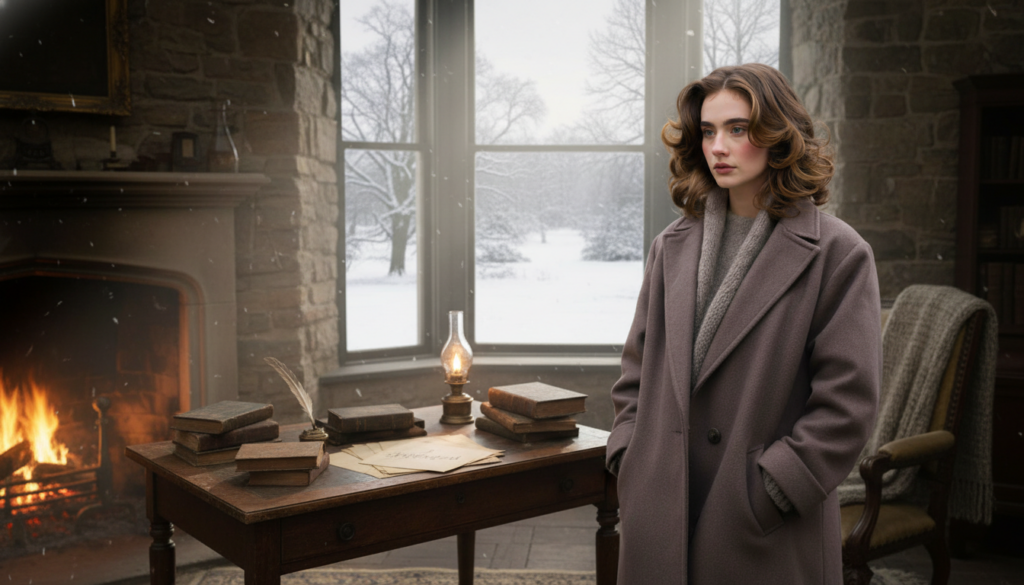
It always starts in front of a mirror that has fogged up. You have fifteen minutes to get out the door, your hair looks like it was just slept on or like it survived a storm, and the curling iron is looking at you like you made a bad choice. Again with the loose mermaid waves? You scroll through your feed, half out of boredom and half out of hope, and there it is: a picture of a girl in a long coat with rosy cheeks from the cold and hair that falls in soft, storybook waves that look effortless and strangely smart. Not beachy. Not perfect for blow-drying. Just a little dramatic.
“Brontë waves” is a new word below.
You don’t know what that means yet, but all of a sudden you want to walk across a windy moor instead of to the subway.
What are “Brontë waves,” and why is everyone so interested in them?
Brontë waves are not like summer hair at all. They don’t yell; they smolder. Imagine a Victorian heroine walking out of a foggy library with her hair slightly messy and those soft, long bends that look like they’ve been shaped by wind and time instead of a 32 mm curling iron.
Not tight curls. Not straightened with a flat iron. These waves are long and slow, and they move from the bottom up so that the roots stay natural and a little mysterious. They frame the face without making it look like “I spent an hour on this.” That’s why they’re all over the place this winter.
You can find them on TikTok and Instagram, from bookish creators to red-carpet stylists. A hairdresser in London told me that they are “the thinking woman’s wave” because they look like the hair of someone who reads, walks, thinks, and still likes to take selfies.
Imagine a friend coming to a winter dinner in a thick sweater, her cheeks red from the cold, and these slow, brushed-out waves brushing her shoulders. You immediately think she’s been somewhere interesting, even if she just got off work. This hairstyle has a quiet power that makes it look like it has a whole story behind it.
They also go well with winter clothes for a reason. Heavy coats, high collars, and scarves can all hide a hairstyle. Brontë waves add vertical movement that cuts through wool and padding, so your hair doesn’t get lost under layers.
The silhouette stays clean near the scalp because the wave only really starts to show from the middle of the hair down. Less volume at the root means that beanies and headbands don’t have as many weird bumps under them, which makes them very comfortable to wear. *They are romantic, but also strangely useful.* That’s exactly why they took over.
How to get Brontë waves at home without going crazy
Begin with hair that is dry and not freshly washed. The texture on day two is just right for Brontë waves because the hair has some grip. To make it feel like you’ve been living in it, spray in a light texturizing mist and rough-dry it with your fingers after you’ve just washed it.
Get a curling iron with a big barrel or a straightener that you can twist. Take a big piece—bigger than you would for normal waves—and bend it away from your face while holding the tool straight up. You don’t want to make a full curl, just a long bend. For a more modern look, leave the ends out and then let go.
Now the most important thing: wait for each part to cool before you touch it. Then use a soft brush to slowly brush everything out. This is where the magic happens, and most people get scared. Brushing can feel like you’re ruining your work, but it’s what changes clear curls into those blurry, literary waves.

You don’t need to use heat at all if your hair is naturally wavy. While it’s still a little damp, braid it into two or three loose plaits. Sleep on it, then in the morning, use a boar bristle brush to brush it out and add some styling cream to the ends. The point is that it won’t be perfect.
This is where a lot of us mess up the look without even realizing it. We use too much product, we hold the tool too high up near the roots, or we curl each section in the same direction until the hair looks like a neat ribbon instead of a lived-in story. Let’s be honest: no one really does this every day. This is a hairstyle for when you want to feel like the main character, and that’s fine.
One stylist in Paris told me, “Brontë waves are less about technique and more about holding back.” You need to stop before it looks “done.” The little mistakes are what make them seem real.
To stay in that sweet spot, pay attention to:
Using a heat setting that bends your hair instead of frying it
Not touching the top third of your hair at all to get a natural root
Changing directions loosely so that the waves don’t turn into one big sausage curl
Lightly spraying flexible hairspray on the hair and then scrunching it with your hands
Accepting that one side will always look better and going with it
Why Brontë waves are perfect for this winter
In the winter, we want a different kind of beauty. More candlelit and less sun-kissed. We like textures that are soft and cozy but still a little dramatic, like soft knits, long coats, flushed skin, and eyeliner that is a little smudged. Brontë waves fit right into that mood, like they were made for it.
They go well with big scarves, high necklines, and big earrings. They look great when they’re half tucked into a wool coat and half out. They frame the face on Zoom calls so that it looks relaxed and thoughtful, but not like “salon blowout.” The emotional code is simple: be a little romantic, a little introspective, and not try too hard.
Main point, detail, and value for the reader
Soft, long bendsWaves start in the middle and are brushed out to make them look blurry.Simple to wear with winter layers without covering up the face
Styling with little heatBig pieces, vertical tool, and a temperature range of low to mediumA faster routine and less damage for hair that is dry and stressed out in the winter
Not a perfect finishOnly brushing, finger-tousling, and light productsLook that’s possible, realistic, and works in real life
| Key point | Detail | Value for the reader |
|---|---|---|
| Soft, elongated bends | Waves start at mid-lengths, brushed out for a blurred effect | Easy to pair with winter layers without overwhelming the face |
| Minimal heat styling | Large sections, vertical tool, low to medium temperature | Faster routine and less damage for dry, winter-stressed hair |
| Imperfect finish | Brushing, finger-tousling, and light products only | Achievable, realistic look that works for everyday life |
The FAQ is:
Can I do Brontë waves on hair that is short?Yes, as long as you have enough length to bend around a tool at least once. For a modern, “literary editor” look, focus the bend just below the cheekbones and keep the ends a little straighter.
What if my hair doesn’t stay curled?Put a light mousse on damp hair, blow-dry it, and then style it. Before waving, use smaller sections than you think you need, let them cool all the way down, and stay away from heavy oils.
Is a curling iron or a straightener better?Both of them work. Beginners find it easier to use a curling iron with a big barrel. A straightener makes a wave that is a little more uneven and undone, which fits the Brontë mood perfectly.
Can I get Brontë waves without using heat?Yes. Try braiding your hair loosely overnight, wrapping it around a soft headband, or using big foam rollers only on the middle lengths. In the morning, brush it out and put a little cream on the ends.
How can I keep them from getting frizzy in the cold?After styling, put a little serum on the ends of your hair and a leave-in that hydrates it on damp hair. When you’re outside, don’t brush your hair with a plastic brush. Instead, use your fingers to bring it back to life.