It was odd how quiet the office was on a Tuesday morning. There were no ringing phones or frantic typing on keyboards. The only sounds were the air conditioning and the occasional ping from an automated dashboard finishing a job that used to take three people. A marketing assistant told me that she now spends her mornings reading, learning new tools, and “sort of waiting for the next big thing that only humans can do.” She said it in a way that was both funny and worried.
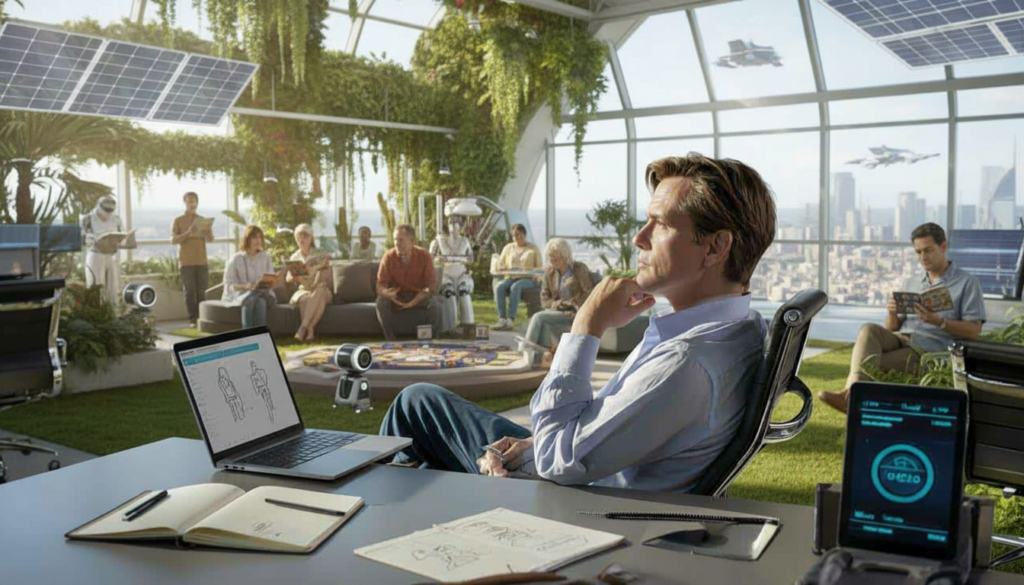
Giorgio Parisi, a Nobel Prize-winning physicist, has been saying out loud what many people only say quietly at coffee machines: Elon Musk and Bill Gates are probably right. We’re going to live in a world with a lot more free time but a lot fewer “normal” jobs.
The robots aren’t the weird part.

It’s what we should do with ourselves next.
The future that Musk and Gates warned about is already here.
You can feel it when you walk through a modern warehouse or factory. Conveyor belts move on their own, robotic arms never stop working, and the people left on the floor look more like machine orchestra conductors than workers. The same thing is slowly making its way into offices through software bots, AI writing tools, and automated customer service.
This isn’t science fiction anymore. The system just closed another ticket without anyone looking at it. It’s Tuesday at 10:43 a.m.
For years, Elon Musk has been very clear: AI will do “everything,” people will get some kind of universal basic income, and work will be more of a choice than a need. Bill Gates goes down a similar path, saying that companies should pay “AI taxes” to pay for social systems when traditional jobs go away.
Giorgio Parisi, who won the Nobel Prize in Physics in 2021, is saying the same thing. He has warned that the world needs to get ready for a job market that will be turned upside down by automation, and that our institutions are moving too slowly. People pay more attention when a man who has spent his whole life modelling complex systems says that the work system is about to break.
Parisi studies how small changes can have big effects. He sees the hidden pattern in swarms, networks, and chaotic systems. He thinks the job market is painfully familiar to him.
On its own, each “small” company automation project sounds fine. There is one new AI tool here, a robot there, and a more efficient process somewhere else. Then, all of a sudden, a whole field of work shrinks by 30%. The maths is cold, but the effects are very real. When you see your job description slowly disappearing on a screen, you can feel it in the pit of your stomach.
How to live in a world where there is more free time and fewer traditional jobs
The physicist’s warning isn’t just for big tech companies or governments. It fits right into your daily life. One thing that people who handle this transition well do over and over again is to treat their skills like a living portfolio instead of a fixed identity.
Take 30 minutes once a week to sit down and ask yourself three questions: What did I do this week that a machine could easily copy? What did I do that made me feel very human? What did I want to learn how to do? Don’t write long answers; just write short ones. This little habit teaches your brain to look for work that will survive and even do well when machines take over the boring stuff.
A lot of people wait for a crisis. The email about the layoffs, the meeting about the industry crash, and the “we’re restructuring” meeting. That’s when they start looking up “future-proof jobs” on Google at midnight, with a knot in their throat. We’ve all had that moment when the ground under your best plans suddenly changes.
The key is not to turn into a self-improvement machine that works all the time. Let’s be honest: no one really does this every day. It’s more about staying interested in a gentle way than just hoping for the best. One online class a year, a side project that you enjoy, and a talk with someone in a field that is growing faster than your own. Small changes made over time change your chances.
Giorgio Parisi recently said that the shift to an economy with a lot of AI “must be governed.” He warned that if new social contracts aren’t made, only a few people will benefit, while “large parts of the population” will be left without stable work or a clear purpose.
It sounds vague until you think about how it applies to your own life. It means not thinking of a job as a “job for life,” but instead as a way to make money, grow, and help others. Some will be the same as paid work, and some won’t.

In the short term, learn how to use AI-friendly tools (like prompting, data literacy, basic coding, and domain knowledge).
In the medium term, you should find a second source of income, no matter how small, that doesn’t depend on one employer.
Long term: Spend time on things that machines can’t fake well, like trust, taste, ethics, community, and hands-on care.
*These quiet layers are more important than trying to get the perfect job title over the course of a decade.*
The awkward gift of “too much” free time
Parisi, Musk, and Gates all talk about a strange idea: a world where millions of people have more free time than ever, but their days are held together by less traditional work. Not a long break. A change that lasts.
Some people will be happy. Time for family, art, travel, and rest. Others will feel lost because work has always been our guide and the answer to the question “What do you do?” The risk isn’t just money. It’s a matter of life and death. What happens when the calendar runs out, but an invisible, automated system still pays the bills?
| Main Point | Detail | What It Means to the Reader |
|---|---|---|
| AI will replace many routine jobs | Automation targets predictable tasks like customer service and basic office work | Helps you identify which parts of your role may be at risk |
| Human skills matter most | Systems rely on judgement, empathy, creativity, and trust as a foundation | Guides you on where to focus your learning and skill development |
| Life design equals career design | New habits, side projects, and sources of meaning become essential with more free time | Prepares you emotionally for a less traditional and less linear work life |
FAQ:
Will AI really take “most” jobs?
Not everything at once, and not all at once. It’s more accurate to say that it will first take over tasks in jobs that are already there, which slowly makes full-time jobs less necessary in many fields.
Should I learn to code to keep up?
Coding is helpful, but it’s not the only way to go. Knowing how digital tools work, how to ask good questions, and how to use tech with domain knowledge can be just as useful.
What jobs seem safer in this future?
Even though AI can help with some parts of these jobs, they are usually harder to fully automate. These jobs involve caring for others, dealing with complicated human relationships, having a lot of trust, or doing very creative work.
What if I really enjoy my regular job?
That makes sense. The most important thing is to stay calm and start learning new skills and options on the side so that you’re ready if your job changes or goes away.
Will we really get paid to “do nothing” one day?
Many countries are trying out some kind of basic income or social safety net, but there are no guarantees. Parisi, Musk, and Gates are trying to start a debate that will get governments ready before the wave hits.